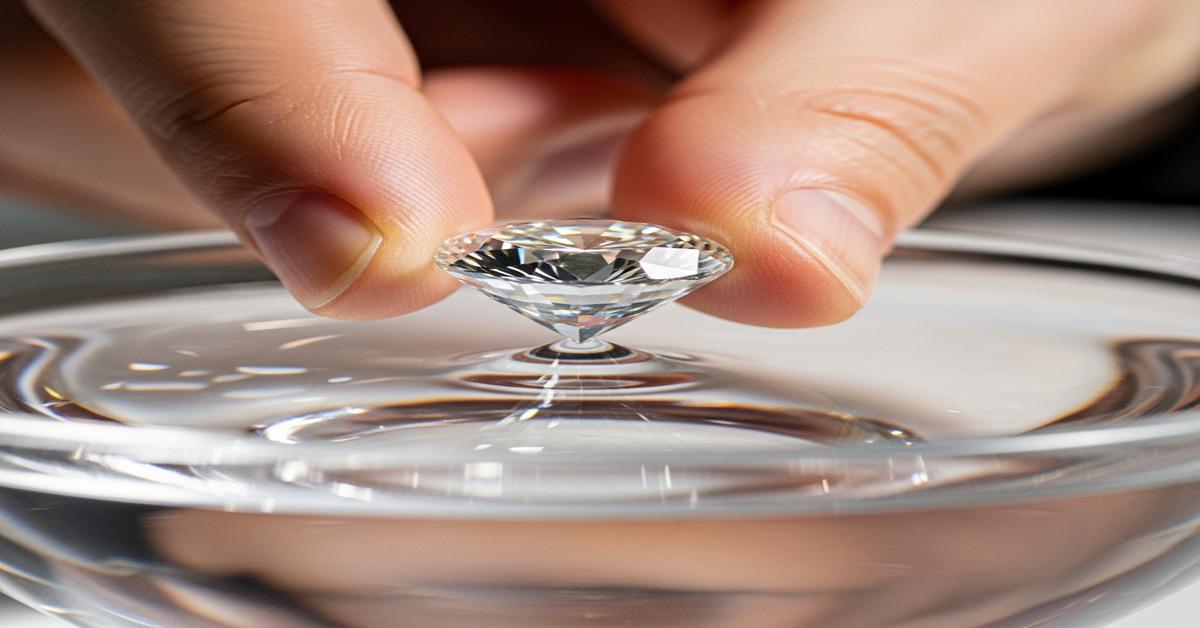
Dropping a diamond in water will not tell you if it’s real. The “water test” is a myth. Real diamonds sink. So do most fakes. If you want answers you can trust, use tests that measure what makes diamond unique: how it conducts heat, how it bends light, and its density. Below are three reliable methods you can do at home or at a jeweler, plus why the water trick fails.
Why the “water test” fails
The water test claims a real diamond sinks and a fake floats. That’s wrong. Diamond is dense (about 3.52 g/cm³). But so are common simulants:
- Cubic zirconia (CZ): ~5.7–5.9 g/cm³
- Moissanite: ~3.2 g/cm³
- Sapphire/spinel: ~4.0 / ~3.6 g/cm³
- Glass: ~2.4–2.6 g/cm³
All of them sink in water. Even light glass sinks. Watching how fast a stone sinks is not a controlled measurement. Surface tension, bubbles, and the shape of the cut all distort what you see. If you want to use density, you must measure it precisely (see Test #2). But a simple “drop in a glass” tells you nothing.
Test 1: Use a thermal + electrical diamond tester (fast, decisive)
Why it works: Diamond moves heat extremely well and electricity extremely poorly. Moissanite also moves heat well, but does conduct electricity. CZ and glass conduct neither. A modern combo tester checks both properties and identifies the stone with high confidence.
What you need: A combo diamond/moissanite tester (handheld pen-style units are affordable). Make sure it tests both thermal and electrical conductivity.
How to do it:
- Clean and dry the stone. Oils slow heat transfer and confuse readings.
- Warm up and calibrate the tester per its manual.
- If the stone is mounted, avoid touching the metal with the probe. Metal sinks heat and can cause false “diamond” or “not diamond” results.
- Probe the table and several facets. Take multiple readings.
How to read it:
- Diamond: Thermal test says “diamond,” electrical test shows no conduction.
- Moissanite: Thermal looks like diamond, but electrical test shows conduction. The unit will flag “moissanite.”
- CZ/glass: Fails thermal test and shows no electrical conduction.
Tips and caveats:
- Testers work on both natural and lab-grown diamonds. Both are “diamond” because they share the same physical properties.
- Very small stones can be tricky. Probe a few facets and stabilize your hand.
- Cold environments and metal settings can throw off a single reading. Confirm with repeat tests.
Bottom line: A combo tester is the fastest, most practical way to separate diamond from moissanite and CZ at home or in a store.
Test 2: Measure specific gravity by hydrostatic weighing (quantitative)
Why it works: Each gem material has a characteristic density (specific gravity, SG). Diamond’s SG is ~3.52. CZ is much higher (~5.7–5.9). Moissanite is lower (~3.21). If you measure SG correctly, you can distinguish diamond from common imitators. This is how to use “water” correctly.
What you need:
- A scale with 0.001 g resolution (jewelry lab scale). 0.01 g is often not precise enough for small stones.
- Thin wire or thread to suspend the stone.
- A cup of room-temperature water and a way to suspend the stone fully submerged without touching the cup.
How to do it:
- Weigh the dry stone. Record this as mair.
- Suspend the stone in water so it is fully submerged and not touching the sides or bottom. Record the apparent weight as mwater.
- Compute SG = mair / (mair − mwater).
Example (1.00 ct stone = 0.200 g):
- If mair = 0.200 g and mwater = 0.143 g, SG = 0.200 / (0.200 − 0.143) ≈ 3.51 → consistent with diamond.
- If mair = 0.200 g and mwater = 0.166 g, SG ≈ 5.7 → consistent with CZ.
What it proves:
- SG around 3.50–3.54 strongly supports diamond.
- SG around 5.7–5.9 is CZ.
- SG around 3.2 suggests moissanite (confirm with Test #1).
Tips and caveats:
- This test works best for loose stones. Settings trap air and skew the reading.
- For stones under ~0.50 ct, you really need a 0.001 g scale. The buoyant differences are tiny.
- Spinel (~3.60) is close to diamond by SG, but it fails the thermal test. Use both tests together.
Bottom line: Hydrostatic weighing provides hard numbers. It separates diamond from CZ with certainty and helps confirm against moissanite when combined with Test #1.
Test 3: Optical checks with a 10× loupe (learn what to look for)
Why it works: Diamond is singly refractive and extremely hard. Moissanite is doubly refractive. CZ is softer and often shows tell-tale wear. Under magnification, these differences show up in repeatable ways.
What you need: A 10× jeweler’s loupe and a bright, diffuse light.
What to check:
- Refraction (single vs double): Look through the crown (top) at the pavilion facets (bottom). Slowly rotate the stone. In moissanite, you often see doubled facet junctions—two parallel lines instead of one—especially near the girdle. Diamond shows crisp, single reflections.
- Facet edge wear: Diamond’s hardness keeps facet edges sharp, even on older stones. CZ and glass show rounded or abraded edges and scratches on the facet surfaces.
- Inclusions: Natural diamonds usually have internal features—tiny crystals, feathers, or needles. CZ is often “too clean” (flawless and bubble-free). Moissanite may show characteristic needle inclusions and growth patterns.
- Girdle inscription: Many lab-graded diamonds have a laser inscription on the girdle (e.g., a report number). Find it and match it to the certificate. That’s strong evidence of authenticity.
- Read-through test (loose stones only): Place the stone upside down on text or a lined card. With a well-cut diamond, you cannot read or see clean lines through the stone because of its high refractive index and facet geometry. CZ and poorly cut simulants may allow partial read-through. Use this only as supporting evidence; cut quality can affect the result.
Tips and caveats:
- Doubly refractive doubling is easiest to see off-axis. Rotate the stone and focus on the pavilion facet edges.
- Mounted stones complicate some checks. Do what you can see clearly and pair with Test #1.
- Fluorescence under UV is not a proof. Diamonds can fluoresce, and so can simulants. Treat it as a curiosity, not an ID.
Bottom line: A loupe can’t measure physics, but it reveals repeatable signs. Combined with a tester, it moves you from guesswork to confidence.
Putting it together: a practical path to proof
- Step 1: Use a combo diamond/moissanite tester. If it reads “diamond” and not “moissanite,” you’ve likely confirmed diamond.
- Step 2: If the stone is loose and you have the tools, measure SG. ~3.52 supports diamond; ~5.8 is CZ; ~3.2 is moissanite.
- Step 3: Verify optical clues with a loupe: no doubling, sharp facets, natural inclusions, and any laser inscription.
If you need a final, lab-level confirmation, ask for Raman spectroscopy or to match a laser-inscribed grading report. Raman sees the diamond’s atomic lattice directly; grading reports tie the stone to a documented identity.
Common myths to skip
- Water drop test: Worthless, as explained.
- Fog test (breath on it): Unreliable. Surface condition and temperature affect how long fog lingers.
- Scratch test: Risky and uninformative. You can damage your stone or another material and still learn nothing conclusive.
Takeaway: Don’t drop your diamond in water. Use physics, not folklore. A combo thermal/electrical tester, a proper density measurement, and a careful loupe exam give you clear, cross-checked answers. That’s how you actually prove authenticity.

I am Satyam Pandey, a gemologist with a Diploma in Polished Diamond Grading from KGK Academy, Jaipur. I love writing about jewelry, gems, and diamonds, and I share simple, honest reviews and easy buying tips on JewellersReviews.com to help you choose pieces you’ll love with confidence.