
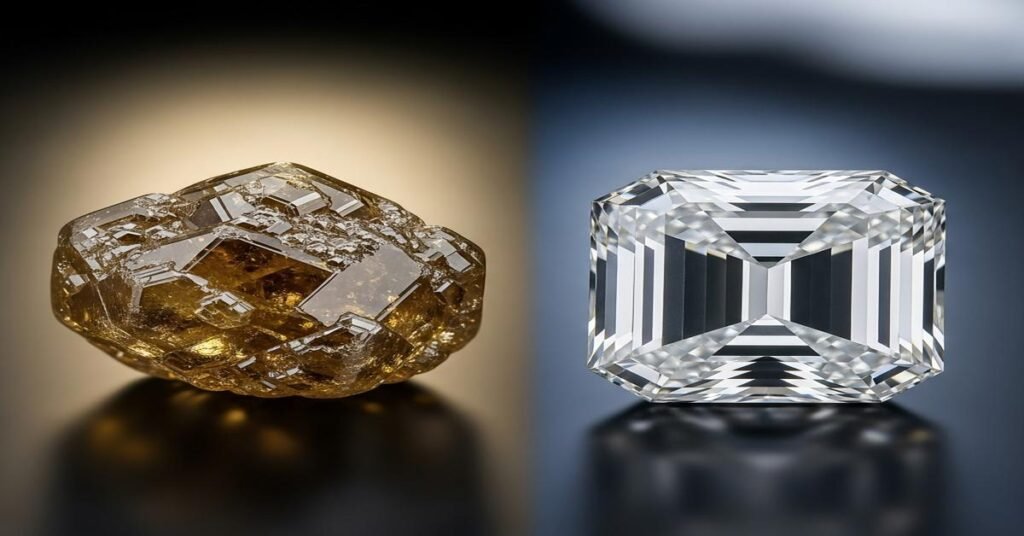
Lab-grown diamonds are real diamonds. They have the same hardness and sparkle as mined stones. But how they grow—CVD or HPHT—shapes their color, inclusions, and how experts identify them. If you’re choosing a lab diamond, knowing the differences helps you pick the right stone and avoid surprises on grading reports.
How Lab Diamonds Grow: CVD vs. HPHT
CVD (Chemical Vapor Deposition) grows diamond layer by layer from a gas in a vacuum chamber. A thin diamond seed sits under a carbon-rich plasma. Carbon atoms settle onto the seed in flat layers. This method tends to make very pure, low-nitrogen crystals (often Type IIa). It is efficient for larger, near-colorless stones.
HPHT (High Pressure High Temperature) imitates the Earth’s mantle. A diamond seed sits in a metal flux with carbon under extreme pressure and heat. Carbon dissolves and crystallizes onto the seed. HPHT often introduces trace elements from the flux. Nitrogen can give a yellow tint; boron can create blue (Type IIb). HPHT is fast and cost-effective, especially for small stones and fancy blues.
Why it matters: Growth method changes which impurities are common, how strain builds up, and which inclusions form. That, in turn, affects color tendencies, clarity features, and the clues gemologists use to separate CVD from HPHT.
What Growth Method Changes (and What It Doesn’t)
- Doesn’t change: The material is diamond in both cases. Hardness (10), refractive index, dispersion, and thermal conductivity are the same. Cut quality still dominates sparkle.
- Does change: Typical inclusions (metallic vs. graphitic), strain patterns, color zoning, fluorescence behavior, and the likelihood of post-growth treatment.
A Note on HPHT Treatment vs. HPHT Growth
“HPHT” can mean two different things on reports. It can be the growth method, or a post-growth treatment used to improve color. Many CVD diamonds are grown by CVD, then HPHT-annealed to remove a slight brown tint. On a lab report, you might see: Method: CVD and Post-growth treatment: HPHT. That is normal and disclosed. Don’t confuse it with an HPHT-grown diamond.
Pros and Trade‑Offs of CVD
- Strengths: Often very pure (Type IIa) with low nitrogen, so near-colorless is common. Fewer metallic inclusions. Scales well to larger sizes with consistent quality.
- Trade‑offs: As-grown CVD can look slightly brown or gray due to vacancy-related defects. Most are HPHT-annealed to improve color. You may see subtle growth banding under magnification, fine graining, or tiny dark pinpoints aligned with layers. Silicon contamination from the chamber is possible and leaves telltale spectroscopic signatures.
- Color range: Excellent for colorless and near-colorless; pinks are usually treated; blues via boron are less common than in HPHT.
Pros and Trade‑Offs of HPHT
- Strengths: Fast growth, abundant in smaller sizes. Produces striking blue (boron-doped) diamonds. Can yield high clarity. Pricing is competitive, especially for melee and rounds.
- Trade‑offs: Metallic flux inclusions (reflective black or silvery crystals) are more likely. Some stones show weak magnetism because those particles contain iron, cobalt, or nickel. Nitrogen often introduces a yellow tint unless growth chemistry is tightly controlled.
- Color range: Blues are commonly HPHT-grown. Near-colorless is widely available but may show sector zoning or fluorescence patterns tied to growth sectors.
How to Tell Them Apart: Practical Checks
Only a proper gem lab can confirm growth method with certainty. Labs use spectroscopy, deep-UV imaging, and microscopy to read defects and growth patterns. Still, you can spot clues with simple tools. These are indicators, not proofs.
- 10× loupe or microscope:
- HPHT clues: Tiny reflective metallic crystals; black opaque specks with bright metallic sheen; “flux halos” around inclusions; growth-sector features that look like cross-hatched internal graining.
- CVD clues: Fine, parallel growth striations or banding; small dark pinpoints or clouds aligned in layers; occasional thin plate-like graphitic inclusions along growth planes.
- Magnet test (strong neodymium magnet):
- HPHT: Some stones show a very slight attraction due to metallic inclusions. Test the loose stone on a thread away from metal. Attraction suggests HPHT, but many HPHT stones are non-magnetic and a few CVD stones can pick up metal contamination. Treat this as a hint only.
- Caution: Mountings and tools are magnetic; they can mislead you.
- UV flashlight (365 nm):
- HPHT: Often bright blue fluorescence, sometimes uneven, with sector zoning. Some may phosphoresce blue if boron is present.
- CVD: Can show blue, or orange-red components from nitrogen-vacancy defects. Afterglow (weak red) can appear in some stones. Fluorescence varies widely; use this along with other clues.
- Polarized light (two polarized lenses or polarized sunglasses):
- HPHT: “Tatami” or cross-hatched strain patterns are common due to growth sectors.
- CVD: Banded or mosaic strain, often parallel to growth layers.
- Why it works: Internal stress affects how light passes through; growth methods create different stress maps.
- Grading report and inscription:
- Look for “Laboratory-Grown” and the method: CVD or HPHT. Check for “Post-growth treatment: HPHT.” Many stones are laser-inscribed with the report number and “Lab-Grown.”
Which Is Better? Choose by Goal
- For colorless center stones (≈1–3 ct): Pick the best cut, clarity, and face-up color you can. CVD often offers very pure Type IIa material with fewer metallic inclusions. HPHT can match quality; judge the individual stone, not the label.
- For fancy blue: HPHT-grown (boron-doped) is the norm and usually gives the strongest color.
- For small diamonds (melee): HPHT dominates supply. Quality is generally high and pricing efficient.
- If inclusions worry you: CVD is less likely to contain metallic crystals that can reflect like tiny mirrors. But always look at the stone under 10×; a clean HPHT stone beats an included CVD stone.
- For long-term wear: Both are diamond. There is no practical difference in hardness or day-to-day durability when cut and set correctly.
Buying Checklist
- Insist on a reputable grading report stating the growth method and whether post-growth treatment was used.
- Verify the laser inscription matches the report number.
- Ask to view the stone at 10×. Look for the inclusion types described above and check that the clarity grade makes sense to your eye.
- Confirm the cut quality. Light performance matters more than growth method. In rounds, aim for well-proportioned, excellent polish and symmetry. In fancy shapes, watch for bow-ties and windowing.
- Check fluorescence under UV in-store. Make sure you like how the stone looks in sunlight and store lighting.
- Get clear labeling on the receipt: “Laboratory-Grown Diamond,” growth method, carat, color, clarity, cut, and return policy.
Common Myths to Ignore
- “One method is harder or more durable.” False. Both are diamond.
- “CVD is always brown.” Outdated. Post-growth HPHT annealing routinely yields colorless grades.
- “HPHT diamonds are all magnetic.” No. Some show weak magnetism; many do not.
- “You can’t tell lab from natural.” A trained lab can, reliably, because growth leaves diagnostic defects and patterns.
- “Lab diamonds have no inclusions.” They can be very clean, but both CVD and HPHT form inclusions. Check clarity, not assumptions.
Care and Setting Notes
- Everyday care: Treat like any diamond. Warm water, mild detergent, soft brush. Ultrasonic and steam are usually fine.
- At the bench: Tell your jeweler the stone is lab-grown and whether it’s HPHT-grown. Metallic inclusions in some HPHT stones can react under aggressive acid cleaning or heavy torch heat. A careful setter will protect the stone and use appropriate techniques.
Bottom Line
CVD vs. HPHT is less about “better” and more about “different.” CVD often excels for near-colorless Type IIa material with fewer metallic inclusions. HPHT shines for fancy blues and abundant small goods. Focus on the finished diamond: cut, clarity, color, and how it looks to you. Then use the growth method—and the clues above—to understand what you’re buying and to read the grading report without confusion.

I am Satyam Pandey, a gemologist with a Diploma in Polished Diamond Grading from KGK Academy, Jaipur. I love writing about jewelry, gems, and diamonds, and I share simple, honest reviews and easy buying tips on JewellersReviews.com to help you choose pieces you’ll love with confidence.