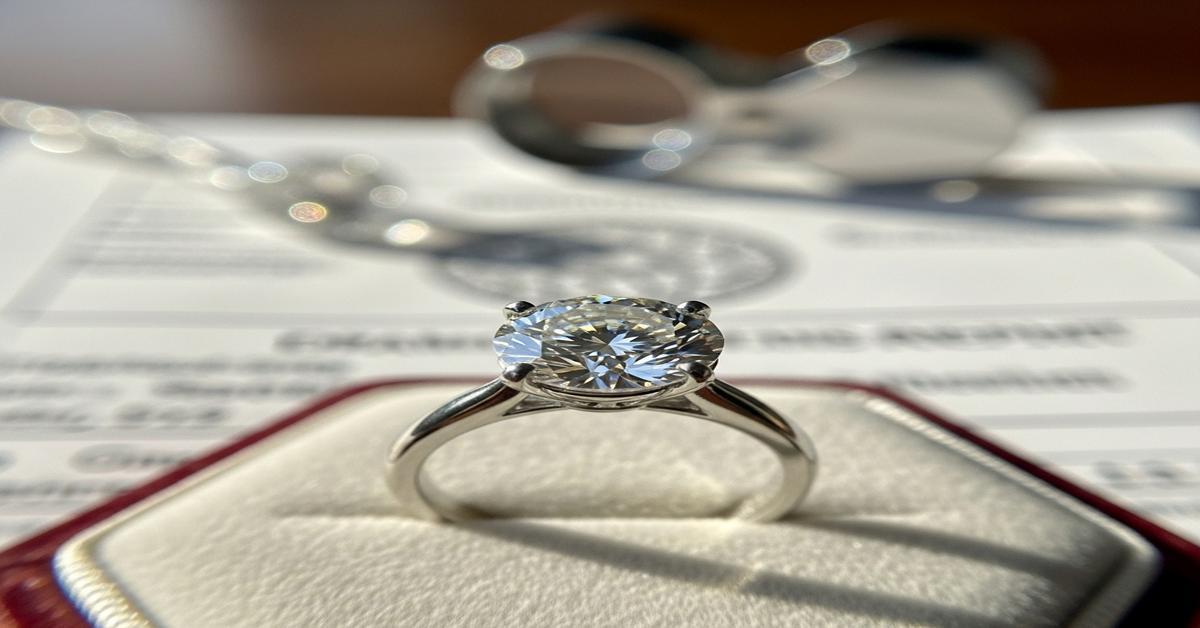
A solitaire looks simple, but the diamond’s weight (carat) and the store’s “cut” grade don’t tell the whole story. Carat is just weight. Cut grades from labs are helpful but broad. If you buy on those two bits alone you can end up with a heavy, dull stone or a bright diamond with visible flaws. Below are the three critical things to check before you buy a solitaire. Each item explains what to ask for, what numbers matter, and why it changes how the ring will look and wear.
1. Light performance and true cut proportions — beyond the single “cut” grade
Why it matters: The cut determines how a diamond returns light. Two “Excellent” rounds can look very different if their proportions vary. Brilliance, fire, and scintillation come from angles and percentages, not just a letter on a report.
- Ask for exact proportions. Request depth%, table%, crown angle, pavilion angle, girdle thickness, and culet size. For a round brilliant, use these as a baseline: depth ~59–62.5%, table ~53–57%, crown angle ~34–36°, pavilion angle ~40.6–40.8°. Deviations outside these ranges often reduce sparkle or throw light out the bottom.
- Measure size vs weight. One carat round is usually ~6.4–6.5 mm. If a 1.00 ct reads 6.0 mm, that stone sits smaller on the finger even though it weighs a full carat. Look at diameter(mm) on the report, not just carat weight.
- Get light-performance images. Ask for ASET or Ideal-Scope images, Hearts & Arrows photos (for rounds), or a well-lit video showing movement. These show actual light return and contrast pattern. Don’t accept vague marketing phrases.
- Understand symmetry and polish. Symmetry and polish affect light flow. Grades of Good to Excellent are acceptable, but check the proportions. Many vendors show two stones with identical GIA cut grades that look different under scope because of small angle changes.
2. Clarity, inclusion location, fluorescence, and treatments — not just the grade
Why it matters: Clarity grade (SI1, VS2, etc.) is useful but not decisive. Where an inclusion sits matters more than the letter. Treatments and fluorescence can change appearance and value.
- Look at a clarity plot and images. A GIA plot shows inclusion type and position. Ask for loupe photos or 10x images. An SI1 with a crystal under the table can be visible to the naked eye. An SI1 with inclusions near the girdle can be eye-clean.
- Know the common inclusion types. Feathers can be stability risks if near the edge. Crystals and clouds affect transparency differently. Needles are thin and often less noticeable. Ask whether inclusions are “under the table” (visible face-up) or off to the side (less visible).
- Check for treatments and enhancements. Laser drilling and fracture filling change value and care needs. Filled fractures must be disclosed and often require special warranty and care. Always confirm “natural, untreated” if you want a natural diamond.
- Consider fluorescence carefully. Strong blue fluorescence can make an H–J color look whiter in daylight. But very strong fluorescence can cause a hazy or oily look in some stones. Ask for face-up photos under daylight and incandescent light to see the effect.
- Test for eye-clean appearance. View the stone at normal social distance (12–18 inches) in daylight and indoor light. If inclusions are visible without tools, you might pay premium for a clarity grade that doesn’t translate to a clean appearance.
3. Setting, metal, security, certification, and practical wear factors
Why it matters: The mounting changes perceived size, protects (or exposes) the diamond, and affects long-term wear. Certification and vendor policies protect your purchase.
- Pick the right metal and alloy. White gold is usually 14k (58.5% Au) or 18k (75% Au) and often rhodium-plated. Rhodium wears off and requires re-plating. Platinum (commonly 950 Pt) is denser and more scratch-resistant but costs more. The metal color affects how the diamond’s color reads—near-colorless (G–J) pairs well with yellow or rose gold; D–F pairs with white metals for a colorless look.
- Choose a setting that suits daily wear. Four-prong shows more of the stone and can make it look larger. Six-prong adds security. Bezel and low-profile settings protect the girdle and are good for active wearers, but they hide more of the diamond and reduce apparent sparkle. Tension settings require precise grading and risk if the stone has internal fractures.
- Inspect prongs and mounting construction. Ask about prong thickness, head thickness, and whether the prongs are hand-set or machine-set. Thin or worn prongs are the most common cause of stone loss. Ask about warranty and free prong checks.
- Verify certification and chain of custody. Insist on an independent lab report — GIA and AGS are the most consistent for white diamonds. For lab-grown stones, IGI and GCAL are commonly used but read the report details. Confirm the certificate number matches the stone and get it in writing. Ask whether the seller provides a buyback or upgrade policy.
- Consider ring size and fit. A wide band will make the center stone look smaller. Know the intended finger size; resizing can affect settings and tension mounts. Get a firm return and resizing policy in writing.
Quick practical checklist before you buy: Request the full lab report and proportion table; ask for face-up photos and ASET/Ideal-Scope images; confirm inclusion location and treatments; verify mm diameter for size perception; choose a setting that matches your lifestyle (and check prongs); confirm metal alloy and maintenance needs; get a clear warranty, return, and resizing policy.
Buy a solitaire based on how it looks and how it will live on your hand, not just the carat number or a shorthand cut grade. When you ask for the numbers, images, and certs listed here, you reduce surprises and get real value for your budget.

I am G S Sachin, a gemologist with a Diploma in Polished Diamond Grading from KGK Academy, Jaipur. I love writing about jewelry, gems, and diamonds, and I share simple, honest reviews and easy buying tips on JewellersReviews.com to help you choose pieces you’ll love with confidence.