
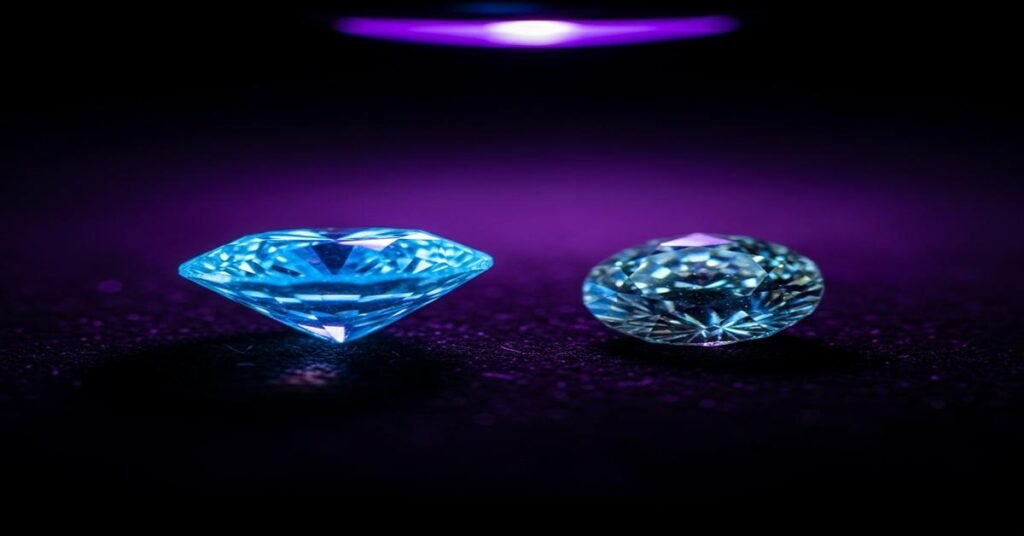
Shine a 365 nm UV flashlight on a diamond in a dark room and watch what happens. Many natural diamonds glow blue. Most lab‑grown diamonds, especially CVD-grown, do not glow at all under this long‑wave UV. That simple observation can quickly separate most naturals from most lab‑growns. It is not a lab test and it is not foolproof, but it is the fastest, cheapest screening step you can do at home or at the counter. Here’s why it works, what to look for, and where it can mislead you.
What “glow” means: fluorescence vs. phosphorescence
When you hit a diamond with UV, electrons in certain defects absorb energy and then drop back down, releasing visible light. That immediate light is fluorescence. If the glow lingers after you switch the UV off, that’s phosphorescence. Different defects produce different colors and behaviors. That is the entire trick behind this test.
Why many natural diamonds glow blue
Most natural diamonds formed deep in the earth with nitrogen in the crystal lattice. Over geologic time and heat, nitrogen atoms cluster into stable groupings. One very common grouping, called the N3 center, emits blue light when excited by long‑wave UV (365 nm). That’s why you often see a blue flash in a dark club or under a jeweler’s lamp.
- How common? Roughly 25–35% of natural diamonds show some fluorescence; about 5–10% show strong to very strong. Most of it is blue.
- What it looks like: An even, uniform blue glow that starts and stops promptly with the UV. The face-up pattern is usually smooth, not patchy.
- Why it matters: That blue is a fingerprint of nitrogen aggregates common in natural stones. It’s not proof, but it’s a strong hint.
There are natural diamonds that do not fluoresce. Type IIa naturals (very low nitrogen) often stay dark under UV. So “no glow” does not automatically mean “lab-grown.”
Why most lab‑grown diamonds don’t glow under long‑wave UV
Modern lab‑grown diamonds come mainly from two methods: CVD (chemical vapor deposition) and HPHT (high pressure, high temperature). Their defect chemistry is unlike most naturals, so their UV response is different.
- CVD diamonds: These are typically Type IIa, grown with extremely low nitrogen. They lack the N3 centers that cause blue fluorescence. Under 365 nm UV, many CVD stones show no fluorescence at all. If they do react, it’s often a weak orange‑red from NV centers (nitrogen-vacancy), and it can look patchy or layered because of the way CVD grows in sheets.
- HPHT diamonds: HPHT stones can include different defects (e.g., H3 at 503 nm, nickel-related centers, or boron in Type IIb). They may glow green or yellow under long‑wave UV and often react more strongly to short‑wave UV. Some HPHT stones also phosphoresce for a few seconds after the lamp switches off, which is uncommon in most natural colorless diamonds.
Manufacturers now control impurities tightly. That’s the point: fewer unintended defects, fewer light emissions. So, statistically, a no‑glow result under 365 nm is more common in lab‑grown (especially CVD) than in natural diamonds.
How to do the at‑home UV test
- Tools: A true 365 nm UV flashlight (not a 395–405 nm “purple” torch), a dark room, white paper, and a known natural diamond if you have one for comparison.
- Prep: Clean the stone with mild soap and water. Oils can dampen fluorescence or cause false haze.
- Set up: Place the stone table-up on white paper. Turn off the lights. Hold the UV 5–10 cm above the stone.
- Observe:
- Color: Blue, green, yellow, orange-red, or none.
- Intensity: None, faint, medium, strong, very strong.
- Pattern: Even across the face or patchy/striped/spotty.
- Afterglow: Does it keep glowing after you switch the UV off?
- Compare: Check your known natural reference under the same light to calibrate your eye.
- Safety: Do not stare into UV light. Protect your eyes. Do not use 254 nm short‑wave UV at home; it can be hazardous.
How to read the results
- Strong, even blue fluorescence (starts/stops instantly): This often points to a natural diamond with N3 centers. It’s a good sign. Caveat: a minority of HPHT stones can show blue; examine other clues.
- No fluorescence at 365 nm: This is common in CVD lab‑grown diamonds, but also occurs in some natural Type IIa stones. Inconclusive on its own.
- Orange‑red fluorescence: More typical of CVD diamonds (NV centers). Rare in naturals. This leans lab‑grown.
- Green or yellow fluorescence, often stronger under short‑wave UV, plus a brief afterglow: This pattern suggests HPHT growth. Naturals can show green/yellow, but the combination of stronger short‑wave reaction and phosphorescence tilts lab‑grown.
- Patchy or banded fluorescence: A layered or mottled pattern is common in CVD due to stepwise growth. Natural fluorescence is usually more uniform.
Bottom line: Blue glow under 365 nm supports “natural.” No glow supports “lab‑grown CVD.” But neither is a guarantee. Use the UV test to triage, not to certify.
Why the physics matches the pattern
Fluorescence colors come from specific defect centers—tiny arrangements of atoms and vacancies that create allowed energy jumps.
- N3 (three nitrogen around a vacancy): Emits blue around 415 nm. Common in natural Type Ia diamonds.
- NV (nitrogen‑vacancy): Emits orange‑red (known lines near 575 and 637 nm). Often present in CVD diamonds.
- H3 (two nitrogen with a vacancy): Emits green (~503 nm). Can appear in HPHT-grown or treated stones.
- Boron-related in Type IIb: May phosphoresce after UV, a telltale afterglow. Some lab HPHT and rare natural blue diamonds show this.
Grow method, temperature, and impurities control which centers form. Natural geological time favors nitrogen aggregation (blue N3). CVD aims for clean Type IIa (no N3), so little to no blue. HPHT can introduce other centers that lean green/yellow and phosphorescence.
Common mistakes and real‑world curveballs
- Relying on cheap “UV” torches: 395–405 nm lights are mostly visible violet. They may not excite diamond centers well and can mislead you. Use a 365 nm light labeled as such.
- Confusing adhesive or filler glow: Residue under a stone can fluoresce wildly. Clean first.
- Assuming blue = natural, full stop: Some HPHT stones and a few treated stones can show blue. Always treat UV as a screen.
- Impostors: Moissanite often fluoresces green or yellow and can phosphoresce; CZ can fluoresce too. Combine UV with a quick loupe check (double refraction in moissanite, facet junction softness in CZ).
- Mixed settings: In multi‑stone jewelry, some diamonds may glow and others may not. Check stones individually.
Buying and selling: practical takeaways
- Fast sorting: Under a bench UV lamp, parcels with many blue‑fluorescent stones likely skew natural. Parcels that stay dark may be CVD-heavy. Verify before you price.
- Price effects: Blue fluorescence can make near‑colorless natural diamonds look whiter in sunlight. Very strong blue can make some stones look hazy in strong UV. Both can affect value.
- Disclosure: Lab‑grown stones should be disclosed. A grading report or laser inscription is final; UV is just a quick check.
- Confirming important stones: For anything valuable, send to a gem lab for FTIR (diamond type), photoluminescence, and growth‑structure imaging. Those tests read the defect centers directly.
Quick reference checklist
- Tool: True 365 nm UV flashlight.
- Blue, even, instant on/off: Points to natural.
- No glow at all: Points to CVD lab‑grown, but could be natural Type IIa.
- Orange‑red or patchy bands: Points to CVD lab‑grown.
- Green/yellow, stronger under short‑wave, with afterglow: Points to HPHT lab‑grown.
- Remember: UV is a screen, not a certificate.
The UV light test works because nature and the lab build diamonds with different defects. Those defects control how the stone responds to UV. Most natural diamonds glow blue; most lab‑grown diamonds do not under long‑wave UV. Use that contrast to your advantage—but confirm anything important with proper gemological testing.

I am Satyam Pandey, a gemologist with a Diploma in Polished Diamond Grading from KGK Academy, Jaipur. I love writing about jewelry, gems, and diamonds, and I share simple, honest reviews and easy buying tips on JewellersReviews.com to help you choose pieces you’ll love with confidence.