
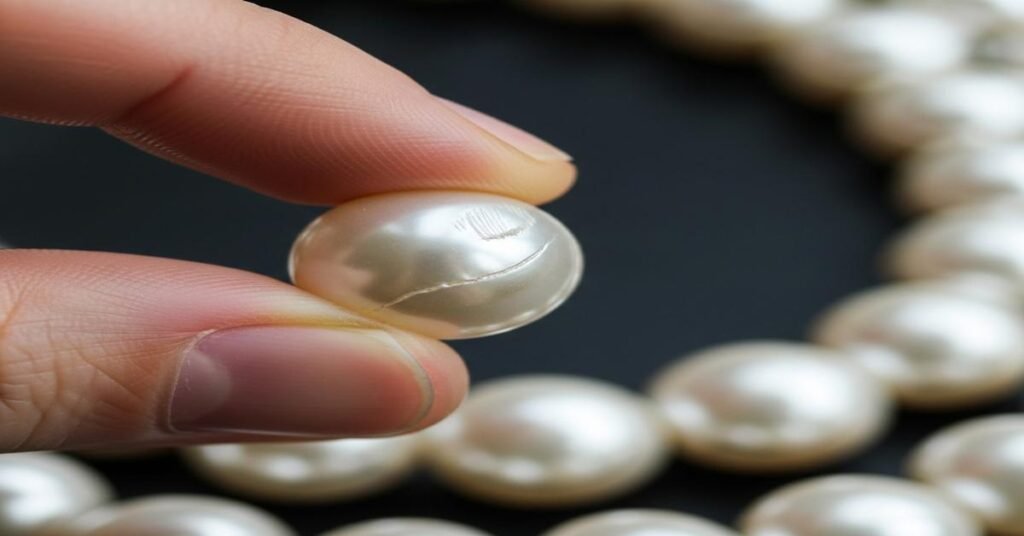
You bought a necklace that looks like pearls. It shines, it feels nice, and the clasp even looks fancy. But many “pearls” today are plastic, glass, or composite beads. Two names you will hear are “Majorica” (a high‑quality imitation from Spain) and “shell pearls” (mother‑of‑pearl cores with a coating). Here is how to tell what you have, why each test works, and how to check without expensive gear. The tooth test is your fastest, most reliable check—but we will back it up with other signs so you can be sure.
What is a “real” pearl vs. Majorica vs. shell pearl?
Real pearls—both natural and cultured—are built from layers of nacre: thin plates of aragonite plus organic matrix. Those layers create the soft, deep glow people call “orient.” They also create microscopic roughness you can feel.
Majorica pearls are imitations. They have a glass core coated with a proprietary lacquer that mimics nacre. The surfaces are very smooth and highly uniform. The brand “Majorica” usually marks the clasp.
Shell pearls are also imitations, but the core is usually mother‑of‑pearl (shell). Makers coat the core with a polymer or lacquer that may include ground nacre powder to imitate the look of layers.
Glass pearls are glass beads with a pearly coating. Plastic pearls are lightweight plastic beads with a pearly paint.
Why it matters: nacre layers give real pearls their texture, depth, and durability. Coated beads are smoother, look more uniform, and wear differently at the drill holes and high‑contact spots.
The tooth test: why it works and how to do it
The tooth test is fast because it uses the structure of nacre. Real nacre is made of tiny platelets with gaps. That micro‑texture feels gritty against tooth enamel. Coated or painted imitations feel slick.
- How to do it: Gently rub the pearl across the biting edge of your front tooth. Do not bite down. Think “light brush,” not pressure.
- Real pearls: Feel a fine “sandpapery” drag or faint grit. It is subtle but unmistakable.
- Majorica, shell, glass, plastic: Feel smooth, slippery glide. No grit. Sometimes it feels like rubbing a marble.
- Rub test variant: Lightly rub two pearls together. Real pearls feel chalky and may create a tiny nacre dust; imitations glide with no resistance.
Why it almost never fails: Even very high‑grade imitations cannot reproduce nacre’s natural platelet texture. Some shell pearls may feel slightly less slippery if the coating includes powder, but they still lack the distinct grit of layers. If you are unsure, test several pearls on the strand. Clean the area after with a soft cloth.
Quick visual checks before you bite
Your eyes can catch clues fast because coatings and factories aim for perfection that nature does not deliver.
- Drill hole edges: Real pearls show clean, sharp nacre at the hole with possible thin growth rings. Imitations often show a thin, darker line where coating meets core, chipping, or flaking. In shell pearls you may see bright white shell core under the coating.
- Surface: Real pearls have tiny pits, lines, or growth marks. Imitations look uniformly smooth. If every bead is flawless, be skeptical.
- Color and overtones: Real pearls show layers of color—cream body with pink, green, or silver overtones. Imitations often look “flat,” with a single, painted tone and mirrorlike shine.
- Matching: Nature rarely makes perfect twins. A strand of real pearls usually varies slightly in shape, luster, or overtone. Majorica and shell pearls are near‑identical bead to bead.
- Seams or mold lines: Obvious on some plastic beads; never on real pearls.
Feel and behavior: weight, temperature, sound, and drape
Touch tells you about material and density. These checks work because different cores behave differently.
- Weight in hand: Glass and Majorica feel heavy for their size. Plastic feels light. Real pearls feel solid but not as heavy as glass. Shell pearls land in between glass and real.
- Temperature: Glass, shell, and real pearls feel cool at first, then warm slowly. Plastic feels warm almost immediately.
- Sound: Tap two beads together. Real pearls make a soft, dull click. Glass makes a sharper, higher ping. Plastic is dull and hollow.
- Drape and movement: Real pearl strands drape fluidly and have a gentle “hand.” Many imitation strands are stiffer because of uniform beads and stringing materials.
Majorica vs. shell pearl vs. plain plastic: tell‑tale signs
- Majorica (glass core):
- Heavier than real pearls of the same size.
- Very consistent color and size across the strand.
- High, even luster with a mirrorlike surface; little to no surface texture.
- Coating may show a faint dark ring at the drill hole or slight peel if worn.
- Often paired with clasps stamped “MAJORICA” or the brand’s mark.
- Tooth test: Smooth.
- Shell pearls (mother‑of‑pearl core + coating):
- Weight between real and glass; cool to the touch.
- At the hole, you may see a white shell core and a distinct coating layer.
- Color options beyond nature (bright teal, metallic rose gold, perfect black) are common.
- Surface is very uniform. Minor “orange peel” texture can appear on some coatings.
- Tooth test: Feels smooth or only faintly draggy, not gritty.
- Plastic pearls:
- Very light, warms almost instantly in your hand.
- Paint may chip at holes or high‑wear spots, revealing a dull plastic core.
- Often strung without knots between beads.
- Tooth test: Very smooth and squeaky.
Simple tools that make you look like a pro
You do not need a lab. A few basics will confirm what your senses tell you.
- 10× loupe or phone macro: Inspect hole edges. Look for layered nacre versus a coating ring and core. On real pearls, you may see growth lines or slight unevenness inside the hole.
- Scale: Weigh the strand and compare to a similar real strand size online or from a jeweler. Unusually heavy often means glass; unusually light often means plastic.
- White LED flashlight: Real nacre disperses light softly. Imitations reflect sharply with little depth.
- UV flashlight: Many real pearls fluoresce softly (often bluish); responses vary by type. Coatings can glow differently or not at all. Use as a supporting clue, not a stand‑alone verdict.
- Cotton swab with water: Gently swab near the hole. Paint on plastic sometimes stains the swab. Real nacre does not.
Destructive tests to avoid: A hot pin can melt plastic or blister coatings, but it ruins the piece. Sandpaper and knives also damage pearls. Use the tooth test and loupe instead.
What jewelers do differently
When value is high or the piece is complex, professionals go beyond touch and sight.
- X‑ray: Real pearls show internal growth structures and concentric rings. Imitations show a solid core with no nacre layering.
- Microscopy: Surface and hole edges reveal layering, peeling, or lacquer patterns.
- Drill‑out inspection: On a loose pearl, a controlled widening of the hole exposes a cross‑section of layers—conclusive but invasive.
Price, claims, and ethics
Price often hints at identity. Large, perfectly matched, “flawless” pearls at a bargain price are almost never real. Majorica and shell pearls are honest products when sold as such. The problem is mislabeling.
- Ask for disclosure: The seller should state “cultured pearl” for real or “Majorica/shell/glass/plastic imitation” for fakes.
- Look at the clasp: Branded clasps and tags can confirm a Majorica strand. Real pearl strands may have gold, silver, or branded findings and are usually hand‑knotted.
- Appraisals: For heirlooms and expensive pieces, get a written appraisal that names the type.
Care tips: real vs. imitation
Care differs because coatings are not the same as nacre.
- Real pearls: Last if you treat them gently. Put pearls on last, take them off first. Avoid hairspray, perfume, and acids. Wipe with a soft cloth after wearing. Restring when the knots darken or loosen.
- Imitation pearls: Coatings can scratch and peel. Keep away from alcohols, acetone, and perfumes. Do not soak. Wipe gently; avoid abrasive cloths. Check coating at holes and high‑rub areas.
A quick decision checklist
- 1) Tooth test: Gritty = real. Smooth = imitation.
- 2) Drill hole under a loupe: Nacre layers with clean edges = real. Ring/chip/peel, visible core = imitation.
- 3) Uniformity: Too perfect in size, color, and surface = likely imitation.
- 4) Weight and temperature: Very light and warm = plastic. Very heavy and cool with mirror shine = glass/Majorica. Moderate, cool, with depth = could be real.
- 5) Strand details: Knotted between beads and a quality clasp suggest real; unknotted and cheap findings suggest imitation.
- 6) Sanity check price: Big, flawless, cheap “pearls” are imitations.
Bottom line
If you only try one method, choose the tooth test. The nacre grit you feel on a real pearl is nature’s signature. Back it up with a loupe look at the drill hole and a quick check of weight, luster, and uniformity. With those three steps, you can spot a Majorica, shell pearl, or plastic bead with confidence—and avoid paying pearl prices for paint on a bead.

I am Satyam Pandey, a gemologist with a Diploma in Polished Diamond Grading from KGK Academy, Jaipur. I love writing about jewelry, gems, and diamonds, and I share simple, honest reviews and easy buying tips on JewellersReviews.com to help you choose pieces you’ll love with confidence.