
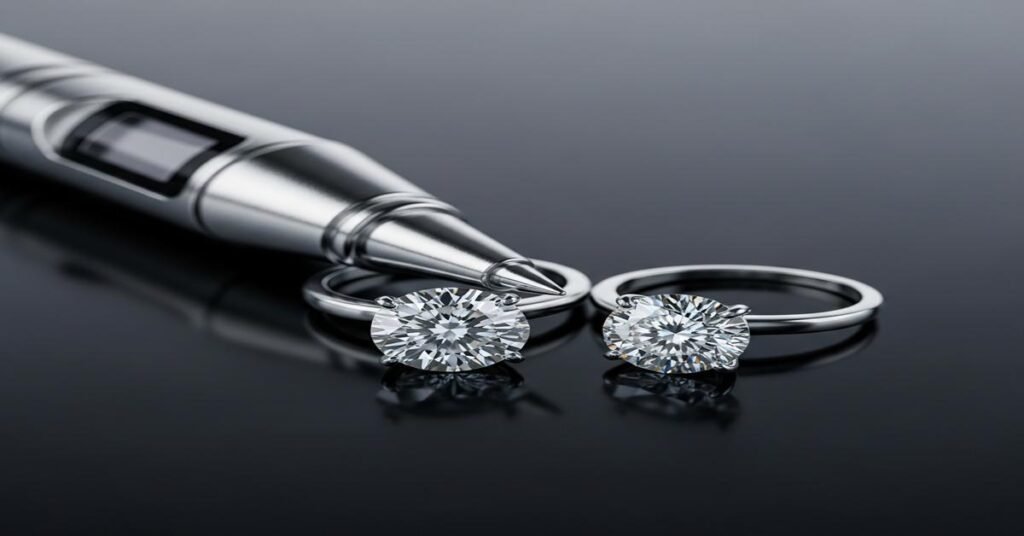
Cheap “diamond tester pens” promise peace of mind for $20. Touch the tip to a stone, hear a beep, and you know if it’s real… right? Here’s the problem: those pens only check how a stone conducts heat (and sometimes electricity). Natural diamonds and lab-grown diamonds are both crystal carbon with the same heat flow. So both will “pass.” If you want to know whether a diamond is natural or lab-grown, that pen can’t help you. For that job, it’s a useless tool.
What a $20 diamond tester actually measures
Most budget pens use a heated probe and a sensor. They push a little heat into the stone and watch how fast it moves away. Diamond pulls heat very quickly. Glass and cubic zirconia (CZ) do not. If the heat escapes fast, the pen beeps for “diamond.” If it lingers, it shows “not diamond.” That is the entire trick.
Some models add an electrical test to better separate diamond from moissanite (a common simulant that also conducts heat well). Moissanite conducts electricity; most diamonds do not. So a “multi-tester” checks heat and then electricity to call it diamond or moissanite.
That’s useful for spotting fakes like CZ or glass. It’s not useful for telling if a diamond grew in the earth or in a reactor. The tester only sees physics, not origin.
Why lab-grown and natural diamonds test the same
Natural and lab-grown diamonds have the same crystal structure: carbon atoms bonded in a tight, three-dimensional network. That structure gives diamond its extreme thermal conductivity. A pen that reads heat flow will call both “diamond” because both conduct heat the same way.
Even the electrical part doesn’t solve it. Most diamonds—natural or lab—are electrical insulators. Some exceptions prove the point:
- Blue type IIb diamonds (natural or lab-grown) contain boron and can conduct electricity. A pen may mislabel them as moissanite.
- Some HPHT-grown diamonds pick up metallic inclusions or impurities that increase conductivity. Again, the pen can misread the result.
So you end up with false positives and false negatives. The tester cannot read growth history. It only sees simple conductivity, which both origins can share.
Common myths and why they fail
- The fog test: Breathe on the stone and see if it clears fast. Diamond disperses heat quickly, so the fog fades—but moissanite behaves similarly, and small stones or room temperature can skew results. It can’t show origin.
- UV flashlight: Some claim lab diamonds glow more. Fluorescence varies widely in both natural and lab diamonds. Plenty of natural stones fluoresce; plenty don’t. It’s not a reliable signal.
- Scratch test: “Diamond scratches glass.” So does moissanite. You’ll ruin a setting and still not know origin.
- Newspaper/read-through: Refractive index tricks rely on cut, size, and clarity. They can help spot CZ but cannot separate natural from lab-grown diamond.
These home tests may weed out obvious simulants. They won’t answer the natural vs lab question.
What a tester can and cannot tell you
- Can: Separate diamond from low-thermal-conductivity simulants like glass or CZ.
- Can (sometimes): With electrical mode, separate most moissanite from diamond.
- Cannot: Tell natural vs lab-grown. Both pass as “diamond.”
- Cannot: Grade quality, detect treatments, or confirm origin claims.
- Often misleads: On small stones, mounted stones, cold stones, or stones near metal prongs, readings can jump. HPHT or boron-bearing diamonds may read “moissanite.”
How professionals tell lab-grown from natural
Jewelers and labs use a mix of screening and confirmatory tests that look for growth features, impurities, and spectral fingerprints—not just heat flow. Examples:
- Instrument screening: Tools like GIA iD, De Beers SynthDetect, and similar devices use spectroscopy and precise UV responses to flag likely lab-grown stones. They cost thousands and are designed for trade use.
- Spectroscopy (Raman, photoluminescence, FTIR): These read atomic-level defects and impurity centers. For instance, silicon-vacancy (SiV) centers at ~737 nm often appear in CVD-grown diamonds; nitrogen or boron signatures can suggest growth method. None of this is visible to a $20 pen.
- Microscopy clues: Under magnification, experts look for patterns that hint at growth:
- CVD diamonds: Layered growth lines, striations, or color zoning; occasional metallic platelets from post-growth treatment.
- HPHT diamonds: Metallic flux inclusions, “graining” consistent with growth under high pressure.
- Natural diamonds: Mineral inclusions, irregular strain patterns, and growth features formed over geologic time.
- Phosphorescence and fluorescence behavior: Some HPHT stones show strong blue or green phosphorescence; some CVD stones show orange-to-red emissions. Patterns matter more than “glows or not.”
- Magnetism screening: A small rare-earth magnet can sometimes nudge HPHT stones with metallic remnants. This is a clue, not a verdict.
These methods don’t rely on a single yes/no beep. They gather multiple signals to reach a confident call, often confirmed by a reputable grading report.
Practical advice for buyers and sellers
- Buy with paperwork. If knowing origin matters, ask for a grading report that states “laboratory-grown” or confirms natural origin. The report number should match the laser inscription on the girdle. A $20 pen is not a substitute.
- Screen before you buy secondhand. If you’re a reseller, invest in a proper screening device and build a relationship with a lab for confirmations. The cost is small compared to a single mistake.
- Mind the mix. Lab diamonds can be set alongside natural diamonds in the same piece (think melee accent stones). Cheap pens won’t help you sort them.
- Set expectations. If a seller relies on a pocket tester to prove “natural,” walk away or insist on lab documentation.
- Know your goal. If all you want is to avoid CZ or glass, a cheap tester can help. If you need origin, it’s the wrong tool.
When a cheap tester is still useful
There are situations where a pen earns its keep—as long as you understand the limits.
- Quick screening: Sorting a box of stones to separate obvious simulants (CZ/glass) from diamonds saves time before more testing.
- Field checks: Verifying that a mounted center stone is at least diamond (not CZ) can protect against blatant fraud.
- Training aid: Teaching staff basic handling, tip contact, and heat effects builds good habits before they use advanced gear.
Use it correctly: let stones reach room temperature, avoid touching metal with the probe, keep the tip clean, and expect errors on very small stones or tight settings. And remember: moissanite can still fool a simple thermal-only pen, and lab-grown diamonds will pass as “diamond.”
Examples that show the limits
- Example 1: A 1.00 ct round lab-grown diamond (CVD) in a solitaire ring. The pen beeps “diamond.” Electrical mode shows “non-conductive.” Result: “diamond.” Origin still unknown.
- Example 2: A 0.90 ct natural blue diamond (type IIb). Thermal test says “diamond,” electrical test shows conductivity. The multi-tester calls “moissanite.” That’s a false call caused by boron.
- Example 3: A 2.00 ct moissanite. Thermal-only pen: “diamond.” Multi-tester with electrical mode: “moissanite.” Same stone, different tools, different answers.
- Example 4: A mixed melee halo with lab-grown diamonds and natural diamonds. All stones pass the diamond test. Only advanced screening or paperwork can tell which are which.
The bottom line
For the question “Is it natural or lab-grown?” a $20 diamond tester is useless. It measures conductivity, not origin. It can help filter out cheap simulants, but it cannot verify the claim most buyers care about today. If origin matters, rely on proper screening instruments, expert evaluation, and a grading report—never a pocket pen and a beep.

I am Satyam Pandey, a gemologist with a Diploma in Polished Diamond Grading from KGK Academy, Jaipur. I love writing about jewelry, gems, and diamonds, and I share simple, honest reviews and easy buying tips on JewellersReviews.com to help you choose pieces you’ll love with confidence.