
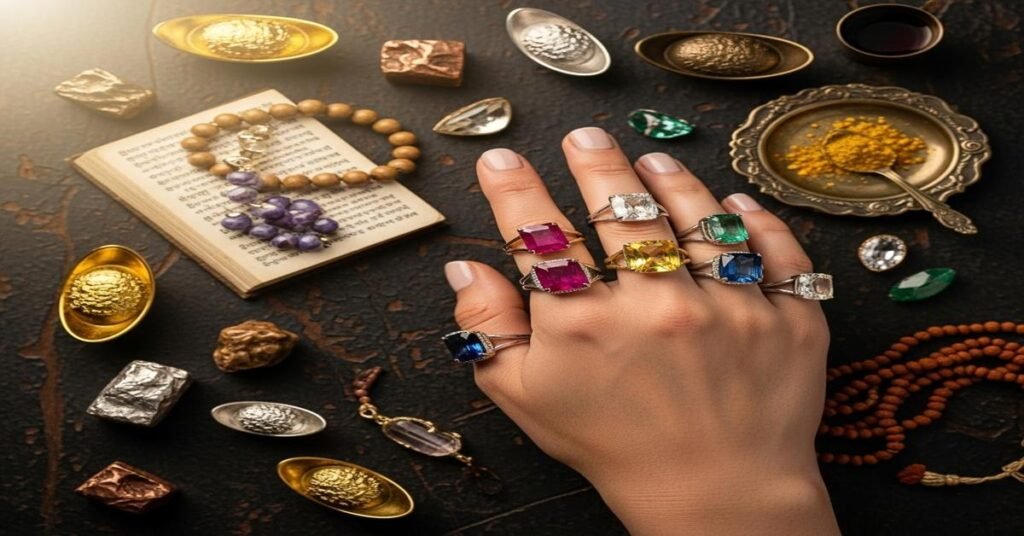
The Correct Way to Wear Gemstones: Which Metal, Finger, and Mantra to Use? Follow This Complete Vedic Guide for 100% Results.
Wearing gemstones according to Vedic rules is about three things: the right stone (quality and weight), the right metal and setting, and the correct ritual — including the finger and mantra. Each choice has a practical reason: the metal conducts and secures the stone, the finger changes how the body and nervous system receive the stone’s influence, and the mantra focuses intention. Below is a precise, practical guide you can use to choose, size, mount, energize, and wear a gemstone correctly.
Which gemstone for which planet (and why)
Vedic tradition matches specific gems to the nine planetary energies (Navagraha). Use the stone most commonly recommended for that planet:
- Sun — Ruby (Pigeon blood to deep red). Supports leadership, confidence. Mantra: “Om Suryaya Namah”.
- Moon — Pearl (natural, white or off-white). Regulates emotions and mind. Mantra: “Om Chandraya Namah”.
- Mars — Red Coral. Increases courage and energy. Mantra: “Om Mangalaya Namah”.
- Mercury — Emerald. Improves communication and intellect. Mantra: “Om Budhaya Namah”.
- Jupiter — Yellow Sapphire (Pukhraj). Brings growth, wisdom. Mantra: “Om Brihaspataye Namah”.
- Venus — Diamond or White Sapphire. Helps relationships and artistic talent. Mantra: “Om Shukraya Namah”.
- Saturn — Blue Sapphire. Strengthens discipline and resilience. Mantra: “Om Shanicharaya Namah”.
- Rahu — Hessonite (Gomed). Addresses karmic and material shifts. Mantra: “Om Rahave Namah”.
- Ketu — Cat’s Eye (Lehsunia). Helps spiritual detachment and insight. Mantra: “Om Ketave Namah”.
Which finger and which hand — practical rules
Finger selection follows tradition because different fingers connect to different nerves and hence different energetic pathways. General, widely used rules are:
- Right hand for men, left hand for women. This is the standard default; exceptions exist per an astrologer’s chart.
- Index (forefinger) — Jupiter (Yellow Sapphire). Use for career growth and education.
- Middle finger — Saturn (Blue Sapphire). Use for discipline, stability; handle cautiously because Saturn effects are strong.
- Ring finger — Sun (Ruby) or Venus (Diamond). Ring finger suits Sun’s authority and Venus’s aesthetic/relationship energy.
- Little finger (pinky) — Mercury (Emerald) and sometimes Moon (Pearl). Ideal for commerce, speech, and mind-related benefits.
- Thumb — Mars (Red Coral). Strong, action-oriented; coral on thumb increases initiative.
Why this matters: nerve endings differ by finger; the right/left hand rule corresponds to giving vs. receiving energies in traditional practice. If you are unsure, start with your natal chart or consult a reputable Vedic astrologer.
Metal choice and alloy specifics
Metal matters. It secures the stone and complements planetary vibrations. Practical, proven recommendations:
- Gold (22K preferred) for most benefic planets (Ruby, Yellow Sapphire, Emerald, Diamond). 22K gold is ~91.7% pure (balance copper/silver). It’s soft enough for setting while retaining traditional resonance.
- Silver (Sterling, 92.5% Ag) for Moon (Pearl) and often Mars/ Mercury combinations. Silver is conductive and supports lunar/mental energies.
- Platinum (950) is excellent for durability and for high-value stones like diamonds. Use when daily wear and scratch resistance are priorities.
- Settings: Prefer bezel or secure prong settings. Avoid glued assemblies or doublets for planetary use.
Gem size, cut and quality — practical thresholds
Gem size affects effectiveness and durability. These are conservative, commonly used ranges and conversions:
- Weight: Aim for 1.0–4.0 ct for most adult wearers. Men often choose 2–4 ct; women 1–2 ct. Larger is not always better — quality and clarity matter more than pure size.
- Millimetres: Rough conversion for round brilliants: 1 ct ≈ 6.5 mm, 2 ct ≈ 8.2 mm, 3 ct ≈ 9.4 mm.
- Cut: Faceted stones are common, but cabochon is required for cat’s-eye or star stones (asterism). Pearls and opals should be natural, well-matched, and set with closed-back protection.
- Clarity and treatments: Get laboratory certification (GIA, IGI, or reputable local labs). Avoid heavily filled glass or dye treatments. Heat treatment is common and accepted for many stones; glass filling and composite stones are not recommended for astrological purpose.
How to energize and wear the gem (step-by-step)
Follow a clear procedure rather than improvising. These steps are practical and repeatable:
- Get the stone certified. No certificate = don’t use for astrological purposes.
- Have the gem set in the recommended metal and finger by a trusted jeweler. For men, right hand; women, left hand (unless astrologer says otherwise).
- Cleanse the stone physically: wash with mild soap and water; for pearls use only fresh water and soft cloth.
- Purify and energize: sit in a quiet, clean place facing east. Place the ring on a copper or silver plate. Recite the planet’s mantra (see list above) 108 times while focusing on your intention. You can repeat for 11 or 21 consecutive days for extra reinforcement.
- Wear the stone at the planet’s chosen muhurta (auspicious time): e.g., Sun — Sunday sunrise; Moon — Monday early morning; Jupiter — Thursday; Saturn — Saturday; Mars — Tuesday; Mercury — Wednesday; Venus — Friday. For Rahu/Ketu, astrologer’s guidance is best.
- Observe for 48–72 hours: good signs include increased calm, clarity, better sleep, or an uptick in the relevant life area. If you notice persistent negative changes, remove the stone and consult an astrologer — the gem may be unsuitable or configured incorrectly.
Care, contraindications, and final checklist
Care: clean per gem type, avoid chemicals, check settings annually, remove while doing heavy manual work.
Contraindications: do not wear uncertified or composite stones for astrological use; do not experiment without consulting an astrologer if you have major health or life issues; Saturn and Mars stones can produce rapid change and should be used cautiously.
Final checklist for “100% best practice”: certified stone, correct carat/size, proper metal (22K gold, sterling silver or platinum), correct finger and hand, mantra chanted 108 times, wear during correct muhurta, observe effects, and consult a qualified Vedic astrologer if anything feels off. Following each step matters because the result is a combination of material quality, physical placement, and focused intention — not any single shortcut.

I am G S Sachin, a gemologist with a Diploma in Polished Diamond Grading from KGK Academy, Jaipur. I love writing about jewelry, gems, and diamonds, and I share simple, honest reviews and easy buying tips on JewellersReviews.com to help you choose pieces you’ll love with confidence.