
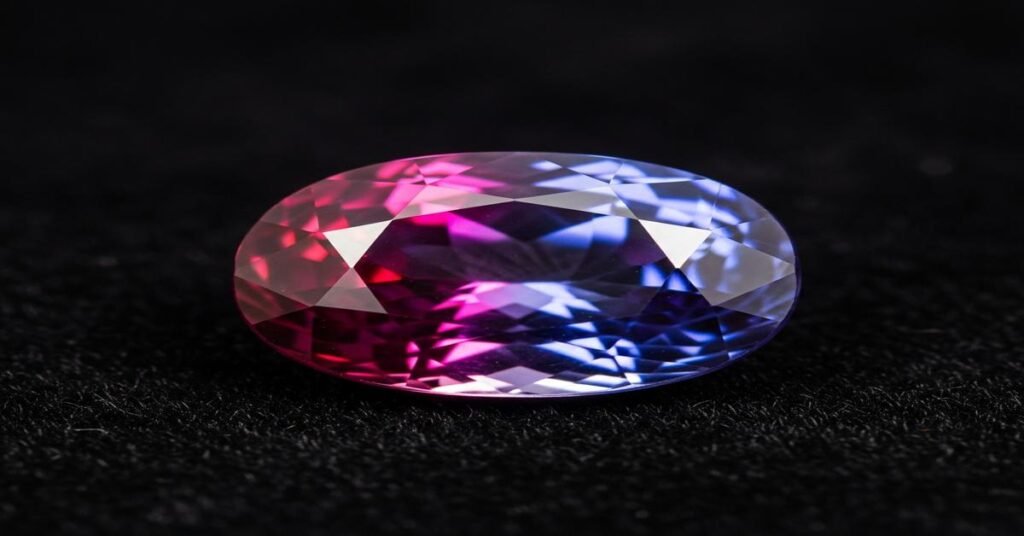
Jewelers love the phrase “lab-grown alexandrite.” It sounds exotic and rare, and it hints at the famous green-to-red color change that collectors chase. Here’s the truth: in today’s market, most stones sold as “lab-grown alexandrite” are not alexandrite at all. They’re lab-grown color-change sapphire. The color change may look similar, but the chemistry, structure, value, and gemological identity are different. If you want the real thing—or simply want to know what you own—understanding the differences will save you money and frustration.
What “alexandrite” really is
Alexandrite is a variety of the mineral chrysoberyl (chemical formula BeAl2O4) colored by chromium. It shows a dramatic shift from green in daylight to red in incandescent light. This effect—often called the “alexandrite effect”—comes from how chromium absorbs parts of the spectrum and how your light source shifts the available colors.
Natural alexandrite is rare and expensive because it forms only in unusual geological conditions with both beryllium and chromium present. Even synthetic alexandrite (true lab-grown chrysoberyl) is costly to produce. Growth methods are complex and slow, and the material often shows inclusions from the growth process.
Why color-change sapphire is not alexandrite
Color-change sapphire is corundum (Al2O3), the same species as blue sapphire and ruby. Its color change usually comes from vanadium (sometimes with chromium). Under daylight it appears blue to bluish-green; under incandescent it shifts toward purple or violet. It can be attractive, but it is not chrysoberyl and not alexandrite.
Gemologically, the two are different species with different physical constants, optic character, inclusions, and value. Calling color-change sapphire “lab alexandrite” is incorrect. It confuses a variety name (alexandrite) with a completely different species (corundum).
How the color change works (and why they can look similar)
Two things drive the effect:
- Chromophores: In alexandrite, chromium creates a strong absorption band that leaves a transmission “window” in green light under daylight and shifts toward red under warm incandescent light. In color-change sapphire, vanadium and other trace elements alter absorption to push a blue-to-purple shift.
- Light source: Daylight is richer in blue-green; incandescent is richer in red. Change the light, and the dominant transmitted color changes. This is why jewelers can make a sapphire “look like” alexandrite by switching lights. Similar behavior doesn’t equal the same species.
To the eye, both stones can appear to change. But alexandrite’s best shift is typically green to red, while sapphire’s is often blue to purple. That difference reflects the underlying chemistry, not just lighting tricks.
How sellers end up mislabeling
- Price pressure: True lab-grown alexandrite is far costlier to make than synthetic sapphire. Many sellers adopt the familiar word “alexandrite” to justify higher prices on inexpensive color-change sapphire.
- Legacy marketing: For decades, cheap synthetic corundum with a color change has been marketed as “alexandrite” in TV shopping and catalogs. The habit stuck.
- Loose language: Some sellers use “alexandrite” to mean “any color-change gem.” That’s not acceptable in gemology. Alexandrite is a specific variety of chrysoberyl, not a generic term.
- SEO and marketplace listings: “Alexandrite” attracts clicks. Some listings use the term just to be found, even when the species is sapphire.
Quick ways to tell what you have
These checks won’t replace a lab report, but they can keep you from being misled.
- Read the species on any certificate: If it says corundum or sapphire, it’s not alexandrite. If it says chrysoberyl and variety alexandrite, that’s correct.
- Look at the seller’s wording: “Lab-grown sapphire (color-change)” is accurate. “Lab-grown alexandrite sapphire” is a red flag; those are different species. “Simulated alexandrite” usually means not chrysoberyl.
- Price reality check: Large, clean, well-cut stones with dramatic green-to-red change priced like costume jewelry are almost never alexandrite. True lab-grown alexandrite is far more expensive than lab sapphire. Natural alexandrite of good quality is in a different league entirely.
- Color character: Daylight green to incandescent red suggests alexandrite. Daylight blue to incandescent purple suggests sapphire. There are exceptions, so treat this as a clue, not proof.
- Curved growth lines: Under 10–20x magnification, curved color banding or curved striae point to flame-fusion corundum. Alexandrite won’t show that pattern.
Definitive identification methods
A trained gemologist can separate them quickly. Here are the most useful tests and what they reveal.
- Refractive index (RI):
- Alexandrite (chrysoberyl): about 1.746–1.755 (biaxial).
- Sapphire (corundum): about 1.762–1.770 (uniaxial).
Different RI ranges mean a refractometer can separate them cleanly.
- Specific gravity (SG):
- Alexandrite: ~3.73.
- Sapphire: ~4.00.
Hydrostatic weighing in a lab confirms the difference.
- Optic character:
- Alexandrite: biaxial positive.
- Sapphire: uniaxial negative.
A polariscope or conoscope reveals this. It’s decisive and not subjective.
- Pleochroism:
- Alexandrite: strong, typically green, red, and bluish hues depending on direction.
- Sapphire: strong dichroism, often blue and violet in color-change material.
A dichroscope helps read the pleochroic pairs.
- Absorption spectrum:
- Alexandrite (Cr): characteristic sharp chromium lines in the red and features in the green; the overall profile creates the classic green-to-red window.
- Color-change sapphire (V): different pattern, often broader bands, typically lacking the sharp alexandrite chromium lines.
A handheld spectroscope is very informative in skilled hands.
- Microscope inclusions:
- Synthetic alexandrite (true chrysoberyl): flux-grown stones may show wispy flux “veils,” reflective metal platelets, or residue; pulled (Czochralski) stones can show straight growth zoning and strained mosaic patterns.
- Synthetic color-change sapphire: flame-fusion material shows curved growth lines and gas bubbles; pulled or Czochralski-grown corundum shows curved or arc-like striae and seed-related features; flux-grown corundum has flux fingerprints but different from chrysoberyl.
Inclusions often tell you the species and even the growth method.
- Fluorescence:
- Alexandrite: often inert to weak; chromium response varies with body color and transparency.
- Color-change sapphire: vanadium-bearing stones are typically weak to inert; chromium-bearing corundum fluoresces stronger red (more typical of ruby than sapphire).
Useful as supporting evidence, not a stand-alone test.
Price reality check
Understanding value protects you:
- Natural alexandrite: one of the most expensive colored gemstones. Fine stones command high four to five figures per carat and up, especially over 1 ct with strong change.
- Lab-grown alexandrite (real chrysoberyl): still costly compared with other synthetics. Production is slow, yields are small, and color change quality varies. Expect hundreds of dollars per carat for good material, often more.
- Lab-grown color-change sapphire: widely available and inexpensive to make. Prices are usually a fraction of true synthetic alexandrite.
If a seller offers “lab-grown alexandrite” with perfect clarity, big sizes, a strong change, and a bargain price, assume it’s color-change sapphire until proven otherwise.
Buying advice that keeps you safe
- Insist on proper species and variety on paper: The report or invoice must say “chrysoberyl, variety alexandrite” if that’s what you’re paying for. “Corundum, variety sapphire (color-change)” is not alexandrite.
- Prefer independent lab reports: Certificates that clearly state species and variety remove guesswork. A respected lab will not call corundum “alexandrite.”
- Check the color change under two known light sources: Use a 5000–6500K daylight-equivalent source and a warm incandescent/halogen source. Note hue, not just presence of change. Green-to-red favors alexandrite; blue-to-purple favors sapphire.
- Be cautious with vague adjectives: “Alexandrite-like,” “Alex-changey,” or “synthetic alexandrite sapphire” are warning signs.
- Match price to reality: If the deal looks too good, it is. Pay alexandrite prices only when the species is confirmed.
What to do if you already bought one
- Get an independent identification: A gemologist can separate chrysoberyl from corundum quickly with standard instruments.
- Compare paperwork to the stone: The wording should match the species. If your invoice says “lab alexandrite” but your report says “corundum,” you were sold the wrong thing.
- Ask the seller for a correction or refund: Mislabeling a stone’s species is a material error. In many jurisdictions, this violates trade guidelines for jewelry descriptions.
- Keep expectations fair: Color-change sapphire can still be pretty and durable. If you like the stone, you may choose to keep it—just make sure the price reflects what it actually is.
The bottom line
Real alexandrite is chrysoberyl. Most “lab-grown alexandrite” sold cheaply online and in mall settings is actually lab-grown color-change sapphire. The two can both shift color, but the underlying species, diagnostic properties, and values are not the same. If you want the genuine article, look for the words “chrysoberyl, variety alexandrite” on a trustworthy report, confirm the green-to-red change under known lighting, and expect to pay accordingly. If you already own a stone, a straightforward identification will tell you the truth—so your expectations and your price match the gem you have.

I am Satyam Pandey, a gemologist with a Diploma in Polished Diamond Grading from KGK Academy, Jaipur. I love writing about jewelry, gems, and diamonds, and I share simple, honest reviews and easy buying tips on JewellersReviews.com to help you choose pieces you’ll love with confidence.