
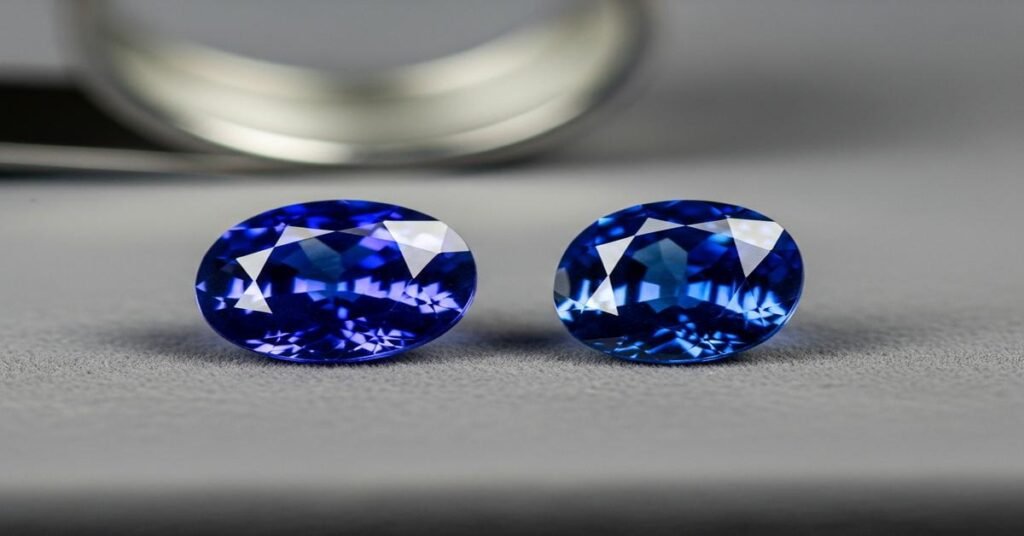
“Cobalt blue” spinel is one of the most confusing stones in the market today. Top natural stones can fetch $10,000 per carat or more. Lab-grown lookalikes cost around $100 per carat. To the eye—and to most jeweler’s tools—they look the same. That gap creates an easy trap for shoppers and even for honest retailers. Here’s how to understand the stone, the science, and the safeguards.
What makes cobalt blue spinel so expensive
Natural spinel is magnesium aluminum oxide. A small amount of cobalt in the crystal replaces magnesium and creates a saturated, electric blue. That trace element mix is rare in nature, so true cobalt-bearing stones are scarce.
Supply is limited. Fine cobalt spinel has come from Vietnam (Luc Yen), Sri Lanka, and parts of Tanzania. Most rough is small. Clean stones above 2 carats are unusual, and stones above 4–5 carats are exceptional. Rarity drives price.
In top quality, buyers pay for three things:
- Color: vivid, pure blue without gray or green. Cobalt gives an almost neon look.
- Clarity: few inclusions at 10x magnification. Eye-clean material is prized.
- Cut and size: bright, even cutting in sizes over 1–2 carats is much harder to find.
As a result, fine natural cobalt spinel can bring roughly $4,000–$12,000 per carat at 1–2 carats, and higher for top stones or larger sizes. Prices vary by lab confirmation, origin, and the exact look in hand.
Why its $100 lab-grown twin looks identical
Spinel is easy to grow in a lab, and cobalt is easy to add during growth. Lab-grown spinel has the same chemical formula and crystal structure as natural spinel. Because the physics is the same, the optical properties match: refractive index, dispersion, luster, and color.
Common growth methods include:
- Verneuil (flame-fusion): fast and inexpensive. Can yield strong blue with cobalt dopant.
- Flux growth: slower, higher quality, fewer obvious growth marks, often very “natural-looking.”
- Czochralski (pulled crystal): also capable of high clarity and even color.
A skilled cutter can facet a lab-grown crystal to the same angles and polish as a natural gem. To the naked eye, the results can be indistinguishable.
Why many jewelers can’t tell them apart
Most jewelers rely on a loupe, a microscope, a refractometer, a polariscope, and a UV lamp. Those tools are great for separating many gems. They are not great at separating natural spinel from synthetic spinel.
- Same optics: Natural and lab-grown spinel have the same refractive index (~1.718) and are singly refractive. Those readings don’t separate origin.
- Similar fluorescence: Blue spinel is usually weak to inert under UV. Cobalt tends to quench fluorescence, so there’s little signal either way.
- Clean material: Flux-grown and pulled synthetics can be very clean and lack obvious “curved striae” or bubbles seen in cheaper flame-fusion stones. Without telltale inclusions, visual clues disappear.
- Color isn’t proof: The exact vivid “cobalt blue” can be achieved both in nature and in a lab.
That’s why honest sellers can be fooled. Without advanced spectroscopy or trace-element analysis, confidence is low. Even experienced gemologists send these to a lab.
The testing that actually works
Separating a $10,000/ct natural stone from a $100/ct lab-grown twin requires lab-level instruments and multiple lines of evidence. No single quick test is enough in borderline cases.
- UV-Vis-NIR spectroscopy: Confirms cobalt-related absorption bands in the yellow-orange region that produce the strong blue. This shows cobalt is present but does not prove natural origin by itself.
- EDXRF (X-ray fluorescence): Detects and quantifies cobalt and other trace elements. Natural cobalt spinel usually shows a mix of Co with Fe, sometimes Cr, V, and Zn. Synthetic material can show different trace profiles. Labs compare these patterns, not just the presence of Co.
- LA-ICP-MS (laser ablation mass spectrometry): High-resolution trace-element “fingerprint.” This is one of the most decisive tools to separate natural from lab-grown based on element ratios and impurities that reflect geology versus growth chemicals.
- Microscopy: Helpful when features exist. Natural blue spinel may show octahedral growth zoning, “fingerprint” healing patterns, included crystals, or natural stress patterns. Flame-fusion synthetics can show curved striae and gas bubbles. Flux-grown synthetics may show flux residues, wispy veils, or platelets. Clean stones may lack clear indicators, pushing the need for spectroscopy.
- Raman spectroscopy: Identifies the species as spinel but does not determine natural vs synthetic origin.
- Magnet test (screening only): Cobalt-bearing spinel—natural or synthetic—can be noticeably attracted to a strong neodymium magnet due to paramagnetism. This can suggest cobalt but cannot prove natural origin.
Reputable labs combine these methods and issue a report that states two different things: species/identity (spinel) and origin of growth (natural or synthetic). A separate line may confirm the presence of cobalt and, sometimes, geographic origin.
The vocabulary trap: “cobalt blue” vs “cobalt-bearing”
In the trade, “cobalt blue” is often used as a color name. It does not guarantee the stone contains cobalt. A natural blue spinel colored mainly by iron can be labeled “cobalt blue” in casual listings because it looks cobalt-like. That is a pricing trap.
Cobalt-bearing spinel means the lab detected cobalt as a chromophore. Many collectors pay a premium for that chemistry. Without a lab report explicitly stating cobalt is present, you should not pay cobalt-bearing prices.
Also separate two ideas that sellers sometimes blur:
- Natural vs synthetic: How the crystal formed.
- Origin (Vietnam, Sri Lanka, etc.): Where a natural crystal formed. Origin is a separate, tougher call and usually requires trace-element and inclusion analysis.
Price realities and red flags
Approximate market ranges (assuming fine color and cut):
- Natural cobalt-bearing blue spinel: about $4,000–$12,000 per carat at 1–2 ct; exceptional stones and larger sizes can exceed this. Stones with weaker color, more gray, or more inclusions drop quickly in price.
- Lab-grown cobalt blue spinel: commonly $50–$200 per carat, sometimes more for branded or precision-cut pieces.
- Lab reports: Expect roughly $120–$350 per stone for mainstream labs; specialized origin work can cost more. This cost is small compared to a four- or five-figure purchase.
Red flags that should slow you down:
- “Cobalt blue spinel” with no lab report, priced like a bargain.
- Claims of “Vietnam origin” without a major-lab report. Origin is a premium claim, not a guess.
- Generic or obscure “certificates” that avoid stating natural vs synthetic, or that never mention cobalt in the comments.
- Large sizes (3+ ct), perfect clarity, and a very low price. That mix usually means synthetic or non-cobalt blue spinel.
Buying checklist that protects you
- Insist on a major-lab report that states “natural spinel” and notes cobalt if present. If the report does not mention cobalt, assume the market will not pay a cobalt premium.
- Verify the tests performed. Ask the seller which methods were used (UV-Vis, EDXRF, LA-ICP-MS). Specifics reduce ambiguity.
- Get a return period that allows independent verification. Make the sale contingent on confirmation by a lab you trust.
- Evaluate color in daylight. Look for rich saturation without gray. Rotate the stone; cobalt-blue should remain lively across angles.
- Accept trade-offs. If your budget is fixed, consider slightly smaller sizes or stones with tiny inclusions rather than compromising on verification.
- Ask direct questions. “Is this natural or lab-grown?” “Is cobalt confirmed?” “Which lab tested it?” Vague answers are a sign to pause.
If you already bought one
Send the stone to a reputable lab. Ask for identity, natural vs synthetic, and cobalt detection. If your stone was sold as natural cobalt spinel and comes back synthetic or non-cobalt, you have grounds to return it or renegotiate.
For insurance, use the lab report to set value. Do not insure a stone at natural prices if it is lab-grown. Premiums and claims depend on correct classification.
For jewelers: how not to get burned
- Don’t rely on color alone. Vivid blue is not proof of cobalt, and cobalt is not proof of natural origin.
- Use EDXRF if you have it. It quickly screens for cobalt, iron, and other trace elements. Still send borderline stones to a major lab for confirmation.
- Look under high magnification. Curved striae or gas bubbles indicate flame-fusion. Flux residues or platelets can suggest flux growth. Lack of features does not prove natural origin.
- Disclose uncertainty. Put “subject to lab confirmation” on invoices. Avoid origin or cobalt claims without evidence.
- Stock lab-grown honestly. There is a real market for well-cut lab-grown cobalt-blue spinel. Clear labeling builds trust.
A quick example that shows the risk
A buyer sees a 1.5 ct “cobalt blue spinel” for $12,000. The color looks perfect. The jeweler’s refractometer reads 1.718. UV is inert. Under the microscope, it’s clean. Everything fits the story—until a lab report shows it is flux-grown synthetic with cobalt. The real value is closer to $150–$200. One report avoided a five-figure mistake.
Bottom line
“Cobalt blue” is a look. “Cobalt-bearing” is a lab-confirmed chemistry. “Natural” is a lab-confirmed origin. You need all three to justify five-figure prices per carat. Because lab-grown twins share the same chemistry and optics, most jewelers can’t separate them with basic tools. Protect yourself with major-lab reports, clear language, and return rights. When verified, natural cobalt-blue spinel deserves its price. Without proof, assume it’s the $100 twin.

I am Satyam Pandey, a gemologist with a Diploma in Polished Diamond Grading from KGK Academy, Jaipur. I love writing about jewelry, gems, and diamonds, and I share simple, honest reviews and easy buying tips on JewellersReviews.com to help you choose pieces you’ll love with confidence.