
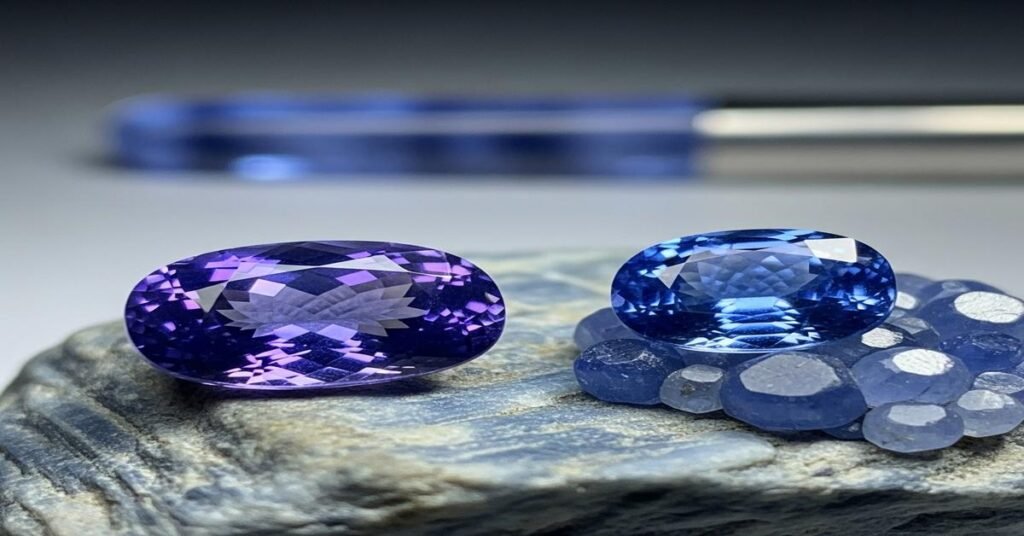
Tanzanite’s famous blue-violet color is almost always the result of heat—virtually every gem on the market has been heated after mining. That fact confuses many buyers: if 100% of tanzanite is heat-treated, does it lower the value? And how does a heated tanzanite compare with a natural (unheated) sapphire in price, durability, and long-term desirability? Here’s a clear, practical look at what heat does, why it’s accepted for tanzanite, and how it stacks up against sapphire.
What “100% heat-treated” really means for tanzanite
When dealers say “100% of tanzanite is heat-treated,” they mean the market assumes heating as standard practice. The gem’s rough is typically brownish with hints of blue and violet. Gentle heat transforms that into the saturated blue-violet color people expect. Without heat, most stones would be unimpressive and hard to sell.
This differs from many other gems where treatment is optional. For tanzanite, heat is the norm because it unlocks the color hidden in otherwise ordinary-looking rough. As a result, tanzanite pricing already “prices in” heat; a heated stone isn’t discounted—the opposite is true: unheated tanzanite usually shows weaker color and is less desirable.
How heat changes tanzanite’s color (and why it works)
Tanzanite is a vanadium-bearing variety of zoisite. The crystal is strongly pleochroic, meaning it shows different colors from different directions—blue, violet, and brown/yellow. Heating (typically around 500–600°C) changes the valence state of vanadium and reduces the yellow/brown component. The result is a cleaner blue-violet palette with stronger saturation.
Important points:
- Low-temperature process: Compared to corundum (sapphire) heat at ~1,700°C or more, tanzanite heat is relatively gentle.
- No added chemicals: This is not coating or diffusion; it’s a uniform change within the crystal lattice.
- Orientation matters: Cutters orient the table to favor the blue axis, minimizing violet/burgundy—another reason you see such consistent color in fine gems.
Is the treatment permanent and detectable?
Permanence: The color change from heat is stable under normal wear. It won’t fade in sunlight or wash out in water. The only real risk is exposure to excessive heat during repair or polishing.
Detectability: Labs can often infer heating in tanzanite from color and microscopic features, but detection is not always straightforward at these lower temperatures. Crucially, because heating is assumed, labs and dealers treat it as standard and acceptable, provided it’s disclosed.
Does heat treatment hurt tanzanite’s value?
No. It enables the value. Because nearly all market-quality tanzanite is heated, buyers and appraisers judge value based on the same factors as untreated gems: color, saturation, cut quality, clarity, and size. There is no price premium for “unheated” tanzanite; in practice, unheated stones usually look browner and sell for less.
Tanzanite vs. natural sapphire: what the market rewards
Here’s where sapphire differs:
- Unheated sapphire is a holy grail category. Untreated blue sapphires with fine color command significant premiums because they are scarce and have a long track record of collector demand.
- Heated sapphire is common but accepted. Most sapphires are heated to improve color and clarity. High-quality heated stones are still valuable, but unheated status raises the ceiling.
- Tanzanite, even fine, is generally priced below high-grade sapphire. That’s due to durability (see below), wider demand for sapphire (especially in engagement jewelry), and the prestige of historic sources (Kashmir, Burma, Sri Lanka).
In short: heat helps both gems look their best, but the market differentiates them. For sapphire, “unheated” boosts value; for tanzanite, “heated” is expected and neutral to positive.
Durability and everyday wear
Tanzanite: Hardness ~6 to 6.5 on the Mohs scale, with one direction of perfect cleavage. That means it can abrade over time and is vulnerable to sharp blows. It’s fine for pendants, earrings, and occasional-wear rings with protective settings, but it is not ideal for a daily-wear engagement ring.
Sapphire: Hardness 9, no cleavage, excellent toughness. It’s the classic choice for rings worn every day. This durability underpins higher demand and stronger long-term value, especially for unheated stones.
Color, cut, and size: what drives price in each
Tanzanite price drivers:
- Color: Rich, deep blue with a slight violet modifier commands the most. Too violet or too light lowers price.
- Cut: Orientation is critical to maximize the blue axis. Well-cut stones face up larger and mask pleochroic brown.
- Size: Price per carat jumps in larger sizes (5–10 ct and up) with top color and good clarity.
Sapphire price drivers:
- Color: Medium to medium-dark vivid blue, even saturation, and minimal zoning are prized.
- Treatment status: “No indications of heating” documented by a reputable lab can multiply value.
- Origin (sometimes): Kashmir, Burmese, or fine Sri Lankan origin can further raise prices, especially unheated.
Example: A 3 ct fine tanzanite with rich blue-violet will be far less expensive than a 3 ct fine unheated blue sapphire of similar visual impact, primarily because sapphire is tougher, more in demand for daily wear, and revered by collectors.
Treatment landscape: heat vs. other treatments
- Tanzanite: heat is standard and acceptable. Be cautious with any mention of coatings or fracture fillings; these are uncommon but would lower value and should be disclosed.
- Sapphire: heat is common and acceptable. Diffusion-treated (especially beryllium) or glass-filled sapphires trade at deep discounts. These treatments can be less durable or surface-concentrated, and labs can detect them.
Why this matters: the market trusts treatments that are internal, permanent, and long-known (like traditional heat). It discounts treatments that are surface-level, unstable, or hard to identify without advanced testing.
Lab reports and disclosure
For high-value purchases, get an independent lab report.
- Tanzanite: Reports often note that heating is common; some will state evidence of heat. The goal is primarily to confirm identity (zoisite var. tanzanite) and natural origin.
- Sapphire: Look for “no indications of heating” if you are paying a premium. If heated, ensure the report does not indicate diffusion or fillings unless the price reflects it.
Reputable sellers should disclose all treatments. If the price seems too good for the color and size, assume a stronger treatment until proven otherwise.
Buying tips (practical and specific)
- Decide based on use: For a ring you’ll wear daily, choose sapphire. For a statement pendant or occasional-wear ring, tanzanite offers striking color at a friendlier price.
- Judge tanzanite in varied light: View in daylight and warm indoor light. Fine stones keep strong blue with only a gentle shift to violet; washed-out or gray tones are less valuable.
- Check the cut: A well-cut tanzanite faces up bright and blue. If you see brown flashes, the orientation may be favoring the wrong axis.
- Ask about treatments plainly: “Is this stone heat-only?” For sapphire, ask explicitly about diffusion and fillings.
- Consider a lab report for any sapphire of meaningful value and for large or high-grade tanzanite.
- Compare like-for-like: When comparing prices, match size, color, clarity, and treatment status. An unheated sapphire should cost markedly more than a heated sapphire or tanzanite of similar face-up appeal.
Care and maintenance
- Tanzanite: Avoid ultrasonic and steam cleaners. Use lukewarm water, mild soap, and a soft brush. Protect from hard knocks and sudden temperature changes. If jewelers work near the stone, they should remove it or use very low heat.
- Sapphire: More robust; ultrasonics and steam are often safe, but avoid harsh impacts and check settings regularly.
Ethics and sourcing notes
Tanzanite comes from a single area in Tanzania (Merelani Hills). That single-source reality adds intrigue but also price volatility. Sapphire comes from multiple countries, each with its own mining practices. If ethical sourcing matters to you, ask for details on origin and supply chain; some dealers offer mine-to-market documentation.
Bottom line
Heat treatment is part of tanzanite’s identity. It is stable, expected, and does not reduce value—because it’s what makes tanzanite look like tanzanite. By contrast, unheated blue sapphire sits in a premium category with exceptional durability and strong collector demand.
If you want maximum color per dollar for occasional wear, a fine tanzanite is hard to beat. If you want a lifetime ring with established long-term value, a natural unheated sapphire—documented by a reputable lab—remains the benchmark. Knowing why the market treats these two gems differently helps you choose the right stone for your style, budget, and lifestyle.

I am Satyam Pandey, a gemologist with a Diploma in Polished Diamond Grading from KGK Academy, Jaipur. I love writing about jewelry, gems, and diamonds, and I share simple, honest reviews and easy buying tips on JewellersReviews.com to help you choose pieces you’ll love with confidence.