
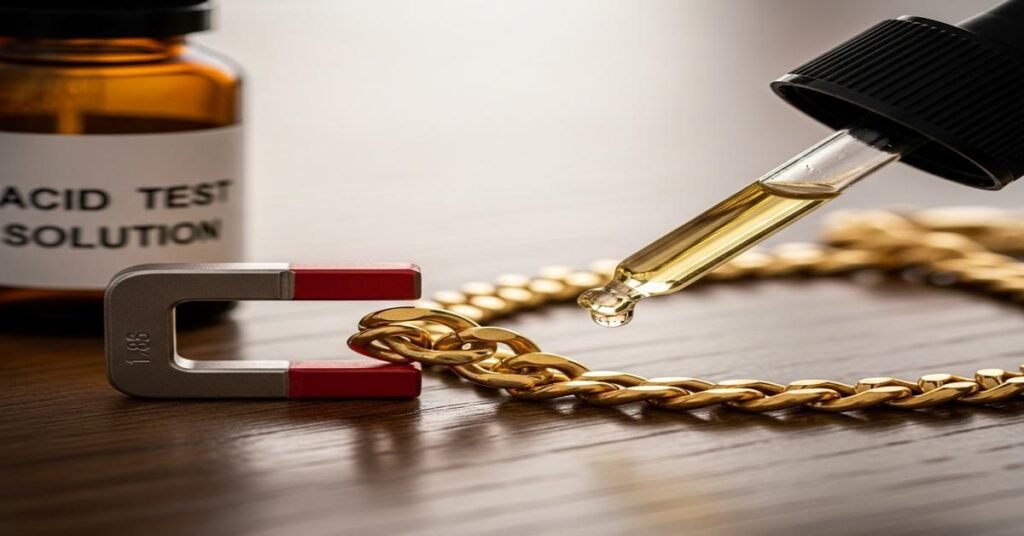
Your 18K gold chain might not be what it claims. Counterfeits are common, and “18K” stamps get faked. The good news: you can screen most fakes at home with one strong magnet and a proper acid test. This guide explains the tools, the exact steps, and how to read each result so you can tell if your chain is real, plated, or something else.
What 18K Gold Really Is (And Why That Matters)
18K gold is 75% pure gold and 25% other metals (often copper, silver, nickel, or palladium). That 25% changes color and hardness, but not magnetism. Gold itself is not magnetic. Those common alloy metals (copper, silver, palladium) aren’t magnetic either. So a solid 18K chain should not react to a magnet. The only consistent exception is the clasp spring, which is steel in many chains and will attract a magnet.
This is also why acid testing works. Nitric acid (and the “karat” acid solutions in test kits) dissolve base metals quickly. Higher-karat gold resists. An 18K test solution is made to dissolve any gold below about 18K while leaving 18K+ mostly intact on a test stone.
Tools You Need
- Neodymium magnet (small but strong). Fridge magnets are too weak.
- Jeweler’s loupe (10x) or a phone macro lens to read stamps and inspect wear.
- Gold acid test kit: at least 14K, 18K solutions and a black test stone. More solutions (10K, 22K) help bracket results.
- Small metal file (fine grit) to expose fresh metal if needed.
- Gloves, eye protection, baking soda (for neutralizing acid), paper towels, and water.
Quick Screening: Visual Clues Before Testing
- Hallmarks: Look for clear, well-formed stamps: “18K,” “750,” or “750 Italy.” Be wary of “18K GP,” “HGE,” “GEP,” “RGP,” or “GF” (gold plated, heavy gold electroplate, rolled gold plate, gold-filled). Those are not solid gold.
- Color consistency: Real 18K has a rich color that’s consistent across links, end caps, and jump rings. Two-tone or bright yellow plating over dull base metal is a red flag.
- Wear points: Check edges and the underside of the clasp. Plating often rubs off at high-contact areas, showing gray (steel) or brassy color (brass/bronze).
- Joints and solders: Mismatched color at solder joints can indicate plating or repairs with different alloys.
Magnet Test: Fast Elimination
Why it works: Solid 18K gold and its usual alloys are not magnetic. If a chain sticks strongly to a magnet, it likely contains ferromagnetic metal (iron or steel) under the surface plating.
How to do it:
- Hang the chain freely and bring a neodymium magnet slowly toward it.
- Test different spots: middle of the chain, links near the clasp, and the clasp itself.
How to read it:
- Strong, obvious stick anywhere on the chain links: Not solid 18K. Likely steel core or steel links with gold plating.
- Only the clasp clicks to the magnet: Still possible it’s real. Many real gold chains use steel springs in clasps.
- No attraction at all: Passes the magnet screen. Move to acid testing.
Common trap: Some stainless steels are weakly magnetic and may show a gentle pull. Solid gold won’t show any pull at all. Test more than one spot and compare to the clasp’s strong click to learn the difference.
Acid Test Basics (And Safety)
Why it works: Nitric-based solutions attack base metals quickly. “18K” solution is formulated so that a gold streak of true ~18K resists longer than lower karats.
Safety first: Work with gloves and glasses in a ventilated area. Protect surfaces. Keep baking soda ready to neutralize spills. Rinse skins or tools with running water after testing.
Test stone vs. direct metal: Start on a black test stone. It limits damage and gives a clear read. Only test directly on the chain if you suspect heavy plating and need to expose the core.
Step-by-Step: The 18K Acid Test on a Stone
- Clean a spot on the chain with a little rubbing alcohol. Oils can affect the streak.
- Make a streak: Rub the chain firmly on the black stone for 1–2 cm to leave a solid, bright metal line. Make it thick enough to observe.
- Apply acid: Place a small drop of 18K solution directly on the streak. Don’t flood the stone.
- Watch closely for 30–60 seconds. Then gently tap-rinse or blow to clear the drop and inspect.
What you should see:
- Streak stays sharp and bright: Likely 18K or higher gold alloy.
- Streak fades slowly but doesn’t vanish: Could be near 18K (17–18K), or alloying metals affecting the reaction. Cross-check with 14K and 22K solutions.
- Streak dissolves quickly (seconds): Plated or lower-karat metal. Base metals will fizz, turn greenish, or vanish.
Bracket the karat: Repeat with 14K solution and 22K solution on fresh streaks.
- If the streak survives 14K but fails 18K, you’re around 14–18K (often 14K or 15–16K in reality).
- If it survives 18K but fails 22K, it’s likely genuine 18K.
- If it fails 14K, it’s not 18K.
Note: White gold with palladium or nickel can behave slightly differently but should still resist according to its true karat.
When to Scratch the Chain Itself
Heavy plating can fool a stone test if your streak picks up mostly plating. If the chain passed the magnet test but the stone results are mixed, do this:
- Pick a hidden spot on the clasp end or underside of a link.
- Make a tiny file notch (1–2 mm) to cut through any plating. You want to see the metal underneath.
- Touch a small drop of 18K solution to the notch. Observe.
- Immediate reaction (green fizz, dark etch): Base metal under plating. Not solid 18K.
- No reaction or very slow dulling: Likely solid gold alloy of high karat.
Rinse, neutralize with baking soda paste, and wipe dry.
Optional Cross-Checks at Home
- Weight and feel: Gold is dense (18K is ~15–16 g/cm³). A solid 18K chain feels “heavier than it looks” compared to brass or aluminum. Hollow chains feel suspiciously light for their size.
- Consistency test: If the chain is marked 18K but the end caps or jump rings clearly test lower karat, it’s likely assembled or altered. Real pieces are usually consistent.
Decision Guide: Put It All Together
- Strong magnet pull on links: Fake or plated over steel. No need to acid test unless you’re curious.
- No magnet pull (clasp only) + streak survives 18K: Likely genuine 18K.
- No magnet pull + fails 18K but passes 14K: Likely 14K or lower gold. Not 18K.
- No magnet pull + streak dissolves fast + notch fizz: Gold-plated base metal.
- Mixed or borderline reactions: Retest with fresh streaks and use 14K/22K solutions to bracket. If still unclear, get a pro XRF or fire assay.
Common Fakes and How They Behave
- Gold-plated steel: Strong magnet stick on links. Acid on a filed notch fizzes green and eats in.
- Gold-plated brass/bronze: No magnet pull. On the stone, the streak disappears fast with greenish tinge. Notch test shows yellow turning brown/green.
- Stainless steel with gold tone: Light to moderate magnet attraction. Acid typically has little gold-like resistance; streak vanishes.
- Gold-filled (GF): Thick plating over base metal. May pass a quick stone streak once or twice. A deep notch exposes base metal; acid reacts quickly at the core.
- Mismarked lower-karat gold (e.g., 14K stamped 18K): No magnet pull. Streak passes 14K but fails 18K. This is real gold, just not the karat claimed.
Safety, Care, and Next Steps
- Neutralize acids after use with baking soda until fizzing stops. Rinse tools and the stone with water and dry.
- Store acids upright with caps tight, away from kids and pets. Replace solutions if they get weak or contaminated; old acids can give false readings.
- Protect the chain: Use the stone method first. Only file a tiny, hidden notch if needed.
- For certainty: If the value is high or results are mixed, a jeweler can run XRF (non-destructive) or a fire assay (destructive but definitive).
Bottom line: A strong magnet test eliminates most fakes in seconds. The acid test, done carefully on a stone, tells you if your chain is truly near 18K. Use both, read the reactions honestly, and you’ll know whether you own solid gold, lower-karat gold, or just gold color.

I am Satyam Pandey, a gemologist with a Diploma in Polished Diamond Grading from KGK Academy, Jaipur. I love writing about jewelry, gems, and diamonds, and I share simple, honest reviews and easy buying tips on JewellersReviews.com to help you choose pieces you’ll love with confidence.