
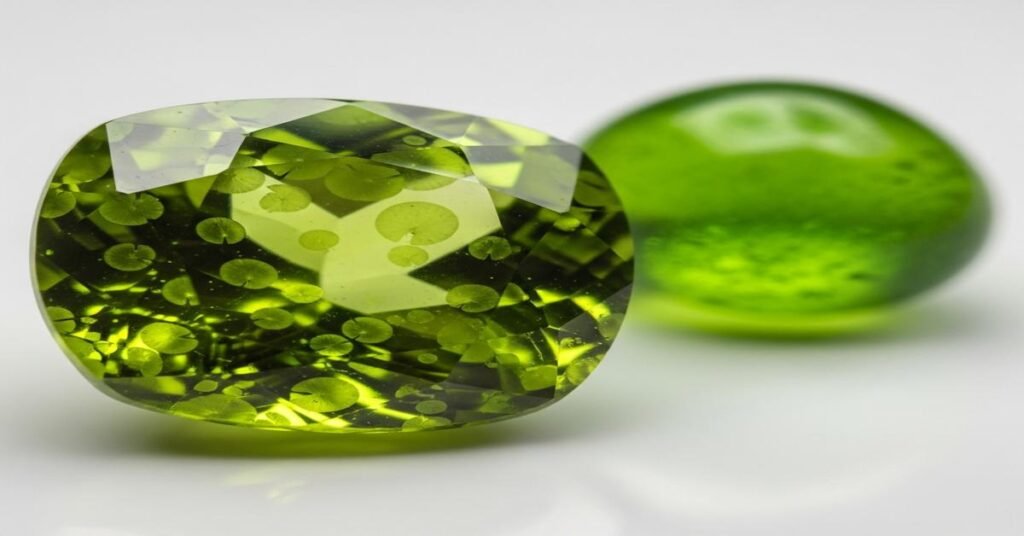
Bright, crisp, and unmistakably summer green—peridot has a look you can spot across the room. Lately, though, a wave of green “nano gems” (glass-ceramic imitations) has blurred the line for buyers. Many of these fakes are sold as “nano peridot,” “lab-grown peridot,” or “nano crystal.” They are not peridot. The good news: real peridot has a fingerprint that glass can’t copy—its classic “lily pad” inclusions. Here’s how to tell the difference, why it matters, and how to protect your wallet.
What real peridot is—and why it looks the way it does
Peridot is the gem variety of olivine, a magnesium–iron silicate. Iron gives it that yellow-green color. Because the color comes from iron built into the crystal itself (not from trace coloring agents), peridot’s hue is usually consistent across the stone: a lively chartreuse to olive green with a warm, golden undertone.
Peridot forms deep in the Earth and in some meteorites. Its growth conditions create internal stress and tiny included crystals. When a hard crystal forms inside peridot, the surrounding stone relieves stress by forming a flat, circular fracture around it. Under magnification, those look like floating discs with a central dot—gemologists call them “lily pads.”
Peridot is also doubly refractive. In plain language, it splits light into two rays as it passes through the stone. That matters because it produces a subtle “double vision” of facet edges when you look closely with a loupe. Glass imitators do not show this effect.
What “nano gems” really are
“Nano gem,” “nano crystal,” and similar names are marketing terms for glass or glass-ceramic materials. They are made in a melt, colored with metal oxides, and cooled under tight control. Makers can grow nanometer-scale crystals inside the glass to tweak optical properties, but the result is still a glass-based product, not a crystal that grew from a solution like a natural gem.
Why that matters:
- Structure: Glass is amorphous (no long-range crystal structure). Peridot is crystalline. Structure affects how light moves through the material, which is why peridot shows doubling and glass does not.
- Inclusions: Glass is usually very clean, or it shows tiny spherical gas bubbles and flow lines from manufacturing. It does not produce stress “lily pad” discs around solid inclusions because there are no embedded crystals to create them.
- Color uniformity: Nano glass tends to have perfectly even color. Natural peridot is even too, but often shows tiny natural features when magnified.
Why green glass fakes are everywhere now
The pressure is simple: price, supply, and photos.
- Low cost, high control: Glass is cheap to produce and color. Sellers can offer big “peridot-green” stones for a fraction of the price and keep margins high.
- Photo-friendly: Glass looks flawless online. Natural peridot’s faint inclusions (which are a good sign) often get edited out or hidden by lighting.
- Fuzzy naming: Terms like “nano,” “crystal,” and “lab-grown” sound scientific and ethical. There is no mainstream production of true laboratory-grown peridot for jewelry. If it says “nano peridot,” assume glass unless proven otherwise.
Meet the “lily pad” inclusion: the peridot giveaway
A lily pad is a flat, circular to oval stress halo around a tiny crystal or cavity inside peridot. It looks like a ring or bullseye, often with a dot in the center. Under 10x magnification you may see several, sometimes overlapping. Why they form: the included crystal and the host peridot expand and contract differently during growth and cooling. That mismatch creates a disc-shaped fracture as the peridot relieves stress. Glass does not grow around crystals in the same way, so you don’t get lily pads.
How to spot them:
- Use a 10x loupe. Hold the stone face-up and scan the interior. Shift the light from the side to catch the faint white rings.
- Look for flat discs, not spheres. Lily pads are planar rings. They do not look like round gas bubbles floating in depth.
- Tilt the stone. A true lily pad stays a flat ring that flashes as the light glances off the plane. A bubble stays a round dot that moves in parallax.
Note: not every peridot shows obvious lily pads, especially small stones or very high-quality material. But if you find clean, vivid green “peridot” with no lily pads, no natural crystals, and a perfectly spotless interior, be cautious. Real peridot is rarely flawless under 10x.
Other quick checks you can do at home
- Facet-edge doubling: Look through the table at the rear facets. In peridot, many edges look slightly doubled because of strong birefringence. Glass edges look single and crisp (until they abrade).
- Bubbles and flow lines: Random, perfectly round bubbles or faint swirly streaks are classic glass signs. Peridot may have crystals and fingerprints, but not swirls.
- Edge wear: Glass abraded edges turn matte quickly with wear. Peridot is harder and usually keeps sharper facet junctions longer, though it can abrade too over time.
- Color character: Peridot typically leans yellow-green. Very bluish or emerald-like greens are suspicious in pieces marketed as peridot.
- Weight-in-hand: Peridot is denser than most common glasses. Two stones of the same size—if the “peridot” feels unexpectedly light, be cautious. (This is a hint, not a standalone test.)
Bench tests for jewelers and serious buyers
- Refractive index (RI): Peridot reads in the mid-1.6s and shows a noticeable split between the two readings. Glass is singly refractive and gives a single reading. This is decisive.
- Polariscope: Peridot shows strain and is doubly refractive; glass is usually isotropic. You’ll see a clear difference in behavior on rotation.
- Specific gravity (SG): Peridot is significantly heavier than standard soda-lime or borosilicate glass. Some leaded or specialty glasses overlap, so use SG with other tests.
- Spectroscope: Peridot has a distinctive iron absorption pattern in the blue region. Most green glasses show diffuse absorption without the same pattern.
- Microscope: Document lily pads, chromite-like dark crystals, and healed fingerprints. Absence of these plus presence of spherical bubbles argues for glass.
Common traps and edge cases
- “Flawless” stones: Large, clean, bright green “peridot” at bargain prices are often nano glass. Clean peridot exists, but it’s not common and it isn’t cheap.
- Marketing language: “Nano,” “nano crystal,” “lab-grown peridot,” and “synthetic peridot” are red flags. Ask the seller to state the material plainly: natural peridot or glass/glass-ceramic.
- Other green lookalikes: Green cubic zirconia or YAG are brighter and more dispersive (“rainbowy”) than peridot and lack facet-edge doubling. Chrysoberyl and tourmaline can look similar but have different inclusion scenes and test values. If in doubt, test.
- Photo-only buying: Studio lighting makes glass glow. Always ask for a loupe video that slowly tilts the stone. Request close-ups of the interior.
Buying checklist: simple, practical steps
- Ask the right question: “Is this natural peridot or a glass/glass-ceramic imitation?” Make them name the material, not just the color.
- Request magnified images: A 10x or microscope video showing the interior. Look for lily pads and doubled facet edges.
- Check disclosure on receipts: The invoice should state “natural peridot” if that’s what you’re paying for. “Nano,” “lab,” or “synthetic” next to “peridot” should trigger more questions.
- Sanity-check the price: If a large, clean, vivid “peridot” costs less than a nice piece of silver work that holds it, something is wrong.
- Return policy: Buy only with a return window. If a gemologist later calls it glass, you need a way out.
Caring for peridot vs. glass
Peridot sits around 6.5–7 on the Mohs scale. It can abrade and chip with hard wear. Avoid ultrasonics and harsh chemicals. Warm soapy water and a soft brush are fine. Glass is typically softer and more prone to surface wear. Treat it gently, keep it separate from harder stones, and store it in a pouch.
Bottom line: the lily pad test saves you
“Nano” is a polished word for glass. Real peridot is a crystalline gemstone with a distinct internal world—especially those lily pad inclusions and the subtle doubling of facets. If you see perfect interior cleanliness, spherical bubbles, and no doubling, you’re likely looking at glass. A 10x loupe, a steady light, and two minutes of patient looking will protect you better than any marketing pitch.
Trust the evidence inside the stone. Peridot tells on itself in beautiful ways—and glass can’t fake them.

I am Satyam Pandey, a gemologist with a Diploma in Polished Diamond Grading from KGK Academy, Jaipur. I love writing about jewelry, gems, and diamonds, and I share simple, honest reviews and easy buying tips on JewellersReviews.com to help you choose pieces you’ll love with confidence.