
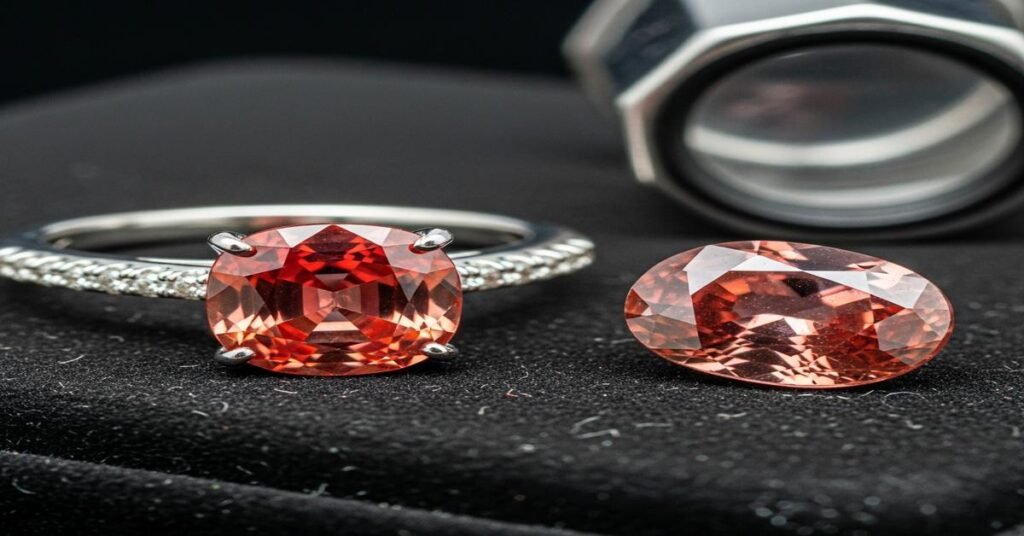
Padparadscha sapphires sit at the knife edge of color: a delicate mix of pink and orange that looks like a tropical sunset. That balance is rare in nature—and easy to mimic in a lab or with aggressive treatments. Today, lab-grown “padparadscha” is common and cheap, while natural stones with true pad color remain scarce and expensive. If you own or are shopping for a pink‑orange sapphire, you need to know what it really is. Here’s how to tell the difference, why it matters, and what tests actually work.
What makes a padparadscha sapphire—and why it’s so easy to fake
“Padparadscha” isn’t just any pinkish-orange sapphire. It’s a narrow color window: *soft, balanced pink and orange* in the same stone, not pure orange, not pure pink, and not brownish or neon. Many experts prefer a pastel, lotus-like color rather than vivid orange or hot pink. That balance is rare because it takes just the right mix of trace elements. Chromium pushes pink, iron contributes yellow/orange; the wrong mix and the hue tilts off target.
Faking that balance is easy with modern methods. Labs can grow sapphire in pad-like colors on demand. Heat and beryllium diffusion can push an ordinary sapphire toward the look. Surface coatings can fake the hue for a while. To make things harder, photos online are often over-saturated, making an ordinary stone look like a dream pad.
Five possible identities for your “pink‑orange” sapphire
Your stone likely fits one of these categories:
- Natural, unheated padparadscha: Rare and costly. Usually has soft, even color. Inclusions are natural (crystal “fingerprints,” rutile silk, zircon halos). Labs will use the word “Padparadscha” when the color meets strict criteria.
- Natural, heated sapphire with pad color: Common. Heat can improve color and clarity. Honest sellers disclose “heated.” Value is lower than unheated but can still be high if color is top-tier.
- Beryllium-diffused sapphire: A high‑temperature treatment drives beryllium deep into the stone to add orange/yellow. Color can look convincing. Major labs do not call these padparadscha on reports. Price is far lower. Undisclosed diffusion is a frequent scam.
- Lab-grown (synthetic) sapphire in pad color: Chemically corundum, but grown by people, not nature. Often very clean, very uniform in color, and inexpensive. Some sellers blur language (“created padparadscha”) to imply rarity. It’s not rare; it’s manufactured.
- Simulants and composites: Glass, coated topaz, synthetic spinel, or sapphire-and-glass composites. These are not sapphire at all (or are heavily glass-filled). They chip easily, show air bubbles, and sell for very little. Often marketed with vague names like “sunset sapphire.”
Quick at‑home screening: what you can and can’t verify
You won’t confirm a true padparadscha at home, but you can rule out many fakes. Use a 10x loupe and good light.
- Color check in different lights: View in shaded daylight, warm indoor light, and cool LED. A real pad color stays in the pink‑orange family across lights. If it swings to brown, pure pink, or pure orange, be cautious.
- Pleochroism (two colors): Sapphire shows two body colors when viewed from different directions. With a simple dichroscope (cheap tool), you should see a pinkish and an orangey component. No pleochroism? It could be glass or a coated simulant.
- Look for curved growth lines: Under magnification, curved color bands or striae suggest flame‑fusion synthetic sapphire. Natural sapphires show straight or angular zoning, not curves.
- Gas bubbles: Round bubbles are classic glass clues. A few pinpoint bubbles by themselves don’t prove glass, but many round bubbles in flowy “swirls” do.
- Facet-edge color concentrations: Bright orange lines hugging facet edges can indicate diffusion or a thin surface coating. True body color won’t pool only along facet junctions.
- Too perfect, too cheap: A large, flawless, vividly colored “pad” for a bargain price is almost always lab-grown or diffusion-treated. Natural pads usually show some inclusions and cost real money.
- Weight vs. size: Sapphire is dense. If a 2 ct stone looks huge for the weight, suspect glass or a composite.
- UV reaction: Many padparadscha sapphires fluoresce red due to chromium. But fluorescence alone won’t separate natural from synthetic—both can glow.
What not to do: Don’t scratch-test (you’ll ruin the stone or setting), and don’t rely on smartphone “gem apps.” They can’t read trace elements or inclusions correctly.
Lab tests that settle it
Only a qualified gem lab can confirm padparadscha color and detect treatments with certainty. Here’s what they look for and why it works:
- Microscopic inclusions: Natural stones show angular color zoning, rutile silk, crystal inclusions with tension halos, and natural growth patterns. Flux-grown synthetics show flux “fingerprints.” Flame-fusion synthetics show curved striae. These patterns reflect how the crystal formed.
- Spectroscopy (UV‑Vis‑NIR): The balance of chromium and iron absorption bands reveals if the color fits the pad window. It also helps separate pad-like peach sapphires that are too yellow or too pink.
- FTIR and trace-element analysis: Detects heat treatment markers and beryllium diffusion. Beryllium leaves a chemical fingerprint that labs can pick up.
- Raman/EDXRF and other methods: Confirm corundum vs. glass or spinel, and identify coatings or fillers.
- Report language: A proper report will state the species (corundum), variety (sapphire), color, whether the term Padparadscha applies, and treatment status (e.g., heated, no indications of heating, diffusion-treated). Some labs also give origin when possible.
Price reality check
Prices vary with color, size, clarity, and whether the stone is unheated. Ballpark ranges (subject to market changes):
- Natural, unheated padparadscha: Often high four to five figures per carat for fine stones over 1 ct. Truly top color can be more.
- Natural, heated pad color: Mid four to low five figures per carat for attractive stones, less for commercial color.
- Beryllium-diffused sapphire: Commonly in the low hundreds to low thousands per carat. Should be a fraction of natural pad pricing.
- Lab-grown “padparadscha” sapphire: Often tens to a few hundred dollars per carat, depending on cut and method (flux-grown costs more than flame-fusion).
- Glass or coated simulants: Dollars to low tens per carat. If the price is too good, it probably is.
Red flag: A seller offering a 2 ct “Ceylon padparadscha” with no lab report for a bargain price is likely moving treated or synthetic stones.
Common scams and vague language
- “Heated only” when it’s diffusion: Beryllium diffusion requires heat, but it’s not the same as traditional heating. If the report says “diffusion,” it’s not accepted as padparadscha by major labs.
- “Created padparadscha sapphire” marketed as rare: It’s synthetic. It may be beautiful, but it isn’t rare or natural.
- Coated gems: A thin pink or orange film is applied to a pale sapphire or another gem. The film can scratch or wear off, especially on the pavilion.
- Photos with boosted saturation: Listings that show neon orange-pink in every light are suspect. Ask for unedited daylight and indoor photos taken the same day.
- Origin claims without reports: “Ceylon” or “Sri Lankan” is often used to justify high prices. Origin is hard to prove without lab data.
How to buy safely
- Insist on a respected lab report for any expensive stone. The report should explicitly use or reject the word Padparadscha and list treatments.
- Demand full disclosure of heat, diffusion, filling, or coating. If the seller doesn’t know, assume the worst.
- Check return and refund terms that allow you to send the stone to a lab. No-returns on expensive gems is a red flag.
- Ask for neutral-light photos and videos in daylight and indoor light. Look for the pink‑orange balance, not neon or brown.
- Prefer reputable dealers who use accurate language and accept independent verification.
Care and durability differences
- Natural and heated sapphire: Hard (Mohs 9) and durable. Safe for everyday wear. Ultrasonic cleaners are usually fine unless inclusions are significant.
- Diffusion-treated: Body color is altered; durability is similar to sapphire, but any surface-only coloration or coating can wear. Ask before ultrasonic cleaning.
- Glass-filled or composites: Fragile. Avoid heat, chemicals, and ultrasonic or steam cleaning. Even household cleaners can damage them.
- Coated stones: Coatings can scratch or dissolve. Clean gently with mild soap and water only.
Bottom line
If you want a real padparadscha, you’re paying for rarity: that precise, soft pink‑orange color naturally balanced in corundum. Because labs can now grow or alter stones to imitate the look, the only safe route is clear disclosure and a serious lab report. At home, you can spot the obvious tells—curved growth lines, bubbles, edge-concentrated color, suspiciously low prices—but you can’t certify the color call or detect beryllium diffusion without instruments.
Decide what you want. If beauty on a budget is your goal, a lab-grown pad-color sapphire can be lovely and honest—if sold as synthetic. If you want the rare natural gem, insist on paperwork that actually says “Padparadscha” and states treatments. Know the why behind the price tag, and you won’t get caught by the pink‑orange mirage.

I am Satyam Pandey, a gemologist with a Diploma in Polished Diamond Grading from KGK Academy, Jaipur. I love writing about jewelry, gems, and diamonds, and I share simple, honest reviews and easy buying tips on JewellersReviews.com to help you choose pieces you’ll love with confidence.