
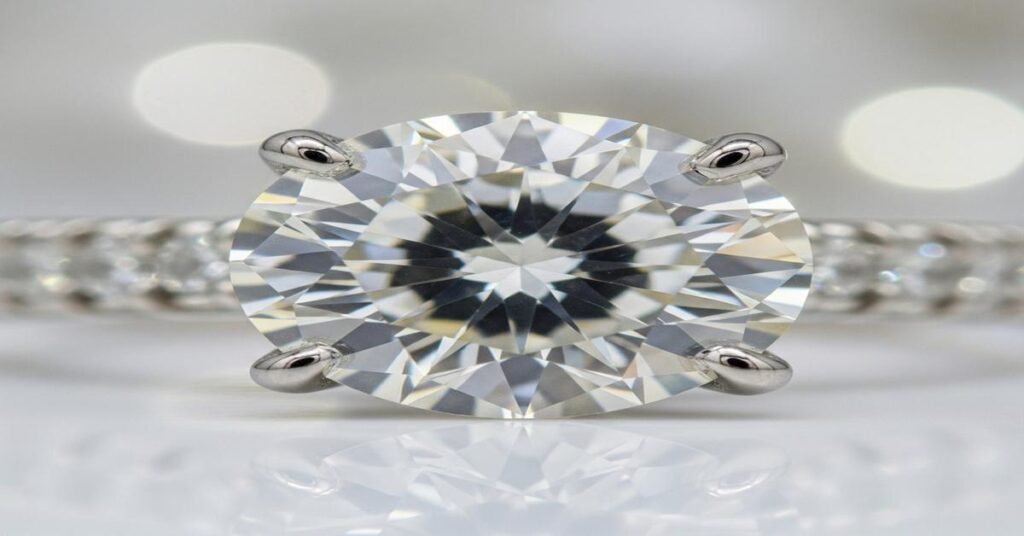
You didn’t buy a diamond. You bought moissanite. That’s not a downgrade—it’s a different gem with its own strengths. The confusion comes from sloppy marketing that calls moissanite a “lab diamond.” It isn’t. Lab-grown diamonds are real diamonds made in a lab. Moissanite is silicon carbide. This guide explains what moissanite actually is, how it behaves, how to read your paperwork, and what to do next so you can enjoy your stone with clear expectations.
What Moissanite Actually Is
Moissanite is lab-created silicon carbide (SiC). Natural moissanite is extremely rare and was first found in meteorites. Every moissanite you see in jewelry is grown in a lab as SiC crystals, then cut like gemstones.
Why this matters: chemistry and crystal structure control how a gem looks and wears. Different atoms and structures mean different sparkle, hardness, and behavior in testers.
Moissanite vs Diamond: The Real Differences
Chemistry and crystal structure
- Diamond: Pure carbon. Cubic crystal. Singly refractive (light travels one way).
- Moissanite: Silicon + carbon. Hexagonal/rhombohedral polytypes. Doubly refractive (light splits into two paths).
Optics (how it looks)
- Refractive index: Diamond ≈ 2.42; Moissanite ≈ 2.65–2.69. Higher RI makes moissanite look very bright.
- Dispersion (fire): Diamond ≈ 0.044; Moissanite ≈ 0.104. Moissanite throws bigger, more colorful flashes. That’s why people call it “disco-ball” sparkle under spotlights.
- Doubly refractive: Look through the top with a 10× loupe and you’ll often see doubled facet edges inside a moissanite. Diamonds don’t do that.
Durability
- Hardness (scratch resistance): Diamond = 10 on Mohs. Moissanite ≈ 9.25–9.5. Both resist scratching in daily wear. Don’t do scratch tests; you can damage stones and metal.
- Toughness (resistance to chipping): Both are tough enough for engagement rings. Any sharp blow can chip facet edges on either stone.
- Heat resistance: Moissanite tolerates heat well and is safe in ultrasonic and steam cleaning. Jewelers still remove stones for major repairs as a best practice.
Weight and size
- Density: Diamond ≈ 3.52 g/cc; Moissanite ≈ 3.21 g/cc. Moissanite weighs less for the same size.
- What you’ll see on listings: “DEW” means Diamond Equivalent Weight—size matched to diamond millimeters, not the stone’s actual weight. Example: a 6.5 mm round diamond is ~1.00 ct. A 6.5 mm moissanite weighs less than 1.00 ct but is the same size to the eye.
Testers and tools
- Thermal diamond testers often beep “diamond” on moissanite because both conduct heat well.
- Multi-testers check thermal and electrical properties to separate diamond from moissanite.
- Loupe test: Doubled facet junctions and stronger rainbow fire suggest moissanite.
Why “Lab Diamond” on a Moissanite Listing Is Misleading
Lab-grown diamond = diamond. It’s the same material as natural diamond (pure carbon), just grown in a machine. It grades like diamond and behaves like diamond.
Moissanite = a diamond simulant. It looks like diamond at a glance but is a different substance. Calling moissanite a “lab diamond” blurs that line and confuses buyers.
Why sellers do it: “Lab diamond” sounds premium. Moissanite is more affordable. The vague term boosts clicks. Regulators require clear naming, so read the product page and paperwork closely.
How to Read What You Actually Bought
Scan your receipt, listing, and any certificate. Look for these clues:
- Material name: The document should say “moissanite,” “silicon carbide,” or “SiC.” If it says “diamond, laboratory-grown,” that means a real lab-grown diamond—not moissanite.
- DEW: “1.00 ct DEW” means the stone is the size of a 1.00 ct diamond (~6.5 mm) but isn’t a 1.00 ct diamond by weight.
- Color terms: Moissanite is often sold as DEF (colorless), G–H (near colorless), or lower. Because moissanite’s optics differ, the “DEF” label doesn’t equal diamond grading rules; it’s a manufacturer’s scale.
- Clarity terms: VVS/VS/SI on moissanite are marketing approximations. Inclusions in moissanite tend to be needles, tiny crystals, or clouds. Diamonds have different inclusion types and grading standards.
- Certificates: Read the title carefully. It should plainly say what the stone is. The issuer and report type should match the material named on the document.
How to Confirm Your Stone
If you want certainty, use two steps:
- At home: Loupe at 10× through the top. Look for doubled facet edges and strong rainbow flashes. Watch for a faint greenish/yellowish or grey warmth in some lights. None of these are conclusive alone.
- At a jeweler or gemologist: Ask for testing with a multi-tester and a microscope. A quick, low-cost check can distinguish diamond, moissanite, and cubic zirconia correctly.
How Moissanite Performs in Real Life
Sparkle and fire: Moissanite has bigger, more colorful flashes than diamond because its dispersion is higher. Some people love the fireworks. Others prefer diamond’s tighter, whiter scintillation. Try it in sunlight and in soft indoor light to see which you prefer.
Color tone: Many modern moissanites are near-colorless. Under certain LEDs or sunlight, some show a slight yellow, green, or grey cast. You notice this more in larger stones.
Cut style: Because moissanite bends light more, cutters often use different proportions to reduce windowing or fish-eye effects. Don’t expect diamond grading reports or “Excellent/Ideal” to map 1:1.
Fluorescence: Some moissanites glow under UV (often blue). This can help identification but rarely affects durability.
Price and Value Expectations
Purchase price: Moissanite costs a fraction of both natural and lab-grown diamond at the same visual size. That’s because it’s a different gem and can be produced efficiently.
Resale value: Expect modest resale demand. Most buyers of moissanite prefer new stones at low prices. This is true for many gems, but more pronounced for moissanite. Diamonds also resell below retail, but there is a larger secondary market.
Insurance: You can insure your ring for replacement cost. Make sure the appraisal states “moissanite” so premiums match actual value and the replacement is like-for-like.
Settings, Care, and Maintenance
Daily wear: Moissanite is hard and durable enough for engagement rings. It won’t scratch easily and resists heat.
Prong wear: Any hard gem (diamond or moissanite) can slowly wear prongs over years. Get routine prong checks to avoid stone loss.
Cleaning: Warm water, mild dish soap, and a soft brush keep it bright. Ultrasonic and steam cleaning are usually safe for moissanite, but follow the jeweler’s guidance for the whole ring, especially if it has delicate side stones or glued parts.
Repairs: Jewelers often remove stones for soldering or plating to protect the entire piece. That’s good practice, not a red flag.
Common Misunderstandings to Avoid
- “It passed a diamond tester, so it’s a diamond.” Moissanite often passes basic thermal testers. Only combination testers or pro evaluation give reliable answers.
- “It’s 1 carat because it’s the same size.” If the paper says DEW, that’s size equivalence, not the stone’s weight.
- “DEF/VVS means the same as diamond grading.” Those letters are borrowed for familiarity. Grading systems and visual results differ across materials.
- “Stamps prove the stone.” Metal stamps (14K, 18K, 925, PT) tell you about the metal, not the center stone. Some rings include stone labels, many do not. Get written documentation.
If You Feel Misled
Check the listing and receipt language. If it says moissanite or SiC anywhere, the seller disclosed it. If it says “lab diamond” but the stone is moissanite, ask for a correction, exchange, or refund within the return window.
Get a written appraisal stating “moissanite.” This protects you for insurance and future servicing. It also makes resale expectations clear.
Decide by your priorities: If you love the look and price, keep it. If you wanted a diamond (natural or lab-grown), return or exchange before resizing or custom work.
Quick Side-by-Side: What You Really Bought
- Material: Moissanite (silicon carbide), not diamond.
- Creation: Lab-grown. Nearly all moissanite is lab-created.
- Look: Very bright with strong rainbow fire; sometimes shows doubled facets under magnification.
- Durability: Excellent for daily wear; slightly less hard than diamond but still very hard.
- Size labeling: Often given in millimeters and DEW; the physical carat weight will be lower than a diamond of the same size.
- Testing: May pass basic diamond testers; requires multi-testing or gemologist for confirmation.
- Value: Much lower price than diamond at the same size; modest resale market.
Bottom Line
Moissanite is its own gem with its own beauty. It isn’t a diamond and isn’t a “lab diamond.” If you bought moissanite thinking it was a lab-grown diamond, you were sold a different product. Now you know how to confirm what you have, how to read the paperwork, and how to care for it. If you love the look and the savings, enjoy it with confidence. If you wanted a diamond, use this guide to talk to the seller and get the stone that matches your expectations.

I am Satyam Pandey, a gemologist with a Diploma in Polished Diamond Grading from KGK Academy, Jaipur. I love writing about jewelry, gems, and diamonds, and I share simple, honest reviews and easy buying tips on JewellersReviews.com to help you choose pieces you’ll love with confidence.