
Intro
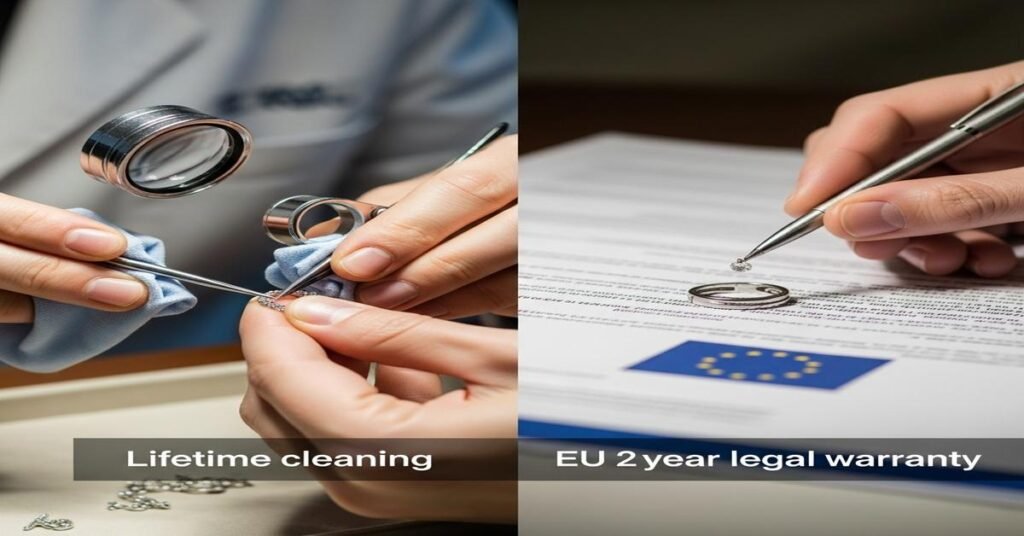
“Lifetime cleaning” and the EU 2‑year legal warranty sound similar. Both promise protection. They cover very different risks. One is a maintenance service. The other is a legal guarantee against defects. Knowing the difference helps you protect jewelry and avoid surprises when something goes wrong.
What each one really is
Lifetime cleaning: A retailer or jeweler offers periodic services for the life of the piece. Typical services include ultrasonic or steam cleaning, polishing, visual inspection, and sometimes free tightening of loose stones. Some shops include rhodium replating for white gold. This is a service contract. It usually requires you to bring the item in at specified intervals and to keep the original receipt.
EU 2‑year warranty (legal guarantee): This is a consumer right under EU law. It guarantees that goods are in conformity with the contract at delivery. If a ring, necklace, or watch turns out to be faulty within two years, the seller must repair or replace it free of charge. If repair or replacement is impossible or fails, you can request a price reduction or a refund. The warranty covers defects present at delivery, not normal wear and tear.
What is covered — practical examples
- Manufacturing defects: Faulty soldering, a cracked setting, or a poorly set 1 ct diamond causing it to fall out immediately. These are covered by the 2‑year legal guarantee. Why: the product wasn’t conforming at time of sale.
- Wear and tear: Thinned prongs after daily wear, scuffs on a wedding band, faded plating on white gold. These are normal use issues. Lifetime cleaning may spot and sometimes tighten prongs, but it rarely pays for full replacement of a worn setting. The EU guarantee does not cover normal wear.
- Rhodium plating: White gold is often plated with rhodium (typically 0.1–1 µm thick) to increase brightness. Plating naturally wears off within months to a few years depending on activity. Lifetime cleaning policies sometimes include free or discounted replating. The EU guarantee will not call plating wear a defect unless the plating was improperly applied at sale.
- Stone loss: If a gemstone falls out after two weeks because the setting was defective, the EU guarantee should cover repair or replacement. If the stone falls out after two years because a prong wore thin from decades of wear, that’s maintenance — not covered by the legal guarantee, and likely not covered by a “lifetime cleaning” unless the shop explicitly promises tightening or replacement.
Key legal details to know
- For the first six months after purchase, defects are presumed to have existed at delivery unless the seller proves otherwise. This helps consumers because proving a hidden manufacturing fault is hard.
- After six months, the burden of proof may shift to the consumer to show the defect was present at delivery.
- The seller must offer repair or replacement free of charge and within a reasonable time. If neither is possible, you can request price reduction or a refund.
- The 2‑year legal guarantee cannot be replaced or waived by a store warranty. A retailer can offer a longer commercial warranty, but it cannot reduce your statutory rights.
Limitations of lifetime cleaning
- It’s a service, not an insurance. It does not automatically replace lost stones or cover theft.
- Terms vary widely. Some shops require annual visits. Others limit what “free” covers. Many exclude incident damage (for example, a ring crushed underfoot).
- Lifetime offers are often non‑transferable. If you sell or gift the piece, the service may end.
- Repairs beyond basic tightening or polishing often carry a fee. Rhodium replating might be free only every few years, with charges in between.
When each is more useful
- Choose the EU 2‑year guarantee when: You want legal protection against hidden defects and poor workmanship. This matters for a newly made engagement ring, a bespoke wedding band, or any item with technical work like pavé settings.
- Choose lifetime cleaning when: You want regular maintenance and inspections to extend the life of a piece. For everyday items like an engagement ring you wear daily, routine prong checks every 6–12 months reduce the chance of stone loss.
Best practice — combine both
- Keep receipts and any warranty paperwork. The EU guarantee requires proof of purchase for most remedies after the first six months.
- Ask the retailer for the written terms of “lifetime cleaning.” Does it include ultrasonic cleaning, polishing, prong tightening, replating? Are there visit requirements?
- Use the store that sold the item for both warranty claims and maintenance when possible. The seller is responsible for the legal remedy under the EU guarantee.
- Inspect prongs yourself: a 6.5 mm round 1 ct diamond sits in four or six prongs. If prongs look pinched or thin, get an inspection immediately. Why: prong failure is the most common cause of stone loss.
- Consider additional insurance for loss, theft, or accidental damage. Neither lifetime cleaning nor the 2‑year guarantee covers theft or everyday accident in most cases.
What to ask the jeweler — short script
- “Can I see the written terms of the lifetime cleaning offer?”
- “Does it include prong tightening and rhodium replating? Are there limits or fees?”
- “How long is your commercial warranty? How does it relate to my EU statutory rights?”
- “If my diamond falls out after eight months, will you repair it under the legal guarantee or under your service plan?”
Bottom line
They protect different risks. The EU 2‑year legal guarantee protects you against manufacturing defects and non‑conformity at sale. Lifetime cleaning protects against neglect and prevents damage through regular maintenance. Both matter. Use the legal guarantee for defects. Use lifetime cleaning to prolong the piece and reduce the chance of future problems. For theft or accidental loss, buy insurance. Read terms, keep receipts, and have prongs checked regularly — especially on daily‑wear rings.

I am G S Sachin, a gemologist with a Diploma in Polished Diamond Grading from KGK Academy, Jaipur. I love writing about jewelry, gems, and diamonds, and I share simple, honest reviews and easy buying tips on JewellersReviews.com to help you choose pieces you’ll love with confidence.