
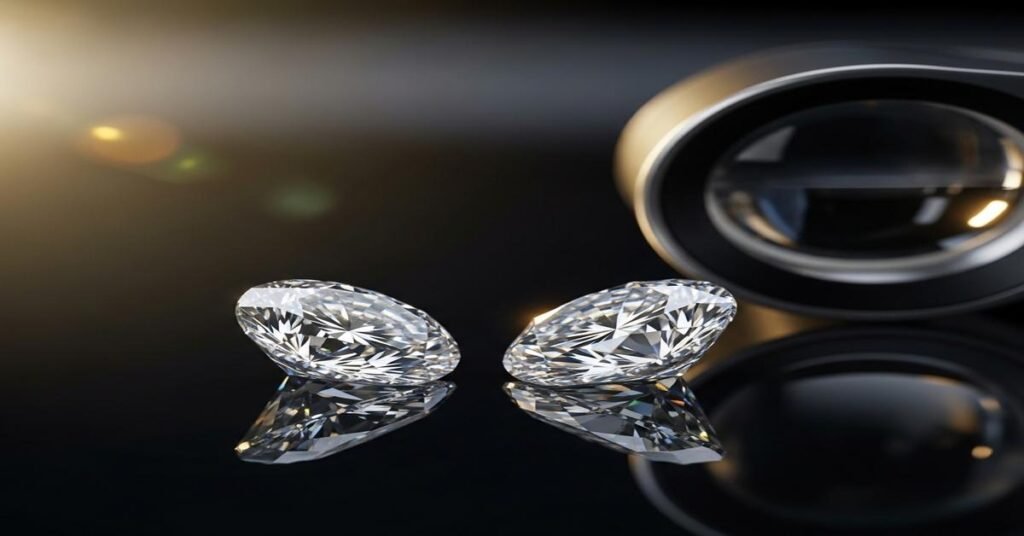
People ask one simple question first: “Are lab-grown diamonds real?” The short answer is yes. Lab-grown diamonds are chemically, physically and optically the same as diamonds formed in the earth. That truth changes only a few things you should know before you buy. Below I explain how lab diamonds are made, how they differ from mined stones in price and resale, how to verify what you’re buying, and which myths deserve to be dismissed.
What “real” means: chemistry, structure, and durability
A diamond is pure carbon in a specific crystal structure. Both lab-grown and natural diamonds share that structure. They have the same hardness (10 on the Mohs scale), the same refractive index, and the same density. That is why a 1.00 ct round brilliant—about 6.4 mm in diameter—looks and wears the same whether it grew underground or in a lab. The only intrinsic difference is origin: one formed over millions of years in the earth; the other grew in controlled laboratory conditions over weeks to months.
How lab diamonds are made and why that matters
Two main methods create lab diamonds: High-Pressure High-Temperature (HPHT) and Chemical Vapor Deposition (CVD). HPHT reproduces the pressure and temperature deep in the earth to turn carbon into diamond. CVD builds diamond layer by layer from carbon-bearing gas. Both produce gem-quality crystals. Why this matters: growth method can leave telltale internal features and trace elements that labs detect. CVD stones sometimes show layered growth patterns; HPHT stones can carry metallic inclusions. These features affect how grading labs identify and report origin.
Appearance and performance: are there visible differences?
Most consumers cannot tell the difference by eye. Under a jeweler’s loupe or microscope, a trained grader can see growth patterns, metallic inclusions, or specific fluorescence signatures that indicate origin. In everyday wear, a 0.75–1.50 ct stone will sparkle the same and resist scratching the same. That’s because light performance and hardness come from the diamond lattice, which is identical.
Value and resale: the practical difference
Lab-grown diamonds are usually cheaper at retail. For the same cut, color, clarity and carat, lab-grown prices are typically about 30–70% lower than comparable mined diamonds. Why? Shorter supply chain, no mining costs, and growing production reduce wholesale cost.
Resale behavior is different. Lab diamonds generally fetch lower prices on the secondhand market. Demand for mined diamonds remains stronger among some buyers who prefer natural origin. Also, a secondary market for lab-grown stones is still developing. If resale value matters to you, expect a bigger drop compared with a mined diamond.
Certification and identification
Legitimate sellers provide a grading report that states origin. Major labs—such as the GIA, IGI and GCAL—issue reports that identify lab-grown diamonds explicitly. Ask for a report that lists carat, cut grade, color, clarity, measurements (for example, a 1.50 ct round: 7.4–7.6 mm), and a clear origin statement. Many lab-grown diamonds also carry a laser inscription on the girdle that notes the report number and “LAB GROWN” or a similar phrase. Why this matters: a certificate is your proof of what you bought and the baseline for insurance and resale.
Myths exposed
- Myth: Lab diamonds are fake. False. They are real diamond by chemistry and structure. The confusion comes from simulants like cubic zirconia (CZ) and moissanite, which are different materials. Simulants are cheaper and look different under magnification.
- Myth: Lab diamonds are always “perfect.” False. Lab diamonds can have inclusions, color tints and growth lines. You can find lab-grown stones across the same clarity and color ranges as mined stones.
- Myth: Lab diamonds are always better for the environment. Not automatically. Producing CVD and HPHT diamonds uses significant energy. Some producers use renewable power and publish footprints; others do not. Ask for lifecycle or carbon-emissions data if this is important to you.
How professionals identify them
Jewelry labs use tools few consumers have: infrared and photoluminescence spectroscopy, DiamondView imaging and other instruments that detect growth patterns and trace elements. Those tests are why reputable labs can state origin confidently. For a buyer, the practical step is to insist on a full report from a known grading lab and a laser inscription matching the report number.
Practical buying checklist
- Get a certificate: GIA, IGI or GCAL reports that state origin and list cut, carat, color, clarity and measurements.
- Check the girdle inscription: Look for the lab report number and “LAB GROWN” or similar engraving under magnification.
- Compare price-per-carat: Expect lab diamonds to be roughly 30–70% less than mined stones for the same specs. Wide deviations could signal mislabeling.
- Ask about treatments: Some lab diamonds are post-growth treated (HPHT annealing or irradiation) to improve color. That must be disclosed.
- Read the return and upgrade policy: This matters more for lab diamonds because resale is less predictable.
- Insure and appraise: Get an independent appraisal for insurance listing origin and replacement value.
Care, setting, and warranties
Care is the same for both types. Clean with warm soapy water and a soft brush. Prongs and settings wear over time, so check them annually. For a ring with a high-set 1.50 ct diamond, expect similar mounting stress whether it’s lab-grown or mined. Warranties and service packages vary by retailer. For peace of mind, choose a seller who offers free resizing, prong repair, and a clear lifetime service policy.
Final takeaway
Lab-grown diamonds are real diamonds. They match mined diamonds in chemistry, durability and brilliance. The main differences are origin, price and resale expectations. If you value lower upfront cost, a clear ethics claim, or specific specs, lab-grown is a sensible choice. If long-term resale or natural origin matters, a mined diamond may suit you better. In all cases, insist on a trusted certificate, a laser inscription, and a return policy. Those three things protect your purchase and let you buy with confidence.

I am G S Sachin, a gemologist with a Diploma in Polished Diamond Grading from KGK Academy, Jaipur. I love writing about jewelry, gems, and diamonds, and I share simple, honest reviews and easy buying tips on JewellersReviews.com to help you choose pieces you’ll love with confidence.