
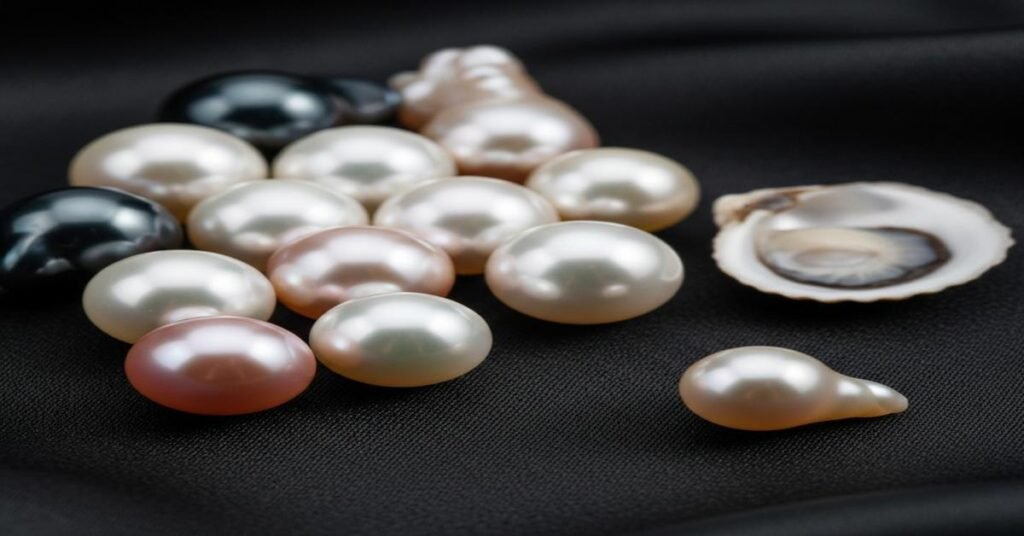
“Lab-grown pearls” sound plausible in the age of lab-grown diamonds. But pearls aren’t crystals you can grow in a vessel. Every real pearl—whether wild or farmed—forms inside a living mollusk. That’s why the phrase is a myth. At the same time, most pearls sold today are not “natural” in the historical sense. They’re cultured, meaning people help start the process, and the mollusk finishes the job in water over months or years. This guide clears up the terms, the types, and what truly drives quality and price.
What a Pearl Is (and Isn’t)
A pearl is a biological object built by a mollusk as a defense. Layer upon layer of nacre—thin plates of aragonite bound by protein—stack like shingles. Light bounces between the layers and interferes, creating luster and sometimes rainbowy “orient.” The layering is why great pearls look alive rather than shiny like plastic.
You can’t reproduce this structure fully in a lab without a mollusk. Scientists can make nacre-like films, but not a whole, layered pearl with the same optical depth. So “lab-grown pearl” is either a misunderstanding or marketing shorthand for an imitation. Imitations include glass beads coated with essence d’orient, plastic beads with pearlescent paints, or “shell pearls” made from crushed shell reconstituted as a bead. They may look smooth and uniform, but they lack the layered nacre that gives real pearls their glow.
Natural vs. Cultured: The Real Divide
Natural pearls form without human help when an irritant enters a wild mollusk. They’re rare because the conditions must align and the mollusk must survive long enough to build thick nacre. Genuine natural pearl strands are museum-level expensive because matching enough pearls in size, color, and shape is extraordinarily hard.
Cultured pearls are real pearls grown in farms under human care. Technicians implant either a bead (usually shell) plus a tiny piece of mantle tissue or just a small piece of tissue. The mantle cells secrete nacre over months to years. The pearls are harvested, sorted, and (often) lightly treated. They’re not “natural” by definition, but they’re not fake. They’re living, layered nacre produced by a mollusk. That’s why cultured pearls dominate the market: they’re beautiful, consistent, and accessible.
Keshi pearls are a special case. They’re all-nacre pearls that form in a cultured mollusk without a bead core, often after the bead is expelled. They’re not “natural” because the mollusk is farmed, but they have the weight and depth of solid nacre and often strong luster.
Saltwater vs. Freshwater: Four Main Categories
Species and environment shape size, color, nacre, and price.
- Akoya (saltwater): Classic white strands. Typical size 3–9 mm; rounds are common. Body color ranges ivory to white with rose, silver, or cream overtones. Growth time about 10–18 months. Historically thin nacre, but modern farms aim thicker for durability. Often lightly bleached and “pinked” to even color.
- Tahitian (saltwater): Naturally dark from black-lipped oysters. Body colors green, charcoal, eggplant; overtones peacock, aubergine, silver. Typical size 8–15 mm. High demand for vivid, clean, round pearls; price jumps for clean rounds over 11 mm.
- South Sea (saltwater): The largest. White and silver (Australia, Indonesia) or golden (Philippines). Typical size 9–16 mm, with rarities over 18 mm. Thick nacre from longer growth (2–4 years). Soft, satin luster compared to the mirror-bright shine of Akoya.
- Freshwater (mostly Chinese lakes/rivers): Wide range of natural pastels (white, peach, lavender). Historically tissue-nucleated (no bead), so many are solid nacre and durable. Typical size 5–10 mm, with larger examples common now. Newer “Edison” freshwater pearls are bead-nucleated and can reach 11–16 mm with striking metallic luster.
Why this matters: species determine your realistic expectations. If you want mirror-like luster and classic white round 7–8 mm, think Akoya. For big, glowing gold pearls, look to South Sea. If you want budget-friendly larger sizes with solid nacre, explore freshwater—especially modern high-grade strands.
How Quality Is Judged
Five factors dominate value. Each has a reason.
- Luster: Sharpness and brightness of reflections. Fine luster means light penetrates and returns from multiple nacre layers, giving a “hard” mirror-like look. Poor luster is dull or chalky because the layers are uneven or thin. Luster matters most because it’s the immediate beauty signal.
- Nacre thickness: More layers mean deeper luster and better durability. In thin-nacre pearls, the bead may show as a dead spot near drill holes over time. Saltwater bead-nucleated pearls vary; South Sea and many Tahitians tend to be thicker. Freshwater tissue-nucleated are often all nacre.
- Surface: Blemishes (pits, bumps, abrasions) interrupt reflections. Clean surfaces help light travel smoothly, increasing luster and value.
- Shape: Perfect rounds are rare; matching many for a strand is rarer. Price jumps for roundness. Baroque, drop, and oval shapes can be beautiful and cost less.
- Size: Growth is slow. Each additional millimeter in diameter requires exponentially more nacre. That’s why a 10 mm Akoya costs far more than an 8 mm of similar quality.
- Color, overtone, and orient: Body color is the base. Overtone is a translucent tint on top (e.g., rose over white). Orient is a rainbow effect from very fine, even layering; rare and prized. These add uniqueness and value when natural and vivid.
- Matching (for strands): Consistency of size, color, luster, and shape across many pearls is hard. A well-matched strand costs more for that reason.
Note: Grading terms like “AAA” aren’t standardized across sellers. Always ask what the grade means in measurable terms (nacre thickness, luster description, surface clean area) and rely on your eyes.
Treatments and What Sellers Should Disclose
- Bleaching and pinking: Common for Akoya to even color and add a soft rose tone. Done well, it’s stable. It should be disclosed.
- Dyeing: Used to create strong colors (especially in freshwater) or very dark pearls. Look for color concentrations near drill holes or in blemishes. Dyes can fade or bleed under harsh conditions.
- Irradiation: Can darken the nucleus or enhance color in some pearls. Usually stable but must be disclosed.
- Polishing/maeshori: Gentle cleaning, mild bleaching, and drying steps that improve luster. Common and generally accepted with disclosure.
- Coatings: Seen mostly in imitation “shell pearls.” Coatings can peel; drill holes often reveal layers.
Why it matters: treatments affect stability, value, and care. Disclosure lets you make fair comparisons.
Price Drivers at a Glance
- Type: Freshwater generally costs less than Akoya of similar size; Tahitian and South Sea cost more due to species, environment, and longer growth.
- Size jumps: Prices rise steeply at thresholds (e.g., 8.5–9 mm Akoya vs 7–7.5 mm) because supply thins.
- Roundness + matching: Perfectly round, well-matched strands command big premiums.
- Luster and surface: High luster and clean surfaces separate “nice” from “wow,” and the price reflects it.
- Natural vs cultured: Confirmed natural pearls are in a different price universe due to rarity and lab authentication costs.
Testing, Certificates, and Terminology Traps
- Tooth test: Rubbing gently feels slightly gritty on real pearls due to crystalline layers; glass/plastic feels slick. Useful, but not definitive.
- Drill-hole clues: Real pearls show concentric growth lines and no paint ridges. Coated beads can reveal chipping or a sharp boundary.
- X-ray: The only reliable way to separate natural from bead-nucleated cultured and to identify some treatments. Major labs use radiography or CT to see internal structure.
- Reports: For expensive single pearls or high-end strands, a lab report identifying type (natural vs cultured, saltwater vs freshwater) adds confidence.
- Watch the language: “Lab-grown” or “lab-created pearls” usually means imitation. “Shell pearl,” “Majorica/Mallorca,” and “crystal pearl” are trade names for imitations. “South Sea color” on a cheap strand is a red flag—it’s likely dyed freshwater, not South Sea.
- Grades: “AAA/AAAA/Gem” scales differ by seller. Ask for photos in multiple lights and return policies, not just letters.
Care, Wear, and Longevity
- Last on, first off: Perfume, hairspray, and cosmetics are mildly acidic and can dull nacre. Put pearls on after getting ready; take them off first.
- Wipe after wear: A soft, damp cloth removes sweat and oils that degrade nacre over time.
- No ultrasonics or steam: These can crack nacre or weaken silk.
- Store soft and separate: Use a fabric pouch or compartment. Hard gems can scratch pearls.
- Restring regularly: Strands should be knotted between pearls to prevent loss and avoid rubbing. Restring annually if worn often, or when knots darken or gaps appear.
Why this matters: nacre is relatively soft (about 2.5–4.5 on Mohs). Gentle habits extend the life and beauty of your pearls dramatically.
Sustainability and Ethics
Pearl farming depends on clean water. Farmers have an incentive to protect habitats because stress and pollution reduce survival and luster. In some regions, farms support local jobs and monitor water quality. That said, any aquaculture can pressure ecosystems if poorly managed—through waste, introduced species, or habitat changes.
Ask sellers where and how the pearls were farmed, what species, and whether the farm follows environmental standards. For vintage or antique pearls, you’re reusing existing materials, which can be a lower-impact choice.
Smart Buying Checklist
- Decide your priority: mirror luster (Akoya), big size (South Sea/Tahitian/freshwater Edison), or value per millimeter (freshwater).
- Ask for type (Akoya, Tahitian, South Sea, Freshwater) and whether they’re bead- or tissue-nucleated.
- Request plain-language quality details: luster description, surface cleanliness, shape, nacre thickness if available, and any treatments.
- For strands, inspect matching under daylight and warm indoor light. Look for consistent color and luster.
- Confirm return policy and, for higher-end buys, consider a lab report.
- Be wary of “lab-grown” or “South Sea color” at bargain prices; verify what they mean.
Examples:
- $150–$300 gift strand: Choose high-quality freshwater 6.5–7.5 mm with bright luster and good matching. Expect minor surface marks.
- $800–$1,500 classic white: Consider 7–7.5 mm Akoya with strong luster, light pinking, and clean surfaces. Check nacre around drill holes.
- $2,000+ statement: Large 9–11 mm Tahitian or golden South Sea drops with high luster. Single pendant or earrings maximize quality at lower cost than a full strand.
The bottom line: there are no “lab-grown” pearls in the way there are lab-grown diamonds. You can buy imitation pearls made in factories, or you can buy cultured pearls grown by mollusks in water—real pearls, just not wild “natural” ones. Learn the types, focus on luster and nacre, demand clear disclosure, and you’ll choose pearls that look beautiful now and age gracefully with wear.

I am Satyam Pandey, a gemologist with a Diploma in Polished Diamond Grading from KGK Academy, Jaipur. I love writing about jewelry, gems, and diamonds, and I share simple, honest reviews and easy buying tips on JewellersReviews.com to help you choose pieces you’ll love with confidence.