
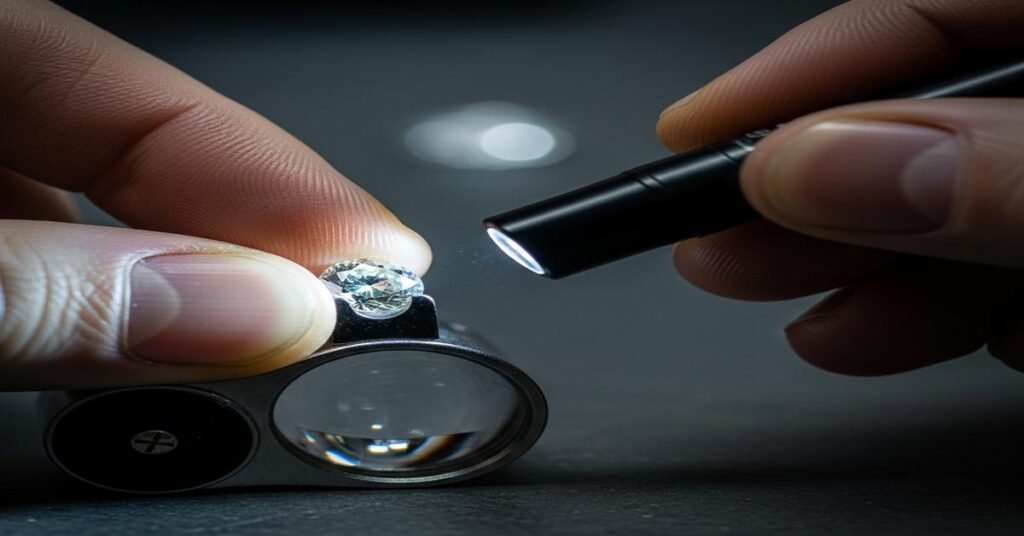
Some jewelers are being caught selling lab-grown diamonds (LGDs) as natural. The stones look the same to the eye, and standard “diamond testers” won’t protect you. The good news: you can do a simple 3-minute check at home that flags most lab-grown stones. It is not a lab-grade verdict, but it can save you from paying mined-diamond prices for a lab-grown. Below is the why, the how, and what to do next.
Why this scam happens
Price is the motive. Lab-grown diamonds typically sell for far less than mined diamonds of the same size and grade. The gap can be big. Resale values also differ. A dishonest seller can pocket the difference by calling an LGD “natural.”
Detection is the opportunity. Lab-grown and natural diamonds are both real diamond, so casual tests don’t help. A thermal “diamond tester” only checks if the stone is diamond, not how it formed. That makes the swap tempting for bad actors.
What actually differs between natural and lab-grown
Both are pure carbon in a diamond lattice. The differences come from growth conditions:
- Impurities: Natural diamonds usually have nitrogen. Many lab-grown have little or none. This affects how they react to UV light and electricity.
- Growth signs: High Pressure High Temperature (HPHT) growth can leave tiny metallic inclusions. Chemical Vapor Deposition (CVD) growth can show certain fluorescence and afterglow (phosphorescence).
- Strain patterns: Internal crystal strain often differs between natural and CVD stones, but you need tools to see it well.
These “fingerprints” let you screen at home. They are not perfect, but they are useful.
The 3-minute home test
What you need:
- A 10x loupe (or a phone macro lens) — optional but helpful.
- A long-wave UV light (365–405 nm). A small 365 nm flashlight or a gel-nail UV lamp works.
- A strong fridge magnet (ideally a small neodymium magnet).
- White paper and a dark room.
Step 1 — Check the girdle inscription (30–60 seconds)
- Clean the stone. Under bright light, look at the thin edge (girdle) with the loupe.
- Search for laser text like “LABGROWN,” “LAB GROWN,” “CVD,” “HPHT,” or a report number that starts with a lab prefix.
Why it works: Reputable labs and many manufacturers laser-inscribe LGDs. Some inscriptions are tiny. Dishonest sellers can hide the number under a prong or polish it off, but it’s a quick, high-yield check. If it’s there, you have your answer.
Step 2 — UV fluorescence and afterglow (90 seconds)
- Dim the room. Place the diamond on white paper.
- Shine the UV light for 5–10 seconds. Observe the color and brightness of the glow.
- Switch off the UV and watch the stone for 3–5 seconds. Look for any afterglow (phosphorescence).
What to look for:
- Strong orange to red afterglow that lingers for a second or more suggests CVD lab-grown. Many natural diamonds stop glowing the instant the light goes off.
- Strong, even blue fluorescence can occur in both natural and HPHT lab-grown. Not decisive by itself.
- No fluorescence tells you little. Many natural and many lab-grown have weak or no fluorescence.
Why it works: CVD growth often leaves defects that store energy under UV and release it as an afterglow. Most natural diamonds do not show this behavior. There are rare exceptions (such as some blue natural diamonds), but those are uncommon and typically documented.
Step 3 — Magnet check for metallic inclusions (30 seconds)
- Remove the ring from your finger so your skin doesn’t affect the magnet.
- Dangle a small neodymium magnet on a thread near the stone. Bring it close to different parts of the diamond, especially near inclusions you can see with the loupe.
- Watch for a tiny, repeatable tug or swing toward the magnet.
Why it works: Some HPHT lab-grown stones trap microscopic metallic flux (iron/nickel/cobalt). That can make them weakly magnetic. Natural diamonds are usually not magnetic. This test is subtle. If you see a consistent pull, suspect HPHT lab-grown.
How to read your results
- Found a lab-grown inscription: It’s lab-grown. Stop there.
- Orange/red afterglow under UV: Likely CVD lab-grown. Get professional confirmation if you need documentation.
- Weak magnetic response: Possible HPHT lab-grown. Confirm professionally.
- No afterglow, no magnetism, no inscription: Inconclusive. Could be natural or lab-grown. Many LGDs will pass these quick screens, so do not assume it’s natural.
Important: Any single home sign can mislead. Use them together. A lab report is the final word.
Common myths that get buyers fooled
- “It passed a diamond tester, so it’s natural.” Wrong. Those devices only detect diamond vs. simulants like glass or moissanite. They cannot tell lab-grown from natural.
- “Fluorescence means fake.” False. Many natural diamonds fluoresce blue under UV. Fluorescence is a clue only when paired with afterglow color and behavior.
- “Lab-grown = fake diamond.” Not true. LGDs are real diamonds. The issue is disclosure and price, not authenticity of material.
If you’re buying soon, use these safeguards
- Ask for documentation upfront. A grading report that explicitly says “Lab-Grown” or “Natural” is standard for better stones.
- Read the invoice language. It should spell out “lab-grown” or “natural.” Vague words like “diamond” without origin are a red flag.
- Check the girdle inscription before you pay. Use the store’s loupe. Match it to the paperwork number and origin.
- Beware of price gaps that are “too good.” If a price is far below mined-diamond market levels for the same grades, ask why.
- Listen for the “we tested it” line. If they only used a thermal tester, that does not establish origin. Ask what lab graded it.
- Get a return window in writing. This gives you time to do independent screening or a lab check.
- Pay with a method that supports disputes. Credit cards offer more protection than cash or wire.
When to get professional verification
If the stone is valuable, or if your home test flags concerns, pay for professional screening. A good jeweler or appraiser can use specialized instruments (like spectrometers and UV-Vis/PL systems) that read the diamond’s defect signatures. These reveal growth method with high confidence. For important purchases, a recognized grading report that states “Lab-Grown” or “Natural” is the safest route.
Examples: putting the test to work
- Example 1: You bought a 1.50 ct “natural” at a steep discount. At home, you see a crisp orange-red afterglow under your nail UV lamp that lasts 2 seconds. No inscription. That afterglow strongly suggests CVD lab-grown. Return it or demand lab verification.
- Example 2: Your stone shows strong blue fluorescence under UV but no afterglow. The magnet does nothing. That result is common in natural diamonds but can also occur in HPHT lab-grown. Get a lab report if origin matters to you.
- Example 3: Under the loupe you find “LABGROWN” on the girdle, yet the invoice says “natural.” That’s misrepresentation. You have clear grounds to return or dispute.
Why this approach works
- It’s fast. You can do it on any mounted stone without tools that could harm the setting.
- It targets growth signals. Afterglow and magnetism come from how the diamond formed, not from surface tricks.
- It avoids false confidence. You are not relying on generic “diamond testers” that miss the real question.
Limits you should know
- Not all LGDs show afterglow or magnetism. A clean CVD stone without the right defects may look like a natural in this quick screen.
- Mountings can hide inscriptions. A prong can cover laser text, or it may have been polished off.
- Rare natural exceptions exist. A tiny fraction of natural diamonds can phosphoresce or show odd behaviors. That’s why lab confirmation matters for high-value buys.
Bottom line
Don’t pay mined-diamond prices without proof. In three minutes you can check for a lab-grown inscription, look for telltale UV afterglow, and try a magnet. These clues catch many misrepresented stones. For certainty, insist on proper paperwork or get professional screening. A little caution now prevents a costly surprise later.

I am Satyam Pandey, a gemologist with a Diploma in Polished Diamond Grading from KGK Academy, Jaipur. I love writing about jewelry, gems, and diamonds, and I share simple, honest reviews and easy buying tips on JewellersReviews.com to help you choose pieces you’ll love with confidence.