
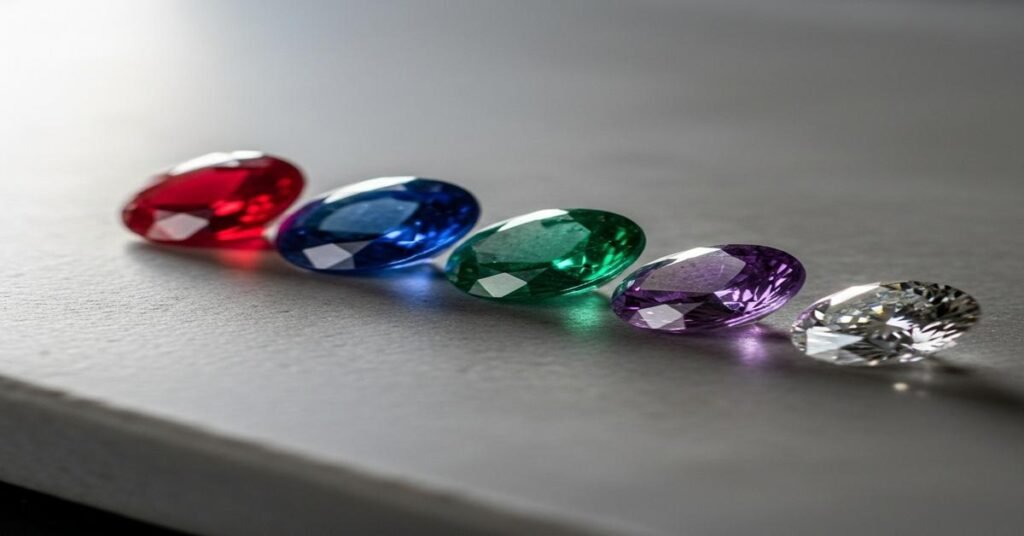
Trying to tell a real gemstone from a fake is possible at home if you know what to look for. No single home test proves authenticity, but five simple checks will catch most common fakes and tell you when to get a professional opinion. Below are easy, practical methods you can do with items from home or a low-cost jeweler’s loupe. I explain why each test works, how to do it, and what limits to expect.
1. Look closely with magnification — bubbles, inclusions, and curved lines
What to use: a 10x jeweler’s loupe (or a strong magnifying glass) and a bright lamp.
What to do: examine the stone from the top and the side. Look at facet junctions, the girdle, and the pavilion.
Why it works:
- Glass imitations often show tiny gas bubbles and curved growth lines (curved striae). Natural crystals don’t form those features.
- Lab-grown stones can have trademark growth patterns like chevrons or seed crystals. Those aren’t typical of natural stones.
- Natural gemstones usually contain mineral inclusions, tiny crystals, or “fingerprint” fluid inclusions. Those are signs of natural origin.
Examples: If a “ruby” shows many round gas bubbles or a smooth curved swirl, it’s very likely glass. A sapphire with rutile needle inclusions is probably natural.
2. The fog (breath) and thermal check — how fast it clears
What to use: your breath or a brief exhale, and time it with your phone stopwatch.
What to do: hold the stone close to your mouth and breathe on it once to fog the surface. Watch how long the condensation lasts.
Why it works: Thermal conductivity varies by mineral. Diamond conducts heat extremely well, so fog clears almost instantly (less than a second). Most imitations and common gems hold fog longer.
Limits: Some simulants like moissanite also clear quickly. Also small stones or stones mounted in metal can affect timing. Use this as a quick screen, not a final test.
Example: A real diamond usually clears instantly. Glass and cubic zirconia (CZ) generally take several seconds to clear.
3. Hardness (scratch) test — use glass and common tools carefully
What to use: a piece of window glass (about 5.5 on the Mohs scale), a steel file or a ceramic streak plate only if necessary, and a safe testing spot on the gem’s girdle or an inconspicuous area.
What to do: try to scratch the glass with the stone or gently touch the stone with the glass edge. Do not apply force to the stone’s face or value areas.
Why it works: Mohs hardness tells you what minerals can scratch others. For example:
- Diamond = 10 (will scratch everything)
- Sapphire/ruby (corundum) = 9 (will scratch glass easily)
- Quartz = 7 (scratches glass)
- Glass/CZ ≈ 5.5–8.5 (CZ ~8–8.5; glass ~5.5)
Limits and cautions: This test can damage the stone. Don’t perform it on valuable pieces. Hardness alone can’t distinguish between two minerals with similar hardness (sapphire vs spinel vs moissanite). It’s most useful to identify obvious fakes (a “diamond” that scratches easily is not a diamond).
4. Specific gravity (weight) test — kitchen scale and water displacement
What to use: a precise jewelry scale (0.01 g accuracy is best), a cup of water, fine thread or a small strong container, and a ruler or digital scale to measure.
What to do:
- Weigh the dry stone on the scale and record mass (m1 in grams).
- Tie thin thread to the stone or place it in a small container and immerse fully in water without touching the cup’s bottom. Weigh the submerged assembly and record reading (m2).
- Calculate displaced mass = m1 − m2. Specific gravity (SG) = m1 ÷ displaced mass.
Why it works: SG (density) is a reliable physical property. Examples of typical SGs:
- Diamond ≈ 3.52
- Moissanite ≈ 3.22
- Quartz ≈ 2.65
- Glass ≈ 2.4–2.8
- Cubic zirconia ≈ 5.6–6.0
Interpretation: If your “diamond” measures SG ≈ 5.9, it’s likely CZ, not diamond. If it’s ≈2.65, it may be quartz (or glass).
Limits: Small stones under 0.25 ct pick up larger measurement errors. Mounted stones must be removed. Accurate measurements require a precise scale and steady setup.
5. Light behavior and doubling — refraction, double images, and UV
What to use: a printed block of text, polarized sunglasses, and a simple UV flashlight if available.
What to do and why:
- Read-through test: Place the stone on printed text and look through it from above. Some gems (e.g., doubly refractive stones like zircon, topaz, and moissanite) will show doubled text or doubled facet edges. Single-refractive stones like diamond or garnet do not double text.
- Polarized light: Look at the stone through polarized sunglasses and rotate it. Doubly refractive stones can show changes in color or brightness as polarization shifts. This helps detect synthetics vs natural stones in some cases.
- UV fluorescence: Shine a long-wave UV light on the stone in a dark room. Many natural diamonds fluoresce blue; some synthetics or treated stones show different colors or none at all. Use this as a supportive clue, not proof.
Limits: Moissanite is doubly refractive and can mimic some optical signs. Fluorescence varies widely in both natural and synthetic gems. These tests are useful together with magnification and SG.
When to stop testing and get a professional
Home tests are great for screening. But they have limits. If you’re considering a purchase over a few hundred dollars, or the stone fails or gives mixed results, get a professional check. A qualified gemologist uses a refractometer, spectroscope, thermal/electrical testers, and can provide a lab report with carat (ct), measurements (mm), cut details, and identification.
Also seek a lab if the stone is mounted in a precious metal that should match the gem (for example, a 1 ct diamond should be set in appropriate alloy like 18K or 14K gold or platinum; suspicious settings can be a red flag).
Final tip: buy from reputable sellers, ask for documentation, and keep receipts. These five tests will spot most common scams. When in doubt, a short visit to a trusted jeweler or a gem lab will save you time and money.

I am G S Sachin, a gemologist with a Diploma in Polished Diamond Grading from KGK Academy, Jaipur. I love writing about jewelry, gems, and diamonds, and I share simple, honest reviews and easy buying tips on JewellersReviews.com to help you choose pieces you’ll love with confidence.