
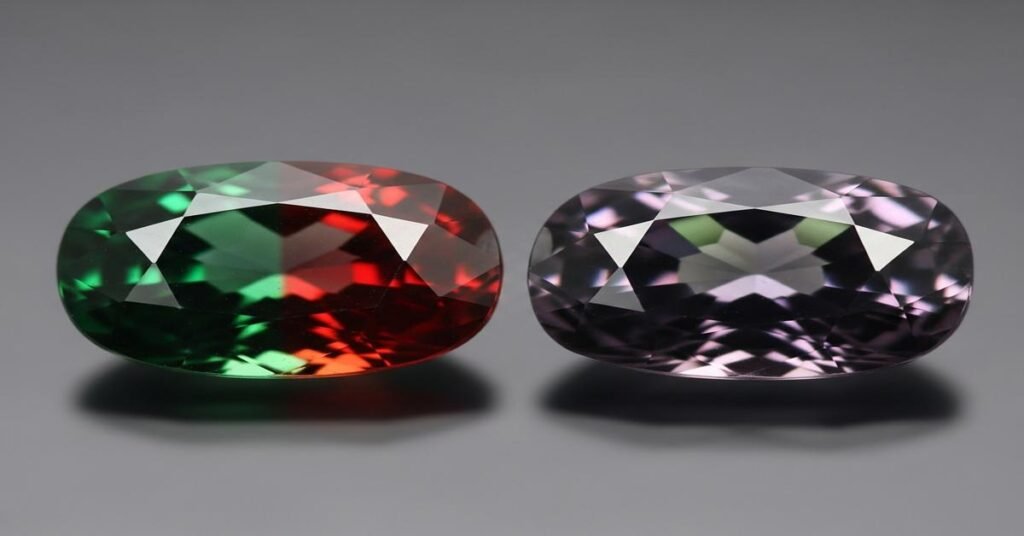
Alexandrite is famous for a dramatic color change. In daylight, it looks green. Under warm, incandescent light, it turns red. That “green to red” shift is the hallmark of the real thing. Yet many stones sold as “alexandrite” flip green to purple instead. That purple shift is a key warning sign of a common lab-grown simulant, not natural alexandrite. Here’s how to understand the difference, why it happens, and how to test a stone with simple tools.
What real alexandrite actually does
Natural alexandrite (a chromium-bearing chrysoberyl) shows a selective absorption pattern. Chromium blocks much of the yellow portion of the spectrum and lets through windows in the green and red. Daylight has a strong blue-green component, so your eye sees a bluish or yellowish green. Incandescent and candlelight are rich in red, so the stone shows a raspberry, wine, or brownish red. The shift isn’t magic; it’s the light source plus the stone’s transmission windows working together.
A few important notes:
- Real alexandrite rarely shows a pure “traffic light” emerald green or a clean lipstick red. Expect slightly mixed tones: teal or yellow-green by day; raspberry, wine, or reddish-brown by night.
- Most fine stones show a strong shift, but not 100%. Some green remains in warm light, and some red influence can appear in daylight.
- Alexandrite is strongly pleochroic. Rotate it and you may see green, orangey, and reddish directions deepen or fade. That’s normal and part of the drama.
Why many “fakes” turn green to purple
When a stone flips green to purple, you’re likely looking at a simulant rather than natural alexandrite. The usual suspects:
- Color-change sapphire (vanadium-doped corundum): often looks greenish to blue in daylight and pinkish-purple under warm light.
- Color-change spinel: commonly shifts blue to violet-purple.
- Neodymium-doped glass or synthetic materials: can swing green to purple because neodymium creates sharp absorption bands that split light into green and purple impressions.
Why purple? Purple requires both red and blue. True incandescent light has very little blue. Natural alexandrite under incandescent tends to show red because it transmits red and there isn’t enough blue to make it purple. If you see purple, either the stone is responding to residual blue (common in LEDs labeled “warm”) or the material’s chemistry favors a blue-red mix rather than a clean red. That’s typical of simulants, not classic alexandrite behavior.
Beware: lab-grown alexandrite is real—but different from simulants
There are two categories you’ll meet in the market:
- Lab-grown alexandrite (actual chrysoberyl, grown by flux or Czochralski methods). It usually shows the correct green-to-red shift and the right gem properties. It’s real alexandrite, just not natural.
- Simulants (not chrysoberyl at all): color-change sapphire, spinel, glass, YAG, etc. These often go green to purple and do not share alexandrite’s optical and physical properties.
Vendors often blur this line. If the listing says “lab alexandrite” that can be legitimate lab-grown chrysoberyl. If it says “alexandrite” with no qualifier and it’s inexpensive, it’s commonly a simulant.
How to test color change at home—properly
Most people test color change under the wrong lights and get confused. Use this simple setup:
- Daylight test: Take the stone outside in bright shade or near a north-facing window at midday. Avoid colored walls. Hold the stone over white paper.
- Incandescent test: Use a halogen desk lamp or an old-school tungsten bulb (2700–3000 K). If you only have LEDs, pick the warmest (2700 K) with high CRI. Many “warm” LEDs still have a blue spike; that can make simulants look purple.
- Observe: Does the stone go from greenish in daylight to red/raspberry/wine under the halogen? Good sign. Does it go to lavender or purple? Likely a simulant.
- Rotate it under each light. A real stone’s pleochroism will shift the strength of hues with orientation, but the overall direction (green to red) should stay obvious.
Other at-home clues that help
- Pleochroism check: Look through the stone from different angles. Natural (and lab) alexandrite is doubly refractive and strongly pleochroic. Spinel and glass are singly refractive and won’t show color directions. Sapphire is uniaxial and pleochroic, but its color directions tend to look blue/purple rather than green/red.
- Double refraction “glint”: Under a 10× loupe, look at a facet edge through the stone. In chrysoberyl, you can often catch a slight doubling of back facets. Spinel and glass do not double.
- Inclusions: Natural alexandrite often shows fine “fingerprints,” tiny crystals, and twin lamellae (fine parallel lines from chrysoberyl’s common twinning). Flux-grown lab alexandrite may show wispy, reflective flux inclusions or tiny platelets. Flame-fusion corundum shows curved color bands and gas bubbles. Glass shows round bubbles and swirled flow lines.
- Weight in hand: Specific gravity differs. Chrysoberyl (~3.70–3.78) feels a bit heavier than spinel (~3.60) and much heavier than most glass (~2.5). Not definitive, but you notice it in larger stones.
Professional tests that settle it
If money is at stake, get a gemologist to test with instruments:
- Refractive index (RI): Alexandrite ~1.746–1.755 with birefringence ~0.008–0.010. Sapphire is ~1.762–1.770 (uniaxial), spinel ~1.718 (singly refractive), common glass ~1.50–1.70.
- Spectroscope: Alexandrite shows chromium features, including a pair of lines in the deep red and broad absorption in the yellow. Vanadium sapphire and neodymium glass show different line sets. This is one of the most telling tests for color-change materials.
- Polariscope: Confirms double refraction for chrysoberyl versus single for spinel/glass.
- Microscopy: Inclusion types and growth features can distinguish natural from lab-grown alexandrite, and both from simulants.
Common scenarios and what they mean
- Looks sea-green in daylight, lavender under a “warm” LED bulb: Likely a simulant or color-change sapphire. Re-test under halogen. If it remains purple, not natural alexandrite behavior.
- Looks olive-green by day, brownish-red under halogen: That’s consistent with many natural alexandrites (especially those with some iron content). Not glamorous, but authentic behavior.
- Looks bright blue by day, hot pink under warm light: Common for flame-fusion color-change sapphire; not alexandrite.
- Strong green-to-red but price is suspiciously low for the size: Could be lab-grown alexandrite (real but man-made). Check inclusions and RI. Natural stones with strong change command high prices.
Price reality check
Price is a practical filter:
- Natural alexandrite: Very expensive per carat, especially above 0.5 ct with strong change and good clarity. Clean stones over 1 ct with vivid change can outprice fine sapphire and ruby.
- Lab-grown alexandrite: A fraction of natural pricing, but still priced as a genuine gem species. Usually presented as “lab-grown” or “synthetic alexandrite.”
- Simulants (color-change sapphire/spinel/glass): Inexpensive, often sold in larger sizes, and frequently labeled just “alexandrite” by non-specialist sellers.
A quick decision checklist
- Color path: Green to red/raspberry = alexandrite behavior. Green to purple = likely simulant.
- Lighting control: Verify with real halogen/tungsten and daylight. Don’t rely on phone flash or “warm” LEDs alone.
- Pleochroism: Strong in alexandrite. Weak or absent in glass/spinel; different pattern in sapphire.
- Inclusions: Natural fingerprints and twinning vs. curved bands/bubbles (simulants) or flux features (lab-grown alexandrite).
- Disclosure and price: If it’s cheap and big, assume simulant unless proven otherwise. If it’s affordable yet shows correct behavior, it may be lab-grown alexandrite.
Why this distinction matters
Natural alexandrite is rare. Its color change is a precise interaction between chromium in chrysoberyl and the spectrum of the light source. The common “green to purple” flip tells you the chemistry and optics are different—usually vanadium in sapphire, neodymium in glass, or other recipes intended to impress under mixed or LED lighting. Understanding the why behind the color lets you test stones confidently and avoid costly mistakes.
Bottom line: if your stone truly travels from green in daylight to red or raspberry under halogen, you’re seeing alexandrite behavior. If it heads into purple, be skeptical. Confirm with proper lighting, then—if the value warrants it—have a gemologist check RI, spectrum, and inclusions. That combination removes doubt.

I am Satyam Pandey, a gemologist with a Diploma in Polished Diamond Grading from KGK Academy, Jaipur. I love writing about jewelry, gems, and diamonds, and I share simple, honest reviews and easy buying tips on JewellersReviews.com to help you choose pieces you’ll love with confidence.