
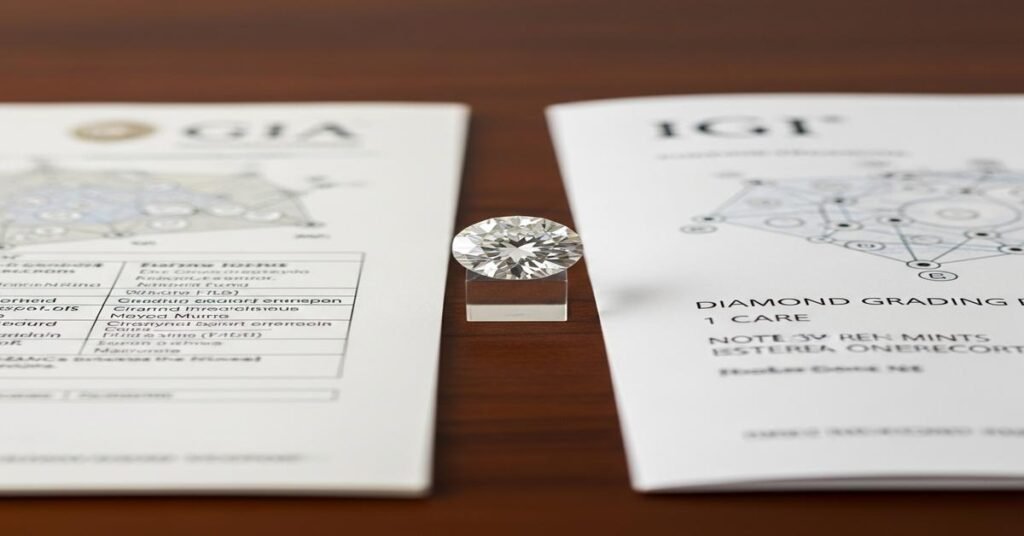
Your diamond’s certificate is not just paperwork. It sets the price you pay and the resale value you can expect. The uncomfortable truth: the same stone can wear different “grades” depending on who graded it, and that grade can inflate the price by thousands. Jewelers rarely explain this because softer grading makes inventory look better on paper. Here’s what really happens with GIA vs. IGI certificates, why the differences matter, and how to protect yourself.
What a Diamond Certificate Is (And Isn’t)
A lab report is an expert opinion on a stone’s 4Cs and some measurements. It is not a guarantee, not a quality seal, and not an appraisal. Two labs can look at the same diamond and assign different grades because grading involves human judgment and tolerance. Small shifts—half a grade in color or clarity—are common.
This matters because price moves in steps. A diamond that “makes” G color over H, or VS2 over SI1, jumps into a pricier bucket. If the grade is optimistic, the seller uses the higher bucket to set the price. You pay for quality you may not truly have.
GIA vs. IGI at a Glance: Where Grades Diverge
GIA built its reputation on tighter, more consistent grading of natural diamonds. The trade tends to treat GIA as the reference scale. IGI grades a huge volume of both natural and lab-grown diamonds and is widely accepted in retail. In practice, many dealers see IGI run slightly “softer” on natural diamond color and clarity on average.
- Color: IGI color on natural stones often trends about a half-grade to a full grade higher than GIA would assign. Example: an IGI “G” that GIA might call “H.” The gap isn’t guaranteed, but it shows up often enough that the trade prices for it.
- Clarity: Differences are most noticeable around SI1/SI2/I1, where inclusion type and visibility are subjective. An IGI SI1 can be a GIA SI2. That single step alters price and eye-cleanliness.
- Cut: Both labs use “Excellent/Ideal” tiers, but the proportion windows IGI allows for top cut grades can be broader. Stones that are too deep or with steeper angles sometimes still earn IGI Excellent. With GIA, those same proportions might drop to Very Good. Cut affects sparkle more than any other C.
- Consistency: GIA reports typically show tighter repeatability across offices. IGI has improved, especially for lab-grown, but variability remains more common across locations and timeframes for natural stones.
None of this means “IGI is wrong” or “GIA is perfect.” It means that if a diamond was graded by a lab with looser tolerance, you should price it as if it might grade lower elsewhere.
How a Softer Grade Inflates Price
Price is built on grade buckets. Change the grade, change the bucket.
- Example 1: 1.00 ct round, IGI G VS2, Excellent cut. If that stone earns GIA H SI1, the market value often drops 10–20% because both color and clarity step down. On a $8,000 diamond, that could be $800–$1,600.
- Example 2: 2.00 ct round, IGI H SI1, Excellent. If GIA calls it I SI2, the discount can stretch to 15–25% at this size. That’s several thousand dollars.
- Cut spread: An IGI Excellent that GIA would call Very Good trades for less because light return and fire are weaker. You pay the “Excellent” price but get “Very Good” performance.
Retailers rarely mention this because the certificate is their pricing engine. A softer lab makes inventory look like higher color, higher clarity, and top cut—on paper—supporting a higher ticket.
Special Case: Lab-Grown Diamonds
IGI dominates lab-grown grading volume. GIA also issues full reports on lab-grown stones now. For lab-grown:
- Grade alignment: IGI and GIA are closer for lab-grown than for natural, but spreads still happen. Always check the stone, not just the paper.
- Treatments and growth method: Watch the report comments for HPHT vs. CVD growth and any post-growth treatments. CVD stones with post-growth HPHT may show improved color but can have strain or graining visible under magnification.
- Resale reality: Lab-grown prices fall rapidly. The certificate helps you compare options, but it does not protect resale value. Prioritize cut and appearance you can see today, and pay a price that reflects steep depreciation.
The Sales Tactics You’ll See (And Why)
- “Certified by a top lab.” Sounds safe, but “top” is doing the heavy lifting. If grading is softer, the stone looks better on paper and commands a higher price.
- “Apples to apples.” Sellers steer you to compare only by the 4Cs printed on the cert. This hides differences in grading standards and cut precision.
- Trade-up policies. Generous upgrades can be funded by higher initial margins on softer-graded stones. You’re paying for the perk up front.
- Magic weights. 1.00 ct, 1.50 ct, 2.00 ct jumps add big premiums. Softer grading at these weights is common because the price jump is juicy.
- Fluorescence downplay. Medium/Strong blue can be great, neutral, or problematic depending on the diamond. If it’s ignored in the pitch, ask why.
How to Protect Yourself
- For natural diamonds, prefer GIA when possible. It’s the market baseline for grading precision. You pay for what the market recognizes.
- If you’re considering IGI for natural, demand a discount. On average, price it as if the stone could be a half to a full grade lower in color or clarity. As a rule of thumb, negotiate 5–15% off comparable GIA pricing, more if the stone sits at a magic weight or shows borderline cut.
- Focus on cut beyond the label. Ask for crown and pavilion angles, not just “Excellent.” Typical strong-performing rounds: table ~54–58%, depth ~60–62.3%, crown angle ~34–35°, pavilion angle ~40.6–40.9°, thin–medium girdle. If numbers push beyond those ranges, be skeptical of an “Excellent” label.
- Inspect clarity for function, not just grade. Ask: Is it eye-clean at 6–8 inches? Are inclusions black or white? Center or near the edge? “Clarity grade based on clouds not shown” can mean hazy brilliance—proceed carefully.
- Handle fluorescence smartly. Faint to Medium is usually fine. Strong blue can be a bargain or a problem. View under daylight and jewelers’ lights. If the stone looks oily or hazy, walk away.
- Use an independent return window. Buy only with a clear return period. If in doubt, recheck with a trusted appraiser or submit to GIA for verification when the stakes are high.
- Compare by the face-up view, not just paper. Two “1.00 ct” stones can face up differently. Check millimeter measurements; a deep stone can look smaller.
- Ask for images. Hearts-and-Arrows images, Idealscope/ASET, or at least high-res videos show whether the cut is truly bright and even.
Quick Report-Reading Checklist
- Measurements and weight: For a 1.00 ct round, ~6.4–6.5 mm diameter is typical. If it’s 6.2 mm, it’s deep; if 6.6 mm, it may be shallow.
- Cut grade (rounds): GIA’s cut grade is stricter. If IGI says Excellent, verify proportions; don’t assume it matches GIA Excellent performance.
- Polish/Symmetry: Aim for Excellent/Excellent or Very Good/Excellent. Lower can hide faceting issues.
- Girdle: Thin–Medium or Medium–Slightly Thick is safe. Extremely Thin risks chipping; Extremely Thick hides weight.
- Fluorescence: Note the intensity and check how it looks in daylight.
- Comments line: Flags like “Clarity grade based on clouds not shown,” “Internal graining,” or “Surface graining” can affect transparency and sparkle.
- Inclusion plot: Black crystals or large feathers near the edge can be risky. Needles, clouds, and pinpoints vary—judge by visibility.
- Color range cues: Borderline colors near a grade boundary (G/H, H/I) are common. Price as if it could slip a grade.
When IGI Can Make Sense
- Budget-first natural diamond: An IGI stone that is clearly bright, faces up well, and is eye-clean can be good value—if priced below equivalent GIA and verified by your own inspection.
- Lab-grown stones: IGI is widely accepted. Compare cut quality and eye appeal across multiple stones and keep price discipline because lab-grown depreciates quickly.
- Fashion settings or smaller sizes: Slight grading leniency is less visible in sub-0.75 ct stones. Still, negotiate on price.
What Jewelers Won’t Tell You
- Grade arbitrage is a business model. Moving stones to a softer lab can bump grades and margins without changing the diamond.
- “Excellent” isn’t one-size-fits-all. Cut labels travel across wide proportion windows. You must check angles and the actual look.
- Return policies are your leverage. Many stores count on you not using them. Use them—compare stones side-by-side in different lights.
Bottom Line
Certificates drive diamond prices, but they’re opinions with tolerances. For natural diamonds, GIA usually provides the tightest baseline the market trusts. IGI stones can be fine, but many are priced as if their optimistic grades were certain. That’s where you overpay.
Buy the diamond, not the paper. Verify cut with proportions and images. Judge clarity by what your eye sees. Treat color near grade boundaries with caution. And if the certificate isn’t the strictest, make sure the price isn’t either.

I am Satyam Pandey, a gemologist with a Diploma in Polished Diamond Grading from KGK Academy, Jaipur. I love writing about jewelry, gems, and diamonds, and I share simple, honest reviews and easy buying tips on JewellersReviews.com to help you choose pieces you’ll love with confidence.