
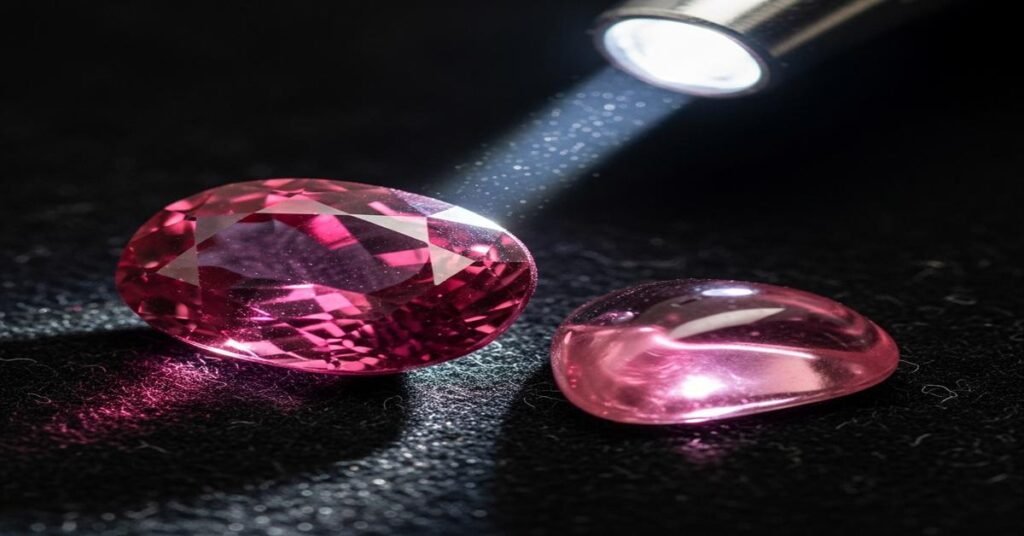
Dealers sometimes sell pink glass as “rhodolite” garnet. It looks right at a glance: bright raspberry color, clean clarity, a nice cut. But real rhodolite is a natural garnet. It has specific optical and physical traits that glass can’t copy. You can spot many fakes at home with a loupe and a few simple checks. One of the fastest checks is for “double refraction.” If you see it clearly, the stone is not a garnet. Then use a few follow-up tests to separate genuine garnet from pink glass.
What real rhodolite garnet is
Rhodolite is a natural mix of the pyrope and almandine garnet species. It is usually pinkish to purplish red, often with a slight violet overtone. Typical traits:
- Optics: Garnet is singly refractive (isotropic). That means it does not split light into two rays. You should not see strong double images of facet edges.
- Refractive index (RI): About 1.74–1.78. This is higher than common glass.
- Specific gravity (SG): About 3.8–4.0. Rhodolite feels “heavy for its size.”
- Hardness: ~7–7.5 on Mohs. Facet edges hold up better than glass in normal wear.
- Pleochroism: None. Garnet’s color does not change when viewed from different directions.
Those values matter because they come from the crystal structure and chemistry. Glass is amorphous (no crystal structure), has lower RI and SG, and wears differently.
Why glass gets sold as “rhodolite”
Pink or raspberry-colored glass is cheap to make and can be cut clean and bright. Sellers use the name “rhodolite” because it is familiar and sells well. The color match can be persuasive in photos. But glass lacks garnet’s weight, optical behavior, and wear resistance. You can use those differences to your advantage.
What “double refraction” really is
Some gemstones split light into two rays. This is called double refraction (birefringence). When it’s strong, you can see doubled facet edges if you look through the stone with a loupe. Examples: zircon and calcite show obvious doubling; tourmaline and sapphire show weaker doubling.
Garnet does not do this. It is singly refractive. If you see clear, consistent doubling through a “rhodolite,” it is not garnet. It might be zircon, tourmaline, sapphire, or an assembled imitation. Note: glass is also singly refractive, so lack of doubling does not prove a stone is garnet. It only helps you expose wrong labels.
One wrinkle: garnets can show weak, patchy “anomalous double refraction” due to internal strain. It looks faint and uneven, not the clean, uniform doubling you see in zircon.
How to check for double refraction at home
You have two easy methods: the loupe test for doubled facets and a DIY polariscope. You don’t need special gem equipment.
1) Loupe check: doubled facet edges
- Use a 10× loupe and a strong light. Hold the stone crown-up (table facing you).
- Look through the table at the rear facet edges. Slowly rotate the stone.
- What you’re looking for: Do the back facet edges look doubled, like a faint shadow line right next to the real edge? Is it consistent across the view?
- Result: Strong, clean doubling = the stone is not garnet. No clear doubling = could be garnet or glass (move on to the next steps).
2) DIY polariscope
A polariscope reveals whether a stone is singly or doubly refractive by how it transmits polarized light.
- Get two polarized lenses (two pairs of polarized sunglasses work). Put one lens on a flashlight or a phone screen as the light source. Hold the second lens in front, at 90° to the first, so they cross and turn the view dark.
- Place the stone between the two lenses.
- Rotate the stone slowly through a full turn.
- Result:
- Stays dark in all positions = singly refractive (like garnet or glass).
- Blinks light/dark as you rotate = doubly refractive (not garnet).
- Patchy, weak light leakage in spots = possible strain (anomalous) but still likely a singly refractive stone.
This test is useful to quickly catch mislabels. If someone sold you “rhodolite” but it blinks strongly, it’s not a garnet.
Separating garnet from pink glass at home
Because both garnet and glass are singly refractive, double refraction tests won’t split them. Use several simple checks together. Each check has a reason behind it; the combination gives you confidence.
1) Heft (specific gravity) check
- Why it works: Garnet’s SG is ~3.8–4.0; glass is ~2.4–2.8. Same size, garnet feels much heavier.
- Hold two stones of similar size (or a coin and the stone). If the “rhodolite” feels surprisingly light for its size, suspect glass.
- For better accuracy, do a simple hydrostatic weigh if you have a kitchen scale:
- Weigh the stone in air (grams).
- Hang it from thread and weigh it submerged in water (grams).
- SG = weight in air / (weight in air − weight in water).
- Near 4.0 suggests garnet. Near 2.5 suggests glass.
2) Loupe check: inclusions and facet wear
- Why it works: Natural garnets form crystals and pick up mineral inclusions; glass traps gas bubbles and shows flow lines.
- Under 10×:
- Glass tells: perfectly round gas bubbles, “swirl” or flow lines, mold marks, soft or smeared facet junctions, tiny pits from wear.
- Garnet tells: small crystal inclusions (often angular), needles, “fingerprint” patterns, crisp facet edges. Demantoid garnet can show “horsetail” inclusions, but rhodolite usually shows finer crystals/needles.
3) Edge durability
- Why it works: Garnet (7–7.5) resists abrasion. Common glass (~5.5) dulls fast.
- Check used pieces. Rounded, frosted facet edges and a general “orange peel” texture point to glass. Sharp edges and tidy polish favor garnet.
- A scratch test is risky and can damage the stone; use visual clues instead.
4) “Dot” and readability test (quick RI clue)
- Why it works: Higher RI bends light more and hides details beneath the stone.
- Place the stone table-down on a small printed dot or fine text. Look from above through the pavilion:
- If the dot/text is clear and sharp, RI is likely low (glass).
- If it’s blurred or hard to see, a higher RI (like garnet) is more likely.
- This is a quick hint, not a lab measurement. Facet design can affect the result.
5) UV light response
- Why it works: Many glasses contain activators that fluoresce under UV; most rhodolite garnets are inert or very weak.
- Shine a cheap longwave UV flashlight:
- Strong neon-like glow (often blue, green) suggests glass.
- No reaction or a very weak, patchy response favors garnet.
- Not definitive—some glasses are inert and some garnets can react faintly.
6) Magnet curiosity check
- Why it works: Many garnets contain iron and are weakly magnetic. Glass rarely is.
- Use a strong neodymium magnet. Suspend the loose stone from a light thread. Bring the magnet near.
- A slight deflection suggests garnet. No movement suggests glass. This effect is subtle; don’t rely on it alone.
Interpreting your results
- Clear double refraction seen: The stone is not a garnet. Your “rhodolite” is misrepresented.
- No double refraction: Could be garnet or glass. Check weight, inclusions, edge wear, and UV. Two or more consistent signs carry more weight than one.
- Heavy feel + crisp edges + natural inclusions: Likely natural garnet.
- Light feel + round bubbles/flow lines + quick edge wear: Likely glass.
Common pitfalls to avoid
- Relying on color alone: Glass can copy rhodolite’s hue. Real ID depends on optics and density.
- Overreading “anomalous” effects: Faint, patchy light under a polariscope can happen in garnet and even in stressed glass. Look for strong, repeatable signals.
- Destructive tests: Don’t scratch or file a mounted stone. You can learn more with a loupe and patience.
- Settings can mislead: A real gold setting does not guarantee a real stone. Always check the gem itself.
When to get a professional opinion
If the stone is valuable, mounted, or your results conflict, a gem lab can confirm identity. A refractometer reading, a proper polariscope test, and spectroscopy resolve borderline cases. This matters if you plan to sell, insure, or appraise the piece.
Quick checklist you can save
- Loupe the back facets for doubling. Strong doubling = not garnet.
- Heft test. Garnet feels heavy for its size; glass feels light.
- Loupe inclusions. Bubbles/flow lines = glass; tiny crystals/needles = garnet.
- Edge wear. Rounded, frosted edges = glass; crisp edges = garnet.
- UV light. Strong glow suggests glass; inert suggests garnet.
- Optional magnet. Slight deflection supports garnet.
The bottom line: Use double refraction to rule out mislabeled “garnets” fast. Then combine weight, inclusions, and wear clues to separate real rhodolite from pink glass. None of these checks is hard, and together they make you very hard to fool.

I am Satyam Pandey, a gemologist with a Diploma in Polished Diamond Grading from KGK Academy, Jaipur. I love writing about jewelry, gems, and diamonds, and I share simple, honest reviews and easy buying tips on JewellersReviews.com to help you choose pieces you’ll love with confidence.