
Black pearls are beautiful—and confusing. Many strands sold as “Tahitian” are actually inexpensive, dyed freshwater pearls. The price looks great, the color looks dramatic, and the description sounds exotic. But the chemistry of dyeing leaves clues. If you know where to look, you can spot dye concentration and avoid paying a premium for the wrong thing.
Why so many “Tahitian” pearls are really dyed freshwater
True Tahitian pearls come from the black-lipped oyster in French Polynesia. They are saltwater, bead-nucleated, and naturally dark. They cost more to farm and sort. Dyed freshwater pearls come from mussels, are mass-produced, and start out white or pale. Dyeing them black is cheap and fast.
Sellers use “Tahitian” because consumers associate it with luxury and natural black color. Many buyers don’t know the differences in structure, overtone, or drill-hole clues. That gap creates room for mislabeling—sometimes out of ignorance, sometimes not.
What real Tahitian pearls look like
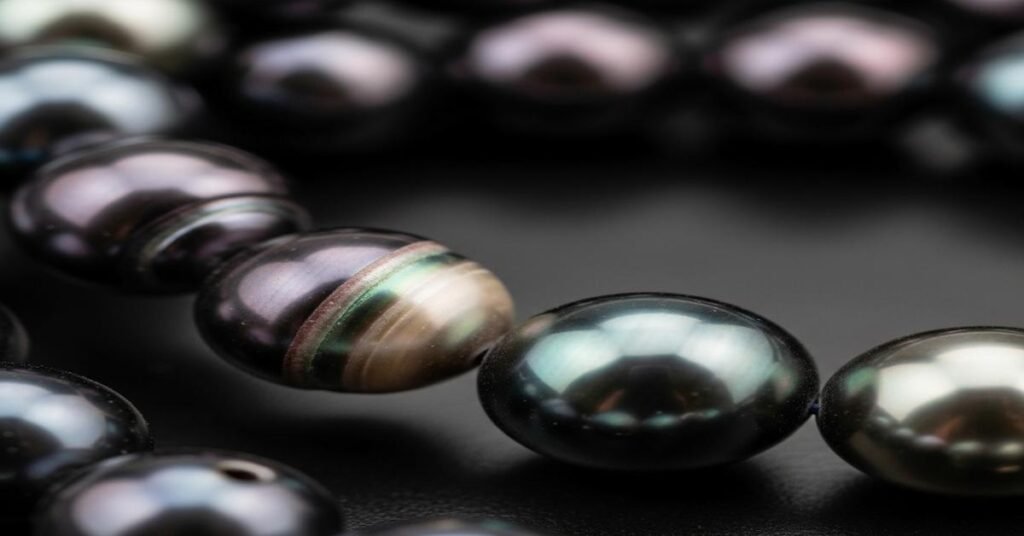
Real Tahitian pearls rarely look like uniform, pitch-black marbles. Their beauty comes from complex layers of color and crisp reflections.
- Body color: Usually charcoal to medium grey, not ink-black. The “black” is more of a dark grey base.
- Overtones: Green, peacock (green with pink), aubergine (eggplant), or silver. These overtones shift with light. That complexity is hard to fake.
- Luster: High, with sharp, mirror-like reflections. You should see crisp edges of reflected objects.
- Size and shape: Commonly 8–14 mm. Perfectly round is rarer and expensive. Drops, ovals, baroques, and circled (“ringed”) shapes are common.
- Structure: Bead-nucleated—thin to medium layer of dark nacre around a white shell bead. This matters for the drill-hole test.
Why this matters: when pearls are naturally dark, you get depth and “oil-slick” nuance from layered nacre, not a flat coat of color. Dyed pearls tend to look uniform and inky.
How to spot dye concentration: a step-by-step inspection
Use bright white light and a 10× loupe if you have one. Take the strand near a window and then into warm indoor light. Look carefully at these points:
- Drill hole “bull’s-eye”: Gently spread the pearls at a hole and look inside. In dyed freshwater pearls, the dye penetrates unevenly. You will often see a darker ring around the outer edge of the hole with a paler center. It looks like a gradient, not a clean boundary. That gradient is dye concentration.
- Contrast this with real Tahitian: You’ll see a thin dark nacre ring and then a distinct white bead core. The transition looks like a sharp circle—dark shell around a white center—rather than a fuzzy gradient of the same material. If you see a crisp white bead core, you’re looking at a saltwater bead-nucleated pearl, consistent with Tahitian (or a treated saltwater pearl, which is less common for Tahitian).
- Dark halos at the hole and knots: On dyed strands, the silk near the holes may be stained; the entry point can have a dark “ink halo.” Natural-color Tahitian pearls usually don’t stain the thread.
- Pooling in blemishes: Inspect pits, wrinkles, or growth lines. Dye often settles into low spots, creating tiny, overly dark pools or lines. It looks like mascara collecting in a crease.
- Monotone crowns: Rotate each pearl. Natural Tahitian overtones shift around the “crown” of the pearl. Dyed pearls often look the same from every angle—flat and uniform—because the color sits evenly on or near the surface.
- Uneven internal blotches: Under magnification, dyed freshwater pearls can show cloudy, patchy color just beneath the surface. Natural-color Tahitian nacre tends to be more even, with depth rather than blotchiness.
Why these signs appear: dye molecules travel along microscopic pathways and concentrate where the structure allows. That creates rings, halos, and blotches. Natural color develops during nacre formation, so it looks layered, not “soaked in.”
Other red flags that scream “dyed freshwater”
- Too black, too uniform: A strand of identical, midnight-black pearls with no overtone variance is a classic dye job. Real Tahitian strands show subtle differences from pearl to pearl.
- Perfect rounds at a suspicious price: Round Tahitians with high luster and clean surfaces are costly. If a 10–12 mm strand of “Tahitian” rounds is cheap, assume dyed freshwater or dyed Akoya.
- No overtones: If the pearls stay flat black under window light and warm indoor light, overtones are likely absent. Natural Tahitians change character as light changes.
- Color uniform through the hole without a white bead core: Freshwater pearls are solid nacre. If the hole shows nacre all the way through with no crisp white center and the color is black, that’s consistent with dyed freshwater.
- Stained silk or clasp components: Dye can migrate, especially on budget strands.
- Size pattern off for the price: True Tahitian strands in 9–11 mm with strong luster almost never sell for bargain prices from reputable sources.
Quick at-home comparisons vs real Tahitian
- Daylight vs. warm light test: Take the pearls outside in shade, then under warm indoor bulbs. Tahitian overtones (green, pink, silver) should rise and fall. Dyed pearls usually look the same—black in both scenarios.
- Reflection sharpness: Hold the pearl near a window frame. Tahitians often show a crisp, mirror-like reflection. Dyed freshwater pearls can have a slightly hazy sheen, especially on cheaper lots.
- Strand matching: Natural-color Tahitian strands show natural range: a few slightly lighter or greener pearls among greyer ones. Dyed strands look eerily consistent.
- Shape mix: A strand of perfect, identical rounds labeled “Tahitian” is suspect. Real strands mix rounds with near-rounds, ovals, or a few circled pearls unless you’re paying a premium.
Note: rubbing with solvents can damage pearls. Skip “wipe tests” and focus on optical and structural clues.
Price and paperwork reality check
Price supports identification. True Tahitian pearls—especially round, high-luster, well-matched—carry significant cost. A big, uniform black strand described as “Tahitian” but priced like entry-level freshwater is almost certainly dyed.
- Ask direct questions:
- Is the color natural or treated?
- What is the species and origin? (Tahitian = black-lipped oyster, French Polynesia.)
- Is the pearl bead-nucleated? (Tahitian should be.)
- Can I see a close photo of the drill hole?
- Is there a lab report or written disclosure?
- Look for disclosure: Ethical sellers state “dyed freshwater” or “color-enhanced.” Lack of disclosure is a red flag.
- Check return policy: If a seller resists returns, be cautious.
Why this works: mislabeling tends to hide behind vague language. Specific questions force clarity. The drill-hole photo request alone filters out most misrepresentations.
When the drill-hole test gets tricky
There are edge cases. Some saltwater pearls (like Akoya) are dyed black. These will also show a white bead core, just like Tahitian, but the overtone pattern often looks different—more metallic, less layered—and sizes are typically smaller. In tough cases, you need combined evidence: overtone behavior, size/shape norms, price, and seller disclosure. Lab testing (X-ray) is definitive because it shows the nucleus type.
What to buy instead (honest options)
- Natural-color Tahitian: Costs more, but you get real overtone depth and long-term value.
- Dyed freshwater, clearly disclosed: Fine if you like the look and price, as long as it’s not sold as “Tahitian.” Ask for good luster and clean surface.
- Dark “peacock” freshwater (undisclosed dye is common): If buying, assume treatment unless proven otherwise.
The goal isn’t to shame dyed pearls—they can be pretty. The goal is to pay the right price for what you’re getting.
A short, practical inspection checklist
- Look for overtone complexity in multiple lights. Flat black is a warning.
- Use a loupe to examine the drill hole:
- Dyed freshwater: dark ring fading to lighter nacre, no crisp white bead core.
- Real Tahitian: thin dark nacre ring, distinct white bead core.
- Check for dye pooling in pits, halos at holes, and stained thread.
- Assess matching: perfect uniformity at a low price is suspect.
- Confirm size and shapes fit Tahitian norms. Lots of perfect rounds for cheap? Walk away.
- Ask for disclosure and be ready to pass if answers are vague.
Bottom line
If your “Tahitian” pearl is an even, pitch-black freshwater pearl, you’re probably looking at dye—especially if the drill hole shows a dark ring with a lighter center and no white bead core. Real Tahitians have layered color, crisp reflections, and a saltwater structure you can see at the hole. Learn the dye-concentration clues and you’ll spot the difference quickly, save money, and buy with confidence.

I am Satyam Pandey, a gemologist with a Diploma in Polished Diamond Grading from KGK Academy, Jaipur. I love writing about jewelry, gems, and diamonds, and I share simple, honest reviews and easy buying tips on JewellersReviews.com to help you choose pieces you’ll love with confidence.