
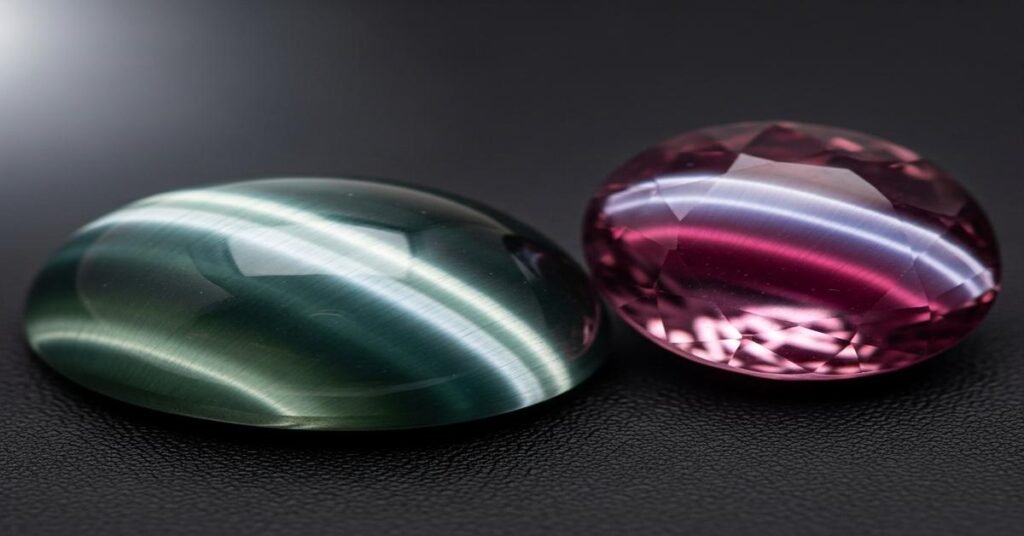
Cat’s eye alexandrite sits in the “almost mythical” tier of gemstones. It combines two rare effects—color change and chatoyancy—inside the same crystal. That rarity has sparked a wave of imitations and lab-grown substitutes. If you collect or buy jewelry, you need to know how to tell a true natural cat’s eye alexandrite from the growing number of fakes. The steps below explain not just what to look for, but why each clue matters.
What “cat’s eye alexandrite” really is
Alexandrite is the chromium-bearing variety of chrysoberyl (chemical formula BeAl2O4) that changes color from greenish in daylight to reddish in warm light. A “cat’s eye” is a cabochon that shows a sharp, moving line of reflected light (chatoyancy) caused by aligned, needle-like or tubular inclusions. A cat’s eye alexandrite is chrysoberyl that shows both effects: color change and chatoyancy.
Why this matters: most “cat’s eye” stones are chrysoberyl without color change, or quartz. Most “alexandrite” stones are faceted and do not show the cat’s eye. The overlap—true alexandrite with a strong, single eye—is extraordinarily rare. Rarity affects price and the kinds of inclusions and optical behavior you should expect to see.
How fakes are made today
You’ll see two broad categories on the market:
- Imitations (simulants): materials that only mimic the look. Common examples:
- Fiber-optic (cat’s eye) glass: a bundle of glass fibers fused into a cabochon. It shows a bright, perfect line but usually no natural inclusions and often a dramatic purple-to-green shift from neodymium doping.
- Cat’s eye quartz or scapolite: can show chatoyancy but do not match alexandrite colors or refractive properties.
- Color-change glass or synthetic spinel: shifts color using rare-earth elements (like neodymium), not chromium.
- Assembled doublets/triplets: a thin slice of color-change material over a cat’s eye base, joined with adhesive.
- Lab-grown (synthetic) stones: crystals grown by flux or hydrothermal methods that are the same species as the natural. Examples:
- Flux-grown alexandrite: can show color change and sometimes chatoyancy if needle-like inclusions are present. Often has “flux fingerprint” inclusions unlike natural.
- Synthetic corundum (sapphire) with color change and a cat’s eye: not chrysoberyl at all, but sometimes sold as “alexandrite.”
Why this matters: each category leaves telltale optical and inclusion signatures you can detect with simple tools.
Quick reality checks before you reach for tools
- Price vs. size: Fine natural cat’s eye alexandrite above 1–2 carats with strong color change is very expensive. A 5–10 ct “perfect” stone at a bargain price is almost certainly an imitation.
- Setting: Extremely rare stones are rarely set in low-cost, mass-market silver mounts with generic certificates. Not definitive, but a red flag.
- Uniform perfection: A mathematically straight, glaring eye with no internal features under 10× magnification points to fiber-optic glass.
At-home observations: what to check and why
You can learn a lot using only a penlight, window light, and a 10× loupe.
- Color change in two lights: View at a window (daylight or cool LED) and then under a warm incandescent or candlelight.
- Natural alexandrite: green to greenish-blue in cool light; red to purplish-red in warm light. The change is due to chromium absorbing in the yellow region, so the stone passes either the green or red ends depending on the light’s spectrum.
- Neodymium-doped glass: often flips purple to green with a “stagey” look and can show narrow, unnatural color bands. The shift can be very strong even in poor lighting because rare-earth absorption lines are intense and narrow.
- Quartz/scapolite: usually shows little to no true alexandrite-type change.
- The cat’s eye itself: Darken the room, use a pinpoint light, and sweep the beam.
- Natural chrysoberyl: a single, sharp line that glides across the dome; at 90° the stone shows a “milk-and-honey” split—one side bright, the other dark. High refractive index (about 1.75) and dense, parallel inclusions create this crisp contrast.
- Quartz: typically a softer, fuzzier eye because quartz has a lower R.I. (~1.54), giving weaker contrast.
- Fiber-optic glass: a laser-straight, almost neon eye that can look too perfect. You may see multiple eyes or an eye that does not “open and close” cleanly when you tilt the stone.
- Loupe clues (10×):
- Natural alexandrite/chrysoberyl: fine, parallel tubes or needles; “fingerprint” fluid inclusions; and sometimes thin, straight twin lamellae (“Brazil twinning”). The eye is aligned with the direction of the tubes.
- Flux-grown synthetic alexandrite: wispy, curving “flux veils,” snowball-like aggregates, or reflective platelets. These do not mimic the clean, straight twin lamellae seen in natural stones.
- Synthetic corundum: curved growth lines or curved color bands—corundum grows in a way that commonly produces curved striae under magnification.
- Glass: round gas bubbles, flow lines, and no crystalline grain. In fiber-optic material, you’ll see a comb of tight, parallel fibers.
- Assembled stones: a planar junction line between layers, often with trapped dust or tiny bubbles along the glue line.
Instrument tests that settle the question
These are non-destructive and affordable at a gem club or jeweler.
- Refractive Index (R.I.) and birefringence:
- Chrysoberyl: R.I. ~1.746–1.755, birefringence 0.008–0.010 (doubly refractive, biaxial +). A spot reading near 1.75 is a strong indicator.
- Corundum: R.I. ~1.762–1.770. If you get ~1.77 with minimal birefringence, think sapphire, not chrysoberyl.
- Spinel: ~1.718 and singly refractive.
- Quartz: ~1.544–1.553.
- Glass: ~1.50–1.70 but singly refractive and often shows a diffuse shadow edge.
Why it works: R.I. depends on composition and structure. It is hard to fake across species.
- Polariscope:
- Chrysoberyl: clearly doubly refractive with optic figure behavior on rotation.
- Glass and spinel: singly refractive (though spinel may show anomalous effects).
- Assembled stones: chaotic reactions due to mixed materials.
- Specific gravity (hydrostatic):
- Chrysoberyl: ~3.73.
- Corundum: ~4.00.
- Quartz: ~2.65.
- Glass: ~2.4–2.7 (varies).
Why it works: density differences are large enough to separate most suspects, even if color is similar.
- Spectroscope:
- Alexandrite (Cr): sharp chromium lines in red and green, with a broad absorption around yellow (about 580 nm) causing the color change.
- Neodymium glass: multiple narrow, repeating lines across red and near-infrared that look “busy” compared to chromium’s pattern.
- Fluorescence:
- Natural alexandrite: usually inert to weak red under LW; variable under SW depending on iron content.
- Synthetic corundum (Cr): often strong red fluorescence. Helps separate “cat’s eye sapphire” from chrysoberyl.
- Glass: often inert or shows odd colors unrelated to chromium.
Common mislabels you will see
- “Cat’s eye alexandrite” that never changes color: Often chrysoberyl cat’s eye (valuable, but not alexandrite) or quartz.
- “Alexandrite cat’s eye” that is actually sapphire: Color-change corundum with chatoyancy exists; it is not alexandrite and should be priced differently.
- “Natural” with a lab name you’ve never heard of: Real reports from major labs clearly state species, variety, and origin as “natural” or “laboratory-grown,” plus whether chatoyancy and color change are present.
Step-by-step: a practical identification workflow
- Observe color change in daylight vs warm light. Note exact hues and strength of change.
- Test the eye with a penlight: look for a single, sharp line and a strong milk-and-honey effect.
- Loupe at 10×: seek parallel tubes/needles and twinning (natural), avoid bubbles/flow (glass), curved striae (synthetic corundum), flux veils (flux-grown alexandrite), and layer lines (assembled).
- Check optics: R.I. around 1.75 and double refraction points to chrysoberyl; 1.77 suggests corundum; single refraction suggests glass/spinel.
- Confirm density with hydrostatic weighing; ~3.73 supports chrysoberyl.
- Use a spectroscope to look for chromium’s pattern versus neodymium’s busy lines.
- If value is significant, get a report from a recognized gemological lab that names the stone as natural chrysoberyl (variety alexandrite) with chatoyancy.
Red flags in online listings
- Vague terms: “Alexandrite-like,” “change color cat’s eye,” “luxury lab alexandrite natural.” Clear listings state species and whether it is natural or synthetic.
- Stock photos: Identical images across sellers often signal mass-made glass cabochons.
- Oversize gems at low prices: A 10 ct “AAA” cat’s eye alexandrite for a few hundred dollars is not realistic.
- Perfect eye plus mirror clarity: Nature rarely gives both in this variety. Too-perfect usually means glass or assembled material.
What a proper lab report should say
A reliable report for a true natural cat’s eye alexandrite will include:
- Species: Natural chrysoberyl.
- Variety: Alexandrite (color-change chrysoberyl).
- Phenomena: Chatoyancy observed.
- Comments: Description of color change and strength; typical inclusions supporting natural origin; any treatments (usually none for chrysoberyl).
Why this matters: the wording locks down both identity and origin (natural vs laboratory-grown), which drive market value.
Caring for the real thing
- Hardness: Chrysoberyl is 8.5 on Mohs, tough, and suitable for daily wear, but avoid hard knocks that can chip a cabochon’s ridge.
- Cleaning: Warm soapy water and a soft brush. Avoid harsh chemicals if the piece could be assembled or fracture-filled.
Bottom line
True cat’s eye alexandrite is rare, costly, and full of subtle clues: a crisp, singular eye aligned with natural inclusions; a chromium-driven color change; and optical/density numbers that fit chrysoberyl. Most “too good to be true” pieces fail those tests. Start with light and a loupe, verify with R.I./SG and a spectroscope, and rely on a respected lab for high-value purchases. When you know why each test works, spotting a synthetic or imitation becomes straightforward—and you protect your budget from the fakes flooding today’s market.

I am G S Sachin, a gemologist with a Diploma in Polished Diamond Grading from KGK Academy, Jaipur. I love writing about jewelry, gems, and diamonds, and I share simple, honest reviews and easy buying tips on JewellersReviews.com to help you choose pieces you’ll love with confidence.