
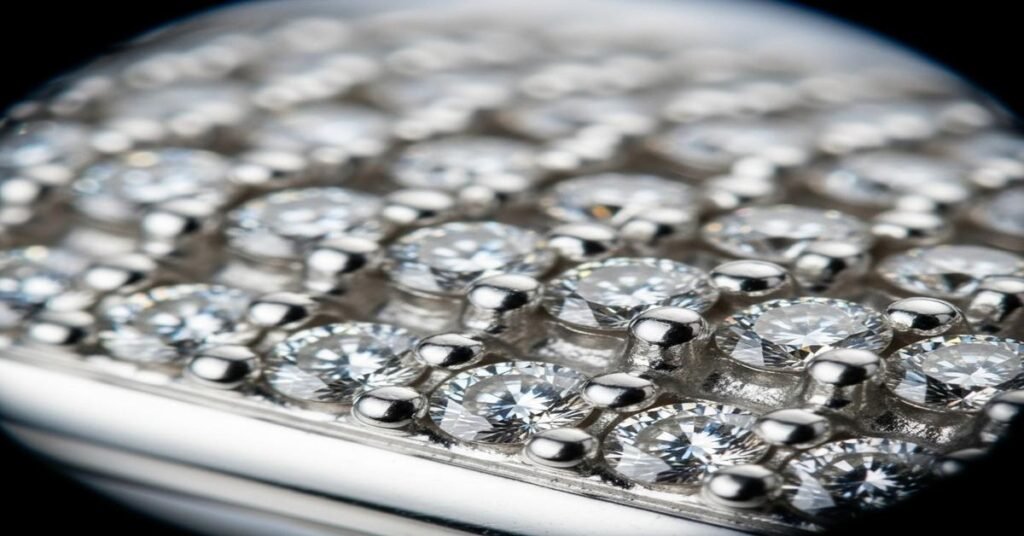
Intro: Jewelers often ask whether micro-pavé tolerances in the EU are tighter than elsewhere. The short answer: there is no single EU legal tolerance for micro-pavé, but many European ateliers and suppliers work to tighter, documented shop tolerances. Those tighter targets come from design expectations, customer demands, and long-standing craft training — not from a single continent-wide law. Below I compare practical bench-side measurements, explain why tighter numbers matter, and give a simple test protocol you can use to compare suppliers or check samples on the bench.
What “tighter tolerances” actually means for micro-pavé
Micro-pavé is about very small stones (commonly 0.6–1.6 mm, with 0.8–1.2 mm very typical). When people say “tighter tolerances” they mean smaller allowable variation in these dimensions and positions:
- Seat diameter tolerance — how close each drilled seat is to the stone diameter.
- Center-to-center spacing — evenness between adjacent stones.
- Vertical play — how much a stone can rock or move up and down in its seat.
- Bead height and uniformity — bead thickness holding the stone and its consistency across the piece.
- Alignment/rotation — stones set with consistent table/crown orientation so light performance is uniform.
Why tighter tolerances matter
Smaller variation gives better optical uniformity, stronger retention, and cleaner finishing. If one seat is 0.10 mm oversized versus neighbors, that stone sits low or wobbles, catching light differently and increasing the risk of loss. Tighter seat diameters reduce need for overzealous bead work, lowering the chance of damaging surrounding metal or stones during finishing.
Observed ranges — practical bench comparisons
From bench work and factory sampling I’ve seen three practical bands. These aren’t regulations — they’re observed shop practices. I give examples so you can measure and judge.
- High-precision European atelier (typical “tight” targets): seat diameter tolerance ±0.02–0.04 mm; lateral stone play <0.05 mm; vertical play <0.02–0.03 mm; bead height variance <0.05 mm. Why this matters: consistent light return and easier hand finishing.
- Standard production (typical mass-market): seat diameter tolerance ±0.05–0.10 mm; lateral play ~0.05–0.10 mm; vertical play ~0.03–0.06 mm; bead height variance 0.05–0.10 mm. This balances throughput and acceptable appearance.
- Low-control or low-cost production: seat tolerances worse than ±0.10 mm; play and bead variance often visible to the naked eye. These pieces may require rework and have shorter service life.
Why those numbers? Because with stones in the 0.8–1.2 mm range, a 0.05 mm difference is visually and mechanically significant. Human vision and light behavior are sensitive at that scale; a few hundredths of a millimeter change how facets line up and how beads catch light.
Bench-side test protocol (simple, repeatable)
Tools: 10× loupe or stereo microscope, set of pin gauges or optical comparator, digital calipers (0.01 mm resolution), push probe or hardened needle and magnified camera or microscope stage. Follow these steps on 10 random stones across the piece.
- Measure stone diameter with calipers or by placing the stone on a black background and measuring under microscope reticle.
- Measure seat diameter with a pin gauge or optical comparator. Record seat minus stone diameter. Target tight: ≤ +0.02–0.04 mm for high-precision; acceptable: ≤ +0.05–0.10 mm for standard.
- Measure center-to-center spacing between adjacent stones with microscope reticle. Calculate mean and standard deviation. Tight work will show variance <0.05 mm.
- Test vertical and lateral play by gently pushing the stone with a probe of known force and observing movement under magnification. Tight retention: vertical play <0.03 mm; lateral play <0.05 mm.
- Check bead height uniformity by focusing across beads and measuring height variance. Tight pieces vary <0.05 mm bead-to-bead.
Material and process factors that influence achievable tolerances
Alloy composition, hardness, and manufacturing method matter. Harder gold alloys or palladium white gold can hold thinner beads without collapse, allowing tighter bead profiles. Softer alloys and high-copper mixes may require thicker beads and looser seats. Laser drilling, CNC seat cutting, or precise gravure tools produce tighter seat diameters than hand-drilled seats. Why this matters: the same design will behave differently in 18k yellow (softer) than in a hard white gold or platinum alloy.
Trade-offs and real-world choices
Tighter tolerances increase cost and slow production. They demand skilled setters, more inspection, and higher scrap control. Resizing or repair is harder when tolerances are tight because there is less metal to re-make or to adjust. For signature high-end pieces, tighter is worth it for optics and longevity. For fashion lines where price and throughput dominate, looser tolerances are common and acceptable.
Practical advice for buyers and bench managers
- If you source from Europe and the supplier claims “tight tolerances,” ask for their numeric bench specs and inspection reports. Don’t accept vague language.
- Sample and test: use the bench protocol above on a random sample. Measure at least 10 stones per sample to get statistical meaning.
- If you need repair/resizing, ask the setter about original tolerances. Pieces set to ±0.02–0.03 mm are repair-sensitive; plan for re-working rather than crude widening/narrowing.
- Specify target ranges in the purchase order, not just “high quality.” Example line: “Seat tolerance: +0.02/−0.00 mm, lateral play <0.05 mm, vertical play <0.03 mm.”
Bottom line
There is no single EU law that universally forces tighter micro-pavé tolerances. But many European ateliers and suppliers consistently work to tighter, shop-defined tolerances because customers expect superior optics and longevity. On the bench you can quantify those differences: tight work will typically show seat and play tolerances measured in a few hundredths of a millimeter, while standard production will relax into the 0.05–0.10 mm band. Use specific numeric targets, simple measurement protocols, and material-aware specifications to ensure the quality you need.

I am G S Sachin, a gemologist with a Diploma in Polished Diamond Grading from KGK Academy, Jaipur. I love writing about jewelry, gems, and diamonds, and I share simple, honest reviews and easy buying tips on JewellersReviews.com to help you choose pieces you’ll love with confidence.