
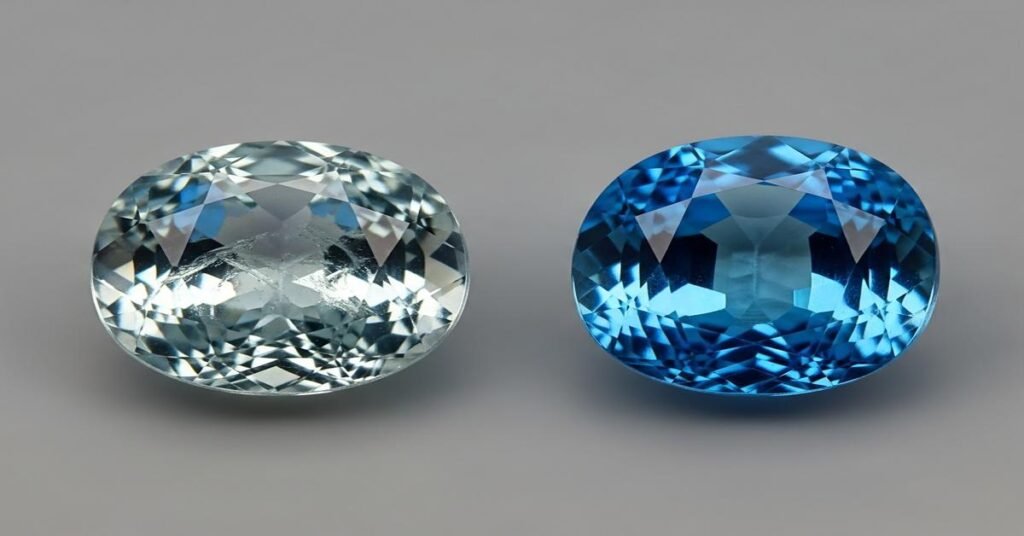
Most “aqua” gems sold in malls and online are not aquamarine. They are treated blue topaz—beautiful, durable, and very inexpensive. The two look similar at a glance, which is why confusion (and mislabeling) is common. But they are not the same. Aquamarine is a type of beryl and can be valuable. Blue topaz is usually irradiated and heated colorless topaz, produced in huge volumes at very low cost. Here’s how to tell them apart by color, price, simple tests, and what to ask a seller.
Why aquamarine and blue topaz get mixed up
Both stones live in the same color family: blue to greenish-blue. That’s enough for casual buyers to assume they’re interchangeable. Retailers add to the confusion by using soft words like “aqua” or “sea-blue” without saying the species.
There’s also treatment. Most blue topaz starts colorless and is irradiated and heated to stable shades of blue. The process is inexpensive and repeatable, so supply is massive. Aquamarine is often heat-treated to reduce green and appear bluer, but it remains aquamarine. These two paths create similar-looking gems with very different scarcity and price.
Color differences you can see in seconds
You don’t need lab gear to catch the biggest tells. Look for these:
- Undertone (the “flavor” under the blue): Aquamarine often shows a greenish-blue undertone, like sea water. Blue topaz is typically a pure, electric blue with little to no green. “London blue” topaz leans dark teal, but still reads inky and cool rather than softly greenish.
- Saturation: Aquamarine is usually light to medium in color. Deep, vivid aquamarine exists but is rare and costly. Blue topaz commonly comes in three “factory” shades:
- Sky Blue – pale, icy blue.
- Swiss Blue – bright, electric medium blue.
- London Blue – dark, inky blue-teal.
If your stone is an evenly bright “neon” blue or very dark in a way that mutes the sparkle, it’s most likely blue topaz.
- Color change with rotation (pleochroism): Aquamarine can show a subtle shift from slightly greenish-blue to slightly purer blue when you rotate it. Treated blue topaz is usually more uniform; the hue stays the same as you turn it. Try this under daylight by a window.
- Zoning: Aquamarine can show gentle color zoning or a soft “wash” of color. Blue topaz is often very evenly colored from edge to edge because of the treatment.
- Lighting behavior: In warm indoor light, aquamarine can look a touch grayer or greener. Swiss or London blue topaz tends to hold a strong, cool blue under the same light.
Quick test: Place the stone on a white paper and view it in indirect daylight. If you see a whisper of green in the blue, think aquamarine. If it’s a punchy, electric blue without green, think topaz.
Price reality check: what each should cost
Price tells the truth when color doesn’t. Here are typical ranges for loose stones and common retail jewelry. Prices vary by cut quality and clarity, but the gap is huge.
- Treated blue topaz (loose)
- Small to medium sizes up to ~5 ct: about $2–$15 per carat wholesale; $10–$40 per carat retail for single stones.
- Large sizes (10–20+ ct): still inexpensive, often under $20–$50 per carat retail.
- Aquamarine (loose)
- Pale commercial aquamarine: roughly $30–$120 per carat.
- Good medium-blue aquamarine with fine cut: roughly $150–$500 per carat.
- Top-tier “Santa Maria”-like color: often $800–$2,000+ per carat, even higher for truly exceptional stones.
Finished jewelry reality: A silver ring with a 5–10 ct blue topaz can retail for $50–$300. A similar ring with a 5–10 ct aquamarine of good color commonly retails in the high hundreds to several thousand. If the tag says “aquamarine” but the price looks like blue topaz, assume it’s blue topaz until proven otherwise.
Simple at-home clues (non-destructive)
These won’t replace a lab, but they push the odds in your favor:
- Weight-in-hand: Topaz is denser (specific gravity ~3.53) than aquamarine (~2.7–2.8). Two stones the same size will feel heavier if it’s topaz. This is subjective, but noticeable in larger stones (8+ mm).
- Polarized sunglasses test: Look at the stone through polarized sunglasses and rotate the stone slowly. Aquamarine may show a subtle hue or brightness change; topaz often changes brightness but not hue. This hints at pleochroism differences.
- Loupe clues (10x):
- Aquamarine often has “rain-like” fine tubes, wispy veils, or tiny crystals. Inclusions tend to be gentle and not sharply planar.
- Topaz commonly shows bright, flat “feather” inclusions or straight cleavage-like planes. London blue often looks very clean but with occasional flat reflective breaks.
- Cut style and setting context: Mass-market large ovals, cushions, and pear shapes in very even electric blue are usually topaz. Aquamarine of similar size and strong color is rarely set in low-cost silver with tiny lab-made accents.
- Name on the tag: If it says “aqua” but not “aquamarine,” ask. Sellers sometimes hide behind color words.
Reliable tests if you want certainty
These are more definitive. Use caution with mounted stones.
- Refractive index (RI): A gem refractometer will separate them quickly.
- Aquamarine (beryl): ~1.57–1.59
- Topaz: ~1.61–1.64
The gap is clear. Any professional jeweler or appraiser can take this reading in minutes.
- Specific gravity (SG) by water suspension: With a precise scale, thin thread, and water you can estimate density. Topaz will calculate near 3.5; aquamarine near 2.7–2.8. Don’t do this with porous settings or glued stones.
- Gem lab report: For expensive purchases, ask for a report identifying the species and any treatment. This is the safest route if the price is high.
Avoid scratch tests: Topaz and aquamarine are both hard (aquamarine ~7.5–8; topaz 8), so scratch tests are risky and inconclusive. You can damage the stone or the metal.
Durability and daily wear: differences that matter
- Hardness vs toughness: Both resist scratching, but topaz has a perfect cleavage. A sharp blow can split it along a plane. Aquamarine lacks that easy split and is generally tougher in rings.
- Cleaning: Avoid ultrasonic and steam cleaners for topaz because of cleavage risk. Mild soap, warm water, soft brush works for both stones.
- Prongs and settings: For topaz, a protective setting (bezel or good prong coverage) helps reduce chipping risk.
Common sales tactics and how to push back
- Euphemisms: “Aqua stone,” “sea blue,” “ocean gem.” Ask, “Is this aquamarine (beryl) or blue topaz?” Make them state the species.
- Half-truths: “It’s a March birthstone.” Both are used for March now, so that doesn’t identify the gem.
- Price fog: If it’s labeled aquamarine but priced like blue topaz, ask for an RI reading or a written identification from a qualified appraiser.
- Treatment silence: Ask, “Is the color natural or treated, and how?” Blue topaz should be disclosed as irradiated/heat-treated. Most aquamarine is heat-treated; that should also be disclosed.
- Return policy: If they won’t provide identification, get a no-questions return period. Then verify elsewhere.
Quick checklist before you buy
- Color has a slight greenish cast, not electric neon blue → leans aquamarine.
- Color is very even, “factory” Swiss or London blue, at a low price → leans blue topaz.
- Stone feels heavy for its size → leans topaz.
- Rotation shows a subtle hue shift → leans aquamarine.
- Large, dark teal stone in budget silver, under a few hundred dollars → almost certainly blue topaz.
- Seller can provide RI reading or lab ID → trustworthy confirmation.
If you already bought “aquamarine” and suspect topaz
- Get a quick ID: Ask a local jeweler or appraiser for an RI test. It’s fast and inexpensive.
- Use the return window: If it’s misrepresented, return it with the written ID.
- Adjust expectations: If it is blue topaz, enjoy it for what it is. It’s durable, comes in bold blues, and looks great in larger sizes. Just know the resale value is low compared to fine aquamarine.
A note on look-alikes you might run into
Glass, synthetic spinel, and some quartzes can imitate aqua blue. Glass feels light and often shows bubbles. Synthetic spinel can be very bright and flawless. If the price and story don’t add up, insist on identification. The same tests (RI and SG) separate these as well.
Bottom line
If your “aqua” is a strong, even blue at a bargain price, it’s almost certainly treated blue topaz. Aquamarine usually looks softer, often with a hint of green, and costs far more in comparable sizes. Use color cues, price logic, simple rotation and weight clues, and—when money is on the line—an RI reading or lab report. A few minutes of checking can save you from paying aquamarine prices for low-value topaz—or help you spot a true aquamarine worth collecting.

I am Satyam Pandey, a gemologist with a Diploma in Polished Diamond Grading from KGK Academy, Jaipur. I love writing about jewelry, gems, and diamonds, and I share simple, honest reviews and easy buying tips on JewellersReviews.com to help you choose pieces you’ll love with confidence.