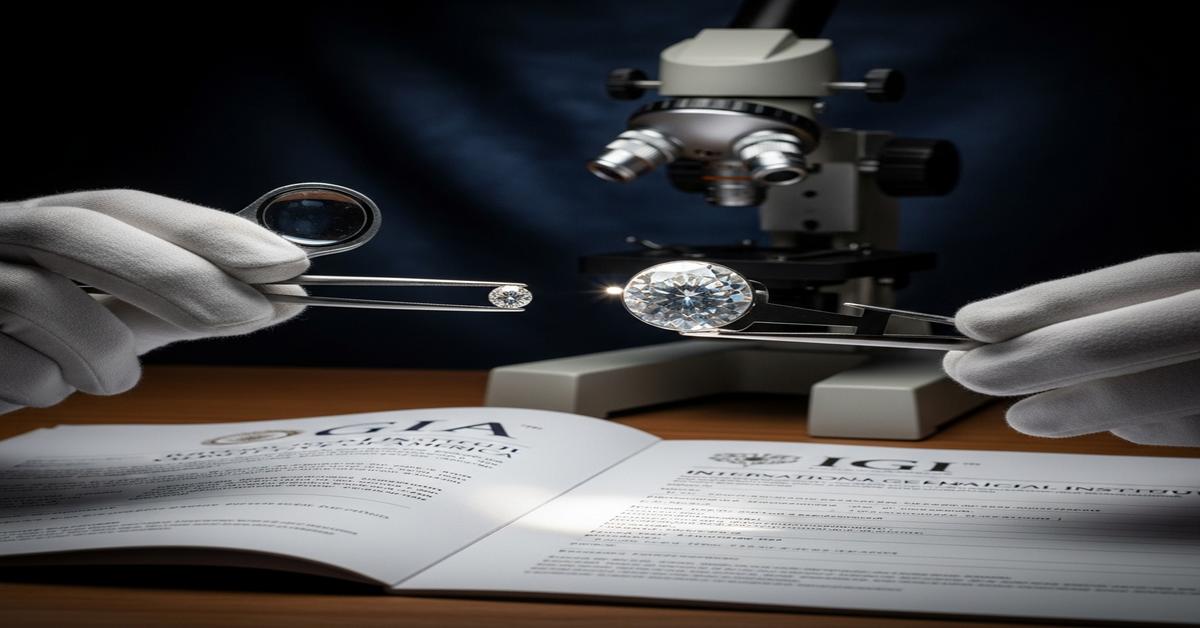
When you shop for a diamond, the certificate is the single most important document that describes what you’re buying. It lists carat weight, measurements in millimeters, color and clarity grades, and a plotted map of inclusions. But not all certificates are created equal. GIA and IGI are two of the most common labs you’ll see on a diamond report. This article explains the real differences, why they matter to price and resale, and how to use a certificate to avoid getting cheated.
What a diamond certificate actually tells you
A certificate (or report) records objective measurements and subjective grades. Key fields are:
- Carat (ct) — the diamond’s weight. Example: 1.00 ct.
- Measurements (mm) — length × width × depth. Example: 6.40 × 6.42 × 3.95 mm for a 1.00 ct round.
- Cut, Polish, Symmetry — cut quality has the biggest effect on appearance. For rounds, cut grade is a formal category with ranges of table %, depth %, and angles.
- Color (D–Z) and Clarity (IF–I3) — color is about body tint, clarity about internal/external flaws.
- Plots and inscriptions — inclusion map and laser inscription that should match the stone.
- Fluorescence, measurements of crown/pavilion and any comments about treatment.
GIA vs IGI: the practical differences
GIA (Gemological Institute of America) is widely regarded as the strictest and most consistent lab. Their grading standards are conservative, especially on color, clarity and cut. Because of that consistency, GIA-certified natural diamonds typically retain higher resale value and are preferred by professional buyers and auction houses.
IGI (International Gemological Institute) grades more diamonds from mass-market and factory sources. IGI is more common on lab-grown diamonds and in fashion/jewelry retail. In some cases IGI grades are slightly more generous — a diamond that IGI calls VS2 might be SI1 by GIA. That doesn’t mean IGI is fraudulent; it means their tolerance for inclusions and color is different.
Why grading differences matter
Two main consequences:
- Pricing and resale: Because GIA is stricter, GIA reports command a premium. Expect GIA-certified stones to sell for roughly 5–15% more than identical-looking IGI stones. For high-value diamonds the gap can be larger. If you buy IGI and later try to resell to a jeweler who prefers GIA, you may take a price hit.
- Trust and verification: GIA’s plotting and measurements are very consistent. That makes it easy to verify a stone against its report by matching millimeters, table %, depth %, and the inclusion plot. With IGI you should still verify—but allow for a slightly wider margin.
Cut grading: why GIA matters more for appearance
Cut quality controls fire, brightness, and scintillation. For round brilliants, GIA uses a detailed cut grade that accounts for proportions (table, total depth, crown and pavilion angles), finish (polish/symmetry), and light performance models. A well-cut round often falls in a range of table ~53–58% and depth ~59–63% with crown angles ~34–35° and pavilion angles ~40.6–40.8°—these are typical targets, not absolute rules. Because IGI’s cut standards can be looser, two diamonds with the same listed cut grade from different labs may not look the same in hand.
Lab-grown diamonds and the IGI factor
IGI is a major certifier for lab-grown diamonds. If you’re buying lab-grown, you’ll commonly see IGI reports. GIA does certify lab-grown stones too, but historically their lab-grown reports are less common at retail. If you want the same level of market trust for a lab-grown stone as for a natural, choose a GIA report if available. If IGI is the only option, verify measurements and the inscription and expect lower resale value compared with a similar natural stone graded by GIA.
How to avoid being cheated — a practical checklist
- Always get the report number and verify it with the lab’s verification tool. The laser inscription on the girdle should match the report number.
- Match measurements: The stone’s mm should match the report within ~0.1–0.2 mm. Big discrepancies are a red flag.
- Check the inclusion plot: Ask for a scope image from the seller and match inclusions to the plot.
- Prioritize cut quality: For appearance, a GIA Excellent or Very Good cut on a round is more important than chasing top color or clarity grades. A well-cut H VS2 will often look better than a poorly cut D IF.
- Consider metal/alloy and setting: If the diamond is mounted, ask about the metal: 14K gold is 58.3% pure gold, 18K is 75% gold, platinum 950 is 95% platinum. Dense metals like platinum hold prongs differently; mounted grading can hide or make it harder to verify proportions.
- Get a second opinion for high-value purchases: For stones over ~$5,000–10,000, an independent appraisal or scope photos reviewed by a trusted gemologist is worth the cost.
When IGI is an acceptable choice
IGI is fine for smaller, lower-cost pieces, lab-grown diamonds, and fashion jewelry where resale isn’t a priority. If you buy IGI, be realistic: the grade may be slightly optimistic and the market will price accordingly. If you plan to keep the piece long-term and wear it daily, focus on a solid cut and secure setting rather than chasing top lab grades.
Final recommendation
If you want maximum market value and the most reliable report, choose GIA. GIA’s stricter grading and consistency make it the safer choice for natural diamonds, engagement rings, and high-value purchases. If you’re buying lab-grown diamonds or lower-cost fashion pieces, IGI is common and acceptable—but verify measurements, inscription, and the inclusion plot before buying.
Remember: the certificate is a tool, not a guarantee. Use the report to check cut proportions, carat-to-mm conversion (for example 1.00 ct round ≈ 6.4–6.5 mm), inclusion plot and inscription. Prioritize cut and verification, and you’ll avoid the common traps that lead people to overpay for a grade that won’t hold up at resale.

I am G S Sachin, a gemologist with a Diploma in Polished Diamond Grading from KGK Academy, Jaipur. I love writing about jewelry, gems, and diamonds, and I share simple, honest reviews and easy buying tips on JewellersReviews.com to help you choose pieces you’ll love with confidence.