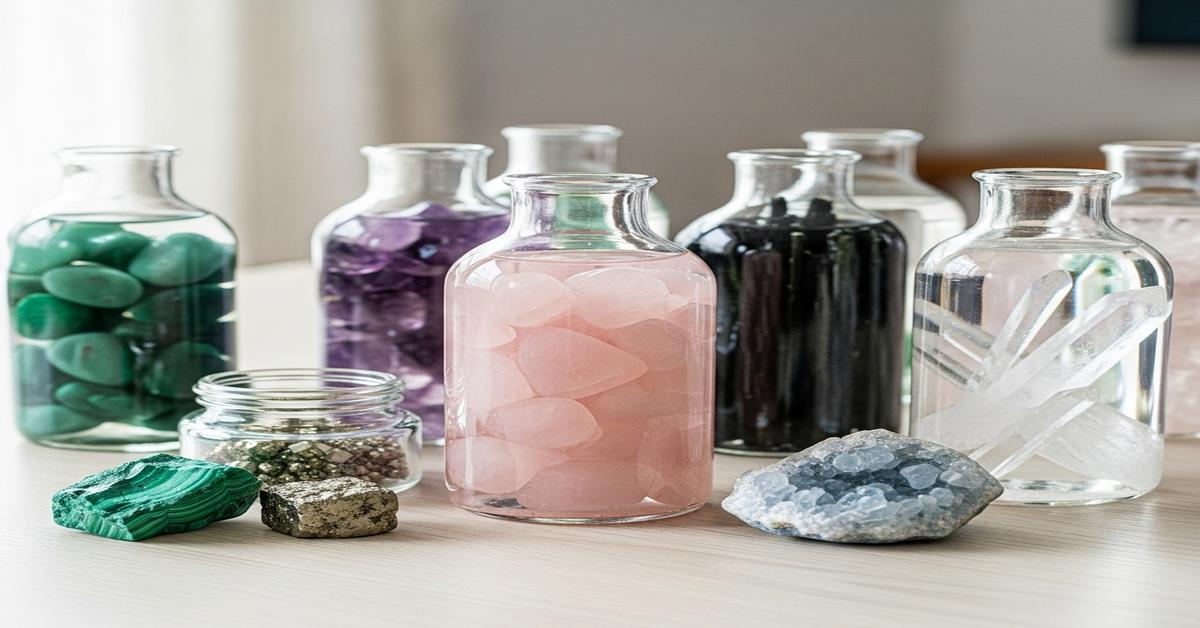
Crystal water bottles are popular because people like the idea that a gemstone can influence the water they drink. The risk many buyers miss is that minerals vary widely in chemical stability. Some stones are hard, inert and safe in water. Others are soft, porous or contain toxic metals that can leach into the water. Below I explain which minerals are generally safe, which are risky, why that matters, and how to choose and care for a crystal bottle so you reduce any health risks.
How to think about safety
Chemical stability matters more than appearance. Two practical properties tell you a lot:
- Solubility and reactivity: Some minerals dissolve or react with water or acids, releasing ions. For example, copper carbonates will release copper ions if wet repeatedly. Acidic conditions increase leaching.
- Porosity and hardness (Mohs scale): Soft or porous stones (Mohs ≤ 3–4) can absorb water, break down, or hold bacteria. Hard, non-porous silicates (quartz family, Mohs ~7) resist leaching and microbial growth.
Also note manufacturing details. Many bottles have a raw crystal point glued to a glass bottle or sealed in a separate chamber. If the crystal is sealed and does not touch the water, the risk of leaching is essentially removed. If it sits directly in the water, the mineral’s chemistry matters.
Generally safe minerals (can be used in direct contact with water)
- Clear quartz, amethyst, rose quartz, citrine (SiO2) — Mohs ~7: Chemically inert silica. They don’t dissolve in water at normal pH and temperature. Examples: 25–40 mm tumbled points are common and safe.
- Agate, jasper, chalcedony (microcrystalline quartz): Same silica chemistry and low porosity. Good for everyday use.
- Garnet, spinel, tourmaline (hard silicates): Generally stable in water. Tourmaline is often used for aesthetic purposes; it’s hard and chemically robust.
- Glass or man-made “crystals”: Borosilicate glass is inert and safe. Some sellers use glass “crystal” rods—these are safer than many natural minerals.
- Hematite (Fe2O3): Iron oxide; largely insoluble and stable. It won’t release harmful ions under normal conditions. Surface rust is unlikely if it’s natural hematite, but avoid metallic-plated “hematite” jewelry which may flake.
Minerals that require caution or should be sealed (avoid direct water contact)
- Malachite and azurite (copper carbonates): Soft (Mohs ~3–4) and contain copper. They readily release blue/green copper-rich water and can be toxic if ingested over time. Avoid direct contact.
- Turquoise and chrysocolla: Often copper-bearing and porous. Many turquoise pieces are stabilized with resin, but untreated turquoise can leach copper and other elements. If used, keep it sealed away from water.
- Pyrite (FeS2): Iron sulfide oxidizes in wet air to produce sulfurous compounds and can stain water. It can generate acids and sulfate; not recommended in direct water.
- Malachite-containing mixes or green-blue stones: Any blue-green discoloration in water is a red flag for copper leaching.
- Calcite, aragonite, and other carbonates (including rhodochrosite): These react with acids and slowly dissolve in water, changing pH and releasing ions (calcium, manganese). Not ideal for long infusions.
- Halite (rock salt) and water-soluble minerals: These simply dissolve and are unsuitable as permanent crystal inserts.
- Selenite (gypsum, hydrated CaSO4) — Mohs ~2: Very soft and will slowly dissolve or disintegrate when immersed. Don’t put selenite in water.
- Galena (lead sulfide), cinnabar (HgS) and other heavy-metal minerals: Contain lead or mercury. These are toxic and must never be used in bottles that contact drinking water.
Why some crystals leach
Leaching happens when water dissolves part of the mineral or when surface-bound metals oxidize and migrate into solution. Acidic water (lower pH), high temperature, longer soak times, and a large surface area increase leaching. For example, a 30–40 mm copper-carbonate point will release more copper if it’s rough, porous, warm, and left in water overnight than a polished, sealed specimen left briefly in cool water.
Practical rules when buying or using a crystal water bottle
- Prefer sealed designs: If the crystal is isolated in a separate chamber or glued behind glass, it won’t contact the water and is safe regardless of mineral.
- Use borosilicate glass bottles and 316 stainless steel lids: Borosilicate resists thermal shock and is inert. Stainless 316 (~16–18% Cr, 10–14% Ni, 2–3% Mo) resists corrosion and won’t leach significant metals into water.
- Ask the seller for stone ID and treatment info: Many turquoise pieces are stabilized with resin; treated stones may still be safe if sealed, but untreated porous copper minerals are risky.
- Watch for signs of leaching: Cloudy water, colored tints (blue/green), metallic taste, or residue on the bottle indicate leaching — discard the water and stop using that crystal in direct contact.
- Limit soak time: Don’t leave crystal-contained water for days. Replace daily and avoid hot water or infusions with acids (lemon) that increase leaching.
- Clean gently: Use warm soapy water and a soft brush. Don’t use acids or harsh cleaners on porous or treated stones. Never put selenite or other soft minerals in water to clean.
- Who should be extra cautious: Pregnant people, children, or anyone with compromised kidney function should avoid bottles where the stone contacts the water unless the stone is clearly inert (quartz family or sealed).
How to test and verify
- Visual inspection: Look for color bleeding or particulate matter after 30 minutes in clear water. Blue/green means copper; metallic flakes suggest plating wear.
- Vinegar spot test (small, controlled): Place a drop of white vinegar on an inconspicuous spot. Effervescence or color change often signals carbonates or reactive minerals. Don’t damage prized stones; use this only if you don’t mind a tiny mark.
- Lab testing: For certainty, request ICP-MS or heavy-metal analysis on the water after soaking a crystal. This is the only way to quantify trace metals.
In short: choose hard, non-porous silicates like quartz and chalcedony if you want a crystal that sits directly in your drinking water. Seal or avoid copper-bearing, carbonate, soft, or soluble minerals. When in doubt, use a sealed chamber or keep the crystal out of the water. That approach keeps the aesthetic you want while minimizing chemical and health risks.

I am G S Sachin, a gemologist with a Diploma in Polished Diamond Grading from KGK Academy, Jaipur. I love writing about jewelry, gems, and diamonds, and I share simple, honest reviews and easy buying tips on JewellersReviews.com to help you choose pieces you’ll love with confidence.