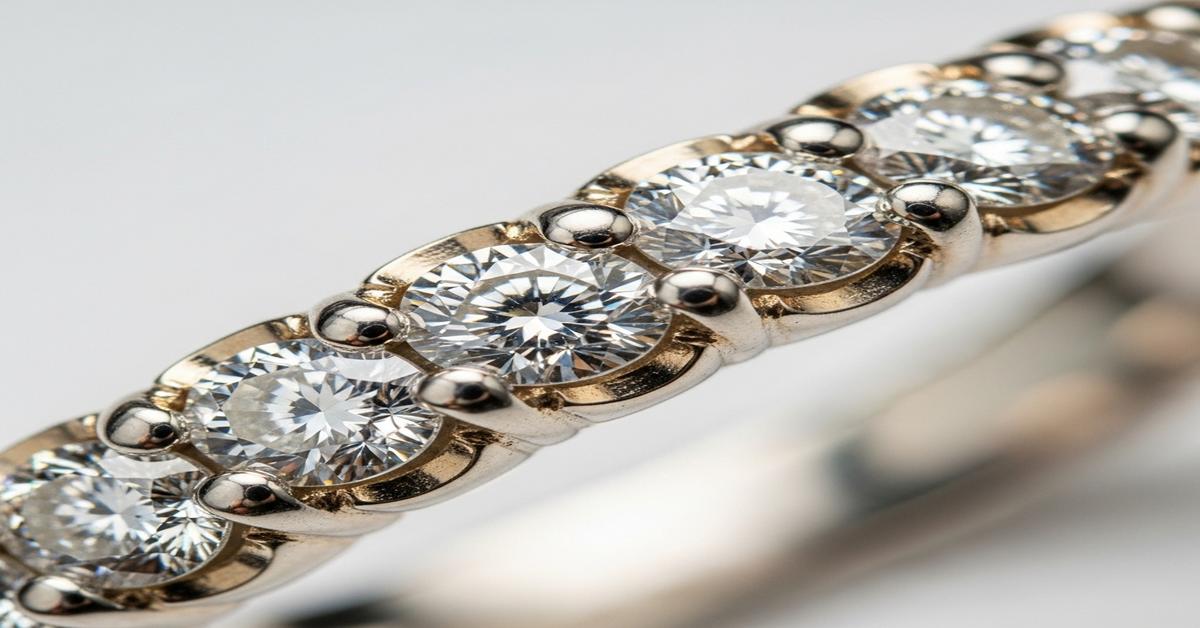
Intro: Pavé that loses stones is one of the most common frustrations for owners of fine jewelry. Stones that seem secure at first can work loose and fall out over months or years. The good news: most losses are avoidable. The single most effective detail is the micro-prong — tiny, precisely formed prongs and beads that grip each stone closely. This article explains how micro-prongs work, why they reduce stone loss, what materials and dimensions matter, how to maintain them, and when a repair or design change is the safer choice.
What a micro-prong (micropavé) is
A micro-prong is a very small metal projection formed between adjacent stones in a pavé layout. Rather than larger claw prongs, the setter creates multiple tiny prongs or beads (often 2–6 per stone cluster) and rolls or burnishes the metal over the stone’s girdle. Micro-prongs are measured in fractions of a millimeter: typical widths are about 0.20–0.40 mm depending on stone size, with height just enough to form a rounded lip over the girdle.
Why micro-prongs prevent stones from falling out
– Tighter grip: Micro-prongs are placed very close to the stone’s girdle and burnished in, so there is less lateral play. Less movement means less fatigue on the metal.
– More support points: Small prongs let a setter add more contact points around each stone. Instead of one or two larger prongs, the force is distributed across many tiny beads. That reduces the chance that a single prong failing will let the stone out.
– Less catch and leverage: Narrow, rounded micro-prongs don’t snag on fabric or edges as easily. Big prongs create a lever arm that, when caught, can pry the prong open. Micro-prongs minimize that lever arm.
– Deeper seats and proper burnishing: Micro-prong setting is usually accompanied by a deeper seat cut into the metal so the girdle sits slightly below the bezel line. The metal is rolled firmly over the girdle, which resists upward and sideways movement better than shallow seats.
For which stones and sizes does micro-prong make sense?
Micropavé is most common with small rounds. Typical ranges:
- Stone diameter: about 1.3–2.5 mm (micro-pavé commonly uses ~1.3–2.0 mm). Millimeter size matters more than carat weight for pavé.
- Diamond weight: these sizes roughly correspond to stones from a few hundredths of a carat up to around 0.08–0.10 ct each. For single stones larger than ~3 mm, shared prongs or small claws are often preferable.
Metal choices and alloys — what holds up best
– Platinum (Pt 950 or Pt 900): Dense and ductile, platinum takes a crisp micro-bead and resists rapid thinning. It can flow under pressure rather than chip, so well-formed micro-prongs remain secure longer. Platinum is a top choice for everyday wear like engagement rings.
– 14k gold (58.3% gold): Harder than 18k, 14k gold offers better wear resistance for thin prongs. 14k white or yellow gold is common for pavé because it retains profile longer under friction.
– 18k gold (75% gold): Softer and will wear faster in thin micro-prongs. It still works for dress pieces worn occasionally, but expect more frequent maintenance.
– Note: rhodium plating on white gold affects appearance, not prong strength; plating will wear off but does not hold metal in place.
Critical setting details that reduce loss
– Seat depth: The seat should engage under the girdle rather than resting on it. That prevents the stone from working up and out.
– Prong geometry: Rounded, slightly tapered beads roll over the girdle. Sharp corners concentrate stress and promote cracking.
– Consistent spacing and pressure: Experienced setters space prongs uniformly and burnish with controlled pressure to avoid over-thinning.
– Backing/support: Where possible, a modest undergallery or inner rail supports the pavé section, reducing flex in the shank and protecting the beads from side impacts.
Common causes of pavé stone loss (and how micro-prongs help)
– Wear and thinning: Metal abrades from everyday contact. Micro-prongs reduce exposure and distribute stress across many beads.
– Snagging and leverage: Large prongs catch and pry open. Micro-prongs are low-profile and less likely to be caught.
– Improper initial setting: Poorly cut seats or uneven beads let stones rock. Micro-prong setting requires a skilled setter and magnification; properly done, it leaves little room for movement.
– Resizing damage: Cutting and soldering near pavé can distort the shank and change bead angles. Communicate with your jeweler — a half‑pavé design keeps the lower shank clear to allow resizing without the setting running through the seam.
Maintenance and inspection — practical tips
– Inspect visually and by feel every 6–12 months if you wear the piece daily. Use a 10x loupe to check beads for thinning or missing metal.
– If you feel a rough edge or a stone wiggles, stop wearing it and bring it to a jeweler. A loose tiny stone can fall out in seconds.
– Avoid wearing pavé rings during sports, gardening, or heavy housework. Remove them for cleaning with harsh chemicals (chlorine and bleach accelerate metal weakening).
– Keep a simple cleaning routine: warm water, mild soap, and a soft brush. Abrasive brushes or ultrasonic cleaners can accelerate wear if prongs are already thin.
Repair options and typical costs
– Rebeading/re-tipping: A jeweler can re-form beads, add metal, and burnish stones back into place. Small repairs for a few beads often run from about $50–$150 depending on metals and location.
– Section repave: If many stones are loose or missing, removing and resetting a section or the whole band is more practical — costs are higher ($200–$800+), and depend on stone replacement and labor.
– Material swap: Upgrading a pavé area to platinum or 14k from 18k (or changing setting style to a channel) will increase longevity but can be costly due to remounting or rebuilding the shank.
Design choices to reduce future problems
– For everyday rings, choose 14k gold or platinum with micro-prongs rather than 18k.
– Favor half- or three-quarter-pavé designs so the lowest-wear region of the shank is plain metal and easier to resize.
– In very high-wear areas (bottom of bands), consider channel set stones instead of pavé. Channel settings protect stone girdles and eliminate exposed beads.
– Specify slightly larger beads or a closer spacing of support rails for pieces intended for heavy daily wear.
Bottom line
Micro-prongs aren’t a gimmick — they are a refined technique that reduces stone loss when done correctly. The key ingredients are the right metal (14k or platinum), accurate seat depth, small rounded beads, and a skilled setter using magnification. Pair good construction with routine inspection and sensible wear habits, and pavé stones will stay secure far longer.

I am G S Sachin, a gemologist with a Diploma in Polished Diamond Grading from KGK Academy, Jaipur. I love writing about jewelry, gems, and diamonds, and I share simple, honest reviews and easy buying tips on JewellersReviews.com to help you choose pieces you’ll love with confidence.