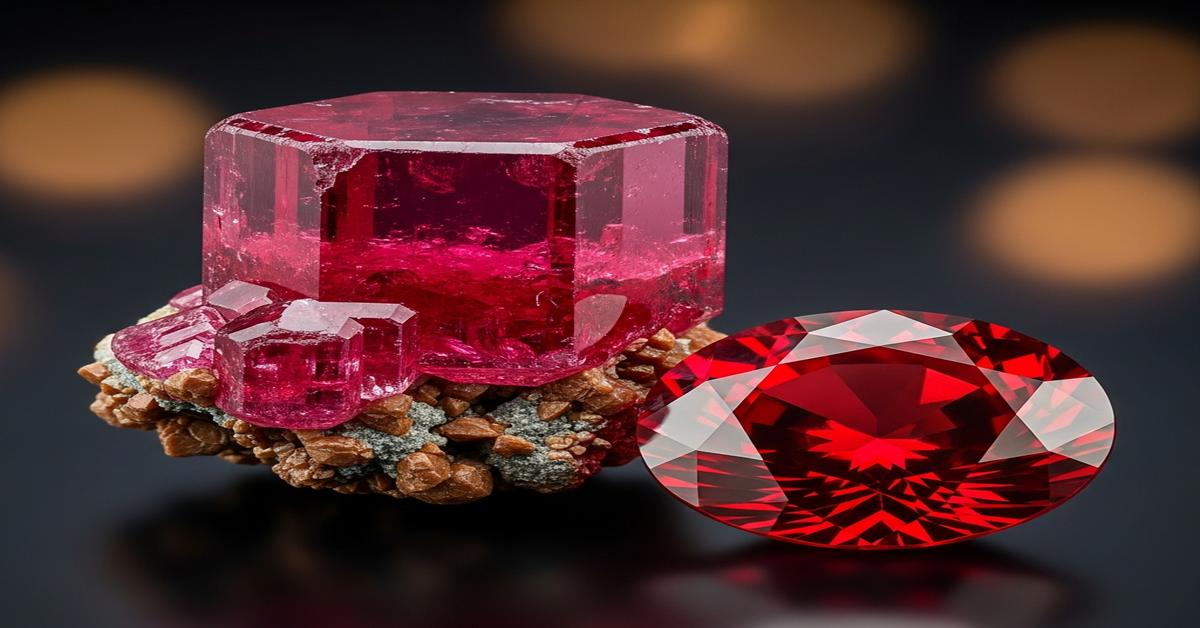
Red beryl is the rarest well-formed gem most people will ever encounter. Jewelers sometimes call it “bixbite” or “red emerald.” Natural stones are tiny, scarce, and very expensive. A lab-grown version now exists, which makes expert testing essential. If you buy one without a lab certificate, you risk paying a five-figure price for a different gem, a synthetic, or an imitation. Here is what red beryl is, why it is so rare, how lab-grown stones are made, and exactly what your certificate should prove.
What Red Beryl Is (and why “Bixbite” is confusing)
Red beryl is the red variety of the beryl family, the same mineral species as emerald, aquamarine, and morganite. Its chemistry is beryllium aluminum silicate, colored by manganese (Mn³⁺). The historical name “bixbite” often causes confusion with a different mineral called bixbyite. Most labs now prefer the name red beryl. You may also see “red emerald,” a trade term used in Utah. That name helps sales but confuses buyers, because it suggests a link to green emerald pricing and behavior. Focus on the science: it is beryl, colored red by manganese, and it is extraordinarily scarce.
Why It Is So Rare
Red beryl needs a tight recipe of geology and chemistry that almost never happens. It forms in volcanic rhyolite where beryllium-bearing fluids met manganese under the right temperature, pressure, and oxidation conditions. That mix is uncommon, short-lived, and local. As a result, well-formed crystals suitable for cutting are tiny and few.
Practical impact:
- Localities: Almost all fine gem material has come from the Wah Wah Mountains of Utah, USA. Minor crystals occur in other Utah ranges and parts of New Mexico, but very little reaches jewelry quality.
- Sizes: Most cut stones weigh under 0.50 carat. Eye-clean stones above 1 carat are rare. Above 2 carats is exceptional. This is why quality examples command high prices per carat.
- Supply: Mining is sporadic and small-scale. Even active operations cannot produce steady, commercial volumes. That keeps prices high and makes documentation important for resale or insurance.
How Rare Is “Rare”? A Reality Check
“Rarest gem on Earth” is often used in ads, but it needs context. There are minerals rarer than red beryl (for example, painite) if you count museum specimens. But for jewelry-quality, facetable stones, red beryl is among the rarest you can actually buy. You can find rubies, sapphires, and even alexandrites in many sizes and sources. You cannot say the same for red beryl. The combination of gem quality, durability (hardness 7.5–8), and beauty makes it uniquely scarce in the real jewelry market.
Color and Appearance You Should Expect
Fine stones show a saturated raspberry to crimson red, often with a slight purplish modifier. The color arises from Mn³⁺, which gives strong pleochroism. In plain terms, the color shifts with viewing direction. Expect red facing up and slightly pinkish-red or orangey-red from the side. Good cutting aims to show the richer direction.
Inclusions are common. Natural crystals form in gas-rich volcanic rock, so you often see fingerprint patterns, fluid inclusions, and small crystals trapped inside. Clean stones are unusual; if a stone looks “too perfect,” consider that a signal to check for lab growth.
Market Prices (and why they vary so much)
Prices vary by color, clarity, size, and proof of origin. As a ballpark:
- Commercial small stones (0.10–0.30 ct) with inclusions can sell in the low thousands per carat.
- Fine stones around 0.30–0.80 ct can reach the mid to high five figures per carat.
- Top color, eye-clean stones near or above 1 ct can command very high five figures per carat, sometimes more.
Why the spread? Two reasons. First, tiny upgrades in color saturation or clarity move value a lot because supply is so thin. Second, lab confirmation affects confidence and price. A stone with a reputable report sells faster and at stronger prices because buyers know exactly what they are getting.
Yes, There Is Lab‑Grown Red Beryl Now
Lab-grown red beryl has been produced in small quantities by crystal growth methods similar to those used for emerald. Two main techniques are used:
- Hydrothermal growth: Beryl is grown from solution in high-pressure vessels. Chemistry is tuned to introduce manganese for the red color. Growth follows seed plates and can show chevron zoning and “nail‑head” spicule inclusions typical of hydrothermal synthetics. This method yields very clean stones that often look “too perfect.”
- Flux growth: Crystals grow from a molten flux that dissolves ingredients and deposits beryl as it cools. Flux-grown stones can trap metallic platelets or wispy flux residues as inclusions. They also tend to have high clarity.
Why this matters: lab-grown stones are chemically and structurally the same species as natural red beryl. Simple tools cannot separate them reliably. Only a trained gem lab can. The price difference is huge, so a proper report is not optional.
Common Look-Alikes and Mislabels
Several gems can be confused with red beryl. Mistakes—sometimes honest, sometimes not—are common.
- Pezzottaite: A raspberry-red beryl-related mineral rich in cesium. It looks close but is not red beryl. It usually shows different refractive index and chemistry. It is more available and less costly.
- Ruby: Red corundum. Higher hardness and different optics. Darker, more “ruby-red” rather than raspberry. Easy to mix up by color alone.
- Red spinel: Bright red, often very clean. Different refractive index and lack of birefringence. Much more common than red beryl.
- Rubellite tourmaline: Reddish-pink to red. Strong doubling and different crystal habit. Often bigger at lower prices.
- Glass or coated stones: Cheap imitations. Obvious bubbles, odd luster, or unnatural surface films under magnification.
Why this matters: a misidentified gem can cost you thousands. Without a lab report, even experienced jewelers can be fooled by a well-cut look‑alike or a synthetic.
How Labs Separate Natural from Lab‑Grown Red Beryl
Reputable labs combine several tests because no single check is conclusive:
- Microscopy: Natural red beryl often shows multiphase fluid inclusions, fingerprints, and mineral crystals consistent with rhyolite-hosted growth. Hydrothermal synthetics may show nail‑head spicules, chevron zoning, and seed plate boundaries. Flux stones can show flux veils and metallic platelets. Clarity that is unusually high for the size is a soft warning sign.
- Spectroscopy: Visible–near infrared and UV–Vis spectra confirm manganese-related absorption features. Labs compare patterns to known natural and synthetic references.
- Trace-element chemistry: Advanced methods (like LA‑ICP‑MS) check the presence and ratios of elements. These can indicate growth environment and help separate red beryl from pezzottaite and from synthetics with different trace signatures.
- Optical constants: Refractive index, birefringence, and pleochroism are measured to confirm the species and variety.
Why You Should Never Buy Without a Certificate
There are four hard reasons:
- Value at stake: Even small stones can cost more than a car. A mistake is expensive.
- Look‑alikes are common: Ruby, spinel, tourmaline, and pezzottaite overlap in color and size. Without testing, confusion is easy.
- Lab-grown exists: Synthetic red beryl can look “perfect” and natural. Only a reputable lab can tell with confidence.
- Resale and insurance: Buyers and insurers want a lab report. Without it, liquidity and coverage suffer, and you may receive a lower valuation.
Which Certificates Count (and what they should say)
Choose an independent report from a recognized gemological laboratory. Strong options include GIA, AGL, SSEF, Gübelin, GRS, and IGI. Local labs vary in rigor; ask your jeweler which lab they use and why.
A good report for red beryl should include:
- Species and variety: Beryl, variety red beryl.
- Natural vs. laboratory-grown: A clear statement. For natural stones, the report should say “Natural.” For synthetics, it must say “Laboratory-grown.”
- Treatments: Disclose any clarity enhancement (fracture filling) or surface coating. Red beryl is not routinely treated for color; if a treatment is present, you need to know.
- Measurements and weight: Exact dimensions and carat weight.
- Comments on features: Any diagnostic inclusions, growth features, or testing notes that support the conclusion.
- Report number and verification: A unique number that you can verify with the lab. Keep copies for insurance and resale.
Buying Checklist
Use this when evaluating a stone:
- Ask for the lab report first. If the seller says they will “get one after,” decline. Reports must match the stone in hand.
- Check the name. If it says “red emerald,” confirm that the certificate says “beryl, variety red beryl.” Trade names should not replace the scientific identity.
- Look for size and clarity realism. A 1‑carat stone that is ultra-clean is rare; demand lab confirmation.
- Inspect the color. Fine stones show rich raspberry to crimson, not dull brownish-red. View under daylight-equivalent light.
- Consider the host story. Claims of “Utah origin” are common. Origin determination is difficult; many labs will not state origin for red beryl. Treat origin claims as unproven unless the certificate says so.
- Compare price to market. If the price is far below norms, assume you are looking at a different gem, a treated stone, or a synthetic.
Care and Durability
Red beryl has hardness 7.5–8 and good toughness for beryl, but many stones are included. Fractures make them sensitive to knocks. Use protective settings. Clean with warm soapy water and a soft brush. Avoid ultrasonic and steam cleaners, especially if the stone has visible inclusions or fracture filling. Store separately to prevent scratching.
Bottom Line
Red beryl sits in a tiny intersection of beauty, durability, and extreme scarcity. That makes it both desirable and risky to buy. Lab-grown versions are now available, and natural supply will likely remain thin. This is exactly the kind of gem where a laboratory report is not a formality—it is the only reliable way to know what you are buying, protect your money, and preserve value for the future.

I am Satyam Pandey, a gemologist with a Diploma in Polished Diamond Grading from KGK Academy, Jaipur. I love writing about jewelry, gems, and diamonds, and I share simple, honest reviews and easy buying tips on JewellersReviews.com to help you choose pieces you’ll love with confidence.