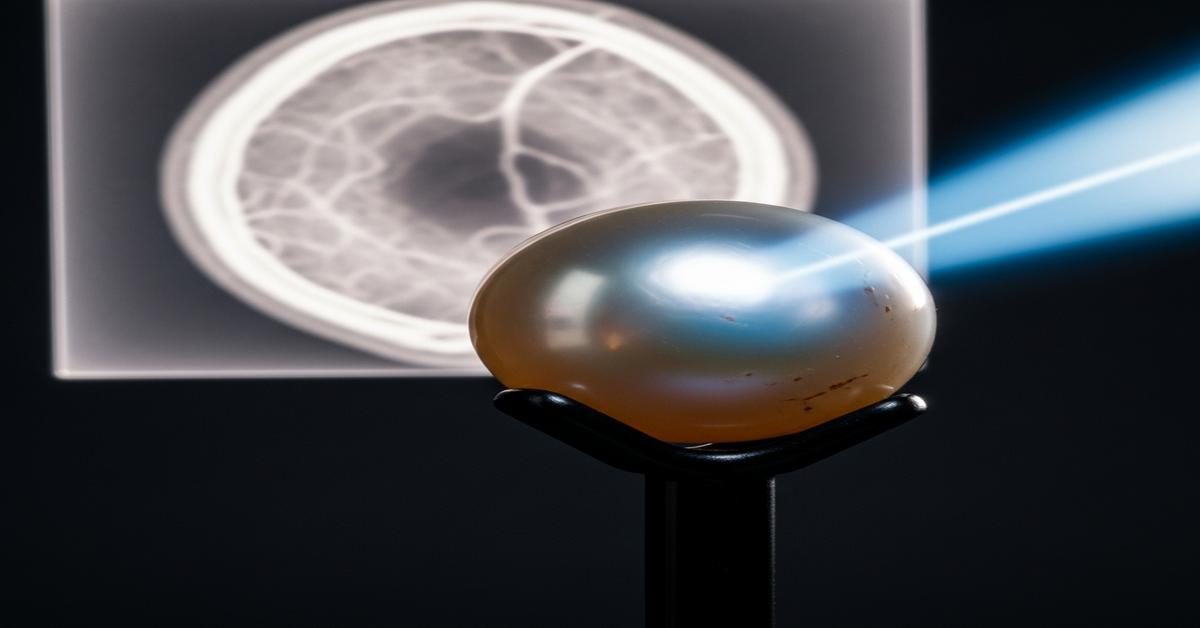
When serious money is on the line, guessing is not enough. With pearls, the question is simple but crucial: is it truly natural, or is it cultured? Many clues can hint at the answer, but only one method can prove it with certainty: an X-ray view of the pearl’s internal structure. This article explains why X-ray imaging is decisive, how labs use it, what they look for, and what this means for rarity and value—especially for the rarest natural pearls.
What “natural” really means
Natural pearl: formed in a mollusk without any human intervention. No implanted bead, no tissue graft, no farming.
Cultured pearl: formed because a technician started the process. Bead-nucleated cultured pearls have a round shell bead implanted. Tissue-nucleated (often called “keshi” in trade) have a small piece of mantle tissue inserted but no bead.
Imitation: not a pearl at all. Often glass or plastic with a coating.
The legal and market distinction hinges on origin, not beauty. A natural pearl can be less lustrous than a top cultured pearl, yet be far rarer and more valuable. That value rests on proof, and proof rests on X-rays.
Why surface clues aren’t enough
Dealers sometimes judge pearls by luster, growth lines, drill-hole features, or weight. These are clues, not proof. Here’s why:
- Surface luster and orient vary with nacre thickness and polishing. Both natural and cultured pearls can show strong luster.
- Drill-hole inspection can reveal concentric layers, but modern bead-nucleated pearls often have thick nacre that hides the bead in the hole. Tissue-nucleated pearls have no bead to see.
- Shape and matching are not reliable. Natural pearls can be round, and cultured pearls can be off-round or baroque.
- UV fluorescence and dye tests can flag treatments or species, but do not prove natural origin.
All these methods look at the outside or chemistry. They cannot show how the pearl started growing. Only X-rays reveal the growth architecture inside.
How X-ray identification works
Why X-rays? X-rays pass through the pearl and are absorbed differently by materials of different density and structure. Nacre grows as concentric layers of microscopic aragonite platelets. A shell bead nucleus is a dense, uniform sphere. These differences produce distinct X-ray signatures.
Labs use two complementary tools:
- X-radiography (2D): a high-resolution X-ray image shows density patterns and layering like tree rings.
- Micro-CT (3D) or X-ray microradiography: a 3D reconstruction that lets experts “fly through” the pearl and examine layers, cores, and voids from any angle.
With these, experts can tell whether the pearl built itself up from a natural irritant with no human start, or if it grew around an implanted core.
What experts look for on the image
Distinct internal structures separate natural from cultured pearls. Key indicators include:
- Presence of a bead nucleus (bead-cultured pearls): A round, even-toned core with a sharp boundary and a mantle-like “ring” around it. The interface between bead and nacre is usually crisp. Sometimes you can see drill marks from the nucleus insertion.
- Growth layering: Natural pearls show complex, concentric deposition with irregular, sometimes off-center cores. Layers may be uneven, with “onion-like” rings that drift and overlap—typical of slow, uncontrolled natural growth.
- Organic channels and voids: Natural pearls often display tiny dark tubes or voids that trace original biological structures. These are less common and differently arranged in cultured pearls.
- Tissue-nucleated cultured pearls (no bead): These can be tricky by eye. On X-ray, they often show a characteristic initial growth front or “seed” region with more uniform layering patterns than natural pearls and fewer structurally chaotic zones.
- Composite or assembled pearls: X-rays can reveal glue lines, doublets, and patches used to repair or “build” pearls (e.g., mabé constructions) that are invisible from the surface.
The logic is straightforward: a deliberately implanted core leaves a persistent structural signature. If the X-ray shows that signature, the pearl is cultured. If the X-ray shows continuous, nucleus-free, naturally chaotic layering from center to surface, it is natural.
Cases that confuse the eye but not the X-ray
- Round natural pearls: Rare but real. Surface observation alone could miscall them as bead-cultured. X-rays reveal the absence of a nucleus and the complex natural core.
- Thickly coated bead-cultured pearls: A drill hole may show only nacre. X-rays cut through the layers and reveal the bead.
- Keshi vs. natural: Both lack a bead. Only micro-CT can reliably separate a natural start (accidental irritation) from a tissue-graft start (human intervention) by studying early growth structure.
- Non-nacreous pearls (conch, melo, tridacna, scallop): The famous “flame” effect is optical, not proof of origin. X-rays still give the decisive answer: natural pearls show continuous growth with no nucleus; any experimental cultured versions show nucleation or more uniform growth fronts.
Why X-rays are considered the only definitive proof
Everything else is inference. X-rays show cause. They reveal whether the pearl grew around an implanted object or not. That gets to the heart of the definition of “natural.” Without an internal image, opinions rest on probability. With X-rays, identification rests on observable structure. This is why major labs rely on X-ray techniques to issue “natural pearl” reports.
Do X-rays harm the pearl?
No. The exposure levels used in gem testing are low. The energy passes through aragonite and organic matter without heating or discoloration. Museums and labs have safely imaged historic pearls for decades.
Rarity and value: why the test matters
Natural pearls are extraordinarily scarce today. Wild mollusks rarely produce pearls, and most historic fisheries are depleted or protected. Most round “antique” natural pearls came from 19th–early 20th century Persian Gulf harvesting. Because supply is tiny, prices diverge sharply:
- Size and shape: A 7 mm round natural saltwater pearl can be worth many times a 7 mm round cultured pearl of similar luster.
- Matched strands: Each additional matched natural pearl dramatically raises rarity. A complete strand of verified natural pearls can be worth orders of magnitude more than a cultured strand of the same look.
- Non-nacreous rarities: Natural conch or melo pearls with strong color and flame are among the rarest. X-ray proof underpins their value because imitations and lookalikes exist.
The price gap exists because natural pearls cannot be produced on demand. The X-ray test protects buyers and sellers by anchoring price to origin, not just appearance.
What a lab report includes (and what to ask for)
A reputable pearl report typically states:
- Type: Natural pearl or cultured pearl (bead or non-bead).
- Environment: Saltwater or freshwater, when determinable.
- Species group: Nacreous or non-nacreous (e.g., Pinctada for many saltwater, Hyriopsis for freshwater, Strombus for conch, Melo for melo). Species identification may use spectroscopy in addition to X-ray, but origin still hinges on X-ray structure.
- Comments: Treatments, assembling, and any limitations if results are borderline.
Always ask for the underlying method (X-ray imaging, micro-CT) and, if possible, a copy of representative images. A credible lab will state that the determination is based on the internal structure seen on X-rays.
A quick tour inside the rarest pearls
- Conch pearls (Queen conch): Non-nacreous. On X-ray, no bead nucleus; growth is dense and often shows subtle internal fibrous zones. The famed “flame” pattern is a surface optical effect, not an X-ray feature.
- Melo pearls (Melo melo): Non-nacreous, typically orange to apricot. X-rays confirm the absence of a bead and reveal homogeneous but natural growth without the sharp bead boundary of cultured pearls.
- Natural saltwater pearls (Pinctada): Nacreous. X-rays show irregular concentric layering and small, off-center cores with occasional organic channels—very different from the crisp, round bead core of cultured Akoya.
- Freshwater naturals (river mussels): Rare today. Internally they show complex layering and multiple growth centers. Tissue-nucleated cultured freshwater pearls may look similar outside, but X-ray patterns differ in how growth begins and organizes.
Practical buying checklist
- Insist on a lab report for any piece represented as “natural.” Verbal assurances are not enough.
- Confirm X-ray imaging was used. If a seller cannot show a report based on internal structure, assume cultured until proven otherwise.
- Check consistency for multi-pearl jewels. Natural strands often mix sizes and shapes slightly. If every pearl is perfectly uniform, scrutiny should rise.
- Be cautious with “keshi” labeling. Many keshi are tissue-nucleated cultured pearls. They can be beautiful but are not natural. Only X-rays separate them.
- Expect higher fees and time for major labs and complex pieces. The cost is small compared to the price difference between natural and cultured.
Bottom line
To prove a pearl is 100% natural, you must see inside it. X-ray imaging reveals the growth story that surface tests cannot. A natural pearl shows continuous, nucleus-free, organically irregular layering. A cultured pearl shows the fingerprints of human start—usually a bead, sometimes a telltale graft origin. That is why professionals trust the X-ray—and why you should, too, before you pay natural-pearl prices.

I am Satyam Pandey, a gemologist with a Diploma in Polished Diamond Grading from KGK Academy, Jaipur. I love writing about jewelry, gems, and diamonds, and I share simple, honest reviews and easy buying tips on JewellersReviews.com to help you choose pieces you’ll love with confidence.