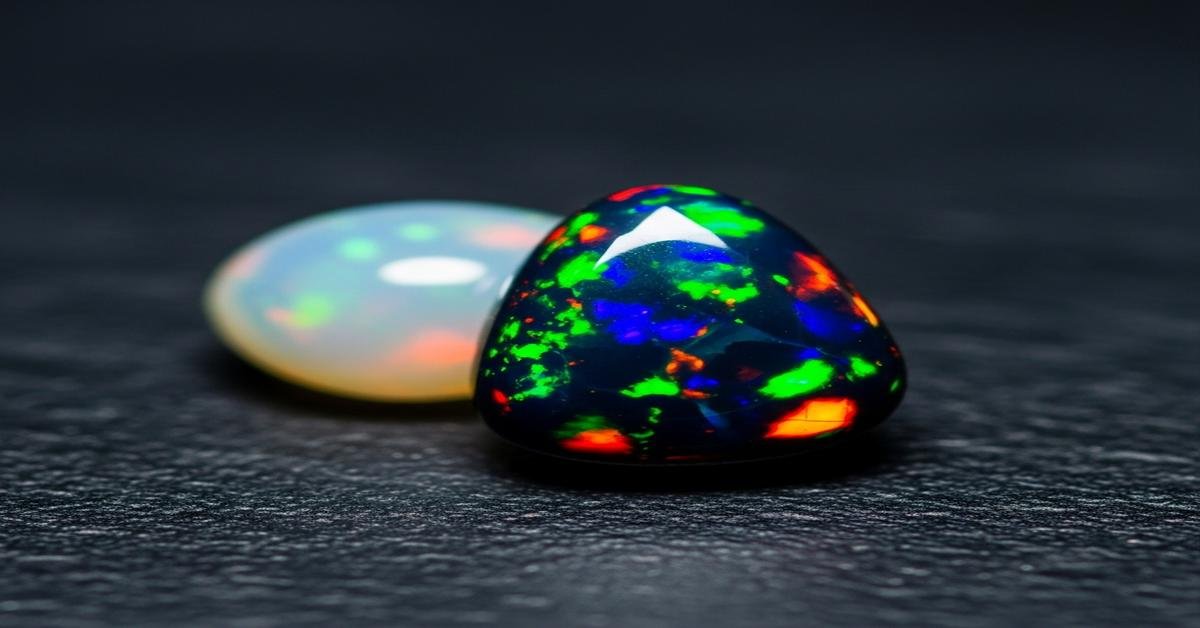
Some opals are naturally black and command high prices because their dark body makes the play-of-color explode with contrast. Others are cheap white opals that have been artificially darkened to imitate this effect. “Smoked” opals fall into that second group. Sellers may present them as natural black opals, but they are simply treated stones with a manufactured body color. Here’s what that treatment is, why it’s deceptive, how it affects the stone’s durability, and the practical ways to spot it before you buy.
What makes a black opal valuable in the first place?
Two things drive value: body tone and play-of-color. A natural black opal has a consistently dark body tone—think charcoal to jet—throughout the stone. That dark background amplifies the neon flashes of color on top. These stones are rare in nature, especially from Australian fields like Lightning Ridge. Because the darkness is internal and uniform, it stays dark from every angle and under any light. That rarity and optical strength push prices into the hundreds or thousands per carat.
By contrast, common white or crystal opal has a pale body tone that doesn’t provide the same contrast. It’s far more abundant and usually far cheaper. Treaters target these pale stones because darkening the body tone can make the colors look far richer, even though the underlying material is common.
What is “smoking” and how does it fake a black body color?
Smoked opal is not burned on a grill. It’s impregnated with carbon. Two common methods are used:
- Smoke treatment: The opal is wrapped (often in foil) and heated with smoldering organic material (wood, resin, oils). Microscopic soot particles enter the stone’s pores and fractures, tinting it gray to black. The particle infiltration is why the stone looks evenly dark at first glance.
- Sugar–acid treatment: The opal is soaked in sugar solution, then in strong acid that carbonizes the sugar within the stone’s pores. The newly formed carbon acts like soot, darkening the body.
Both methods rely on porosity. The most frequently treated opals are hydrophane Ethiopian opals because they absorb water—and, unfortunately, other substances—through a network of microscopic pores. That open structure lets carbon get in where light travels, so the whole stone appears darker and the color looks stronger. It’s convincing to the eye, but it’s not natural.
Why smoked opal is risky and ultimately poor value
Smoked opals are less stable and less predictable than natural black opals:
- Water sensitivity: Hydrophane opals can take up water and lighten in tone, muffle play-of-color, or turn semi-transparent. As the stone dries, the dark look returns. That cycling can confuse buyers and stress the stone.
- Heat and chemical sensitivity: The introduced carbon sits in pores and fractures. Heat, detergents, or solvents can disrupt the appearance. Some stones develop a persistent campfire or burnt sugar odor when warmed.
- Uneven darkening over time: If the carbon is concentrated near the surface, repolishing can reveal a lighter core. Scratches or chips can show light-colored interiors.
- Ethical problem: When not disclosed, the buyer pays a “black opal” price for a cheap, treated stone. Natural black opal is rare; smoked opal is not.
Smoked vs. dyed vs. doublets/triplets—don’t confuse these
- Smoked/cabonized opal: Darkened internally with carbon. The darkness may be throughout or concentrated in pores and fractures.
- Dyed opal: Artificial colorants (often gray/black) sit in surface-reaching cracks and pits. Under magnification, dye looks like paint in crevices.
- Doublets/triplets: Thin opal glued to a dark backing (doublet) and sometimes capped with quartz or glass (triplet). From the side, you can see the layers and the glue line.
All three can create a “black opal look” for far less money. Each should be disclosed. Each prices far below natural black opal.
Fast field checklist: likely signs of smoked or treated opal
Use a 10x loupe, a small flashlight, and a white cloth. These clues are not foolproof alone, but they add up:
- Peppery black specks under magnification, especially along pits, pores, and fractures.
- Darkness that’s strongest at the surface or along edges and seems slightly lighter inside when viewed edge-on with a light.
- Burnt or smoky odor when gently warmed by breath or a low-warmth lamp. Natural opal should have no scent.
- Water absorption behavior: A drop of water may soak in and temporarily lighten or mute the stone. Australian black opal will not do this. Note: do not soak opal—brief, careful observation is enough.
- Color in cracks only: If the black tone pools in surface-reaching fissures like ink, you’re likely looking at dye, not smoke.
- Suspiciously low price for the claimed quality. Genuine black opal with crisp play-of-color rarely sells cheap.
- Layering visible from the side: Indicates a doublet/triplet, not a solid black opal.
Step-by-step at-home observations (non-destructive)
- Edge light test: Hold the opal on white paper. Shine a small flashlight through the edge. In a natural black opal, the interior still looks dark. In a smoked opal, you may see a slightly lighter or hazy interior with darker zones near surface pores.
- Loupe the surface: At 10x, look for tiny black particulate “dust” in pits and along polish lines. Carbon often looks peppery and uneven, unlike a uniform natural body tone.
- Fracture check: If the stone has any surface-reaching fractures or chips, see whether dark color is concentrated in them. That points to dye or carbon infiltration.
- Breath warm-up: Fog the stone lightly with your breath and smell. A smoky, burnt, or sweet “caramelized” scent is a red flag for smoke or sugar–acid treatment.
- Quick water drop (optional, gentle): Place one small drop on a corner for 30–60 seconds, then dry. If the stone briefly turns glassy or the color dulls and returns as it dries, it’s hydrophane Ethiopian opal. That alone isn’t proof of smoking, but it raises the odds of treatment. Australian black opal won’t react.
- Cotton swab test: Lightly wipe an unseen area with isopropyl alcohol on white cotton. If you pick up gray/black residue, it suggests dye. Smoked carbon typically won’t wipe off, but the swab may carry a faint odor.
Important: Avoid harsh solvents, heat, or soaking. These can damage any opal.
What labs look for (and why it works)
Gem labs confirm smoking or dye with tools that go beyond the loupe:
- Microscopy: Aggregates of black particulate in pores and fractures indicate carbon or dye introduction.
- Raman spectroscopy: Graphitic carbon shows characteristic bands; dyes show distinct molecular signals.
- Infrared (FTIR): Reveals hydrophane water features and can help distinguish Ethiopian material that’s more prone to treatment.
This matters because advanced testing can separate naturally dark body tone from a dark look produced by foreign material. If the value is significant, get a report.
Price reality check: what’s reasonable?
Prices vary by size and quality, but ranges help protect you:
- Natural black opal: Often hundreds to thousands per carat for crisp, bright play-of-color. Exceptional stones are far higher.
- Smoked/dyed Ethiopian opal: Commonly tens to low hundreds per carat. If a “black opal” with huge, clean flashes is priced inexplicably low, assume treatment until proven otherwise.
- Doublets/triplets: Usually priced well below solid natural black opal of similar face-up appearance.
The “why” is scarcity. True black opal is rare geologically; smoked opal is as common as the treatable starting material.
Questions to ask any seller
- Is this stone treated in any way, including smoke, dye, sugar–acid, or assembled constructions?
- What is the origin? “Ethiopian Welo” signals hydrophane and higher treatment risk. “Australian Lightning Ridge” is typical for natural black opal, but still verify.
- Is there a lab report? For expensive stones, request one from a recognized lab naming the treatment status.
- Return policy and disclosure in writing? Good sellers stand behind their descriptions.
- Care instructions and warranty against color change? Vague answers are a red flag.
Care: if you already own a smoked opal
- Keep it dry: Avoid soaking, swimming, or steamy environments. Hydrophane opal may change appearance with water.
- Avoid heat and chemicals: No ultrasonic cleaners, no harsh detergents, no jewelry steamers.
- Gentle cleaning only: Soft cloth, mild room-temperature water if absolutely needed, then dry promptly.
- Protect from abrasion: Carbon-darkened surface regions can reveal lighter interiors if repolished too much.
Common pitfalls and edge cases
- Not all dark Ethiopian opals are treated: Natural dark or “chocolate” tones exist but are rarer. A lab report is the safest call when value is high.
- Lighting can mislead: Jewelry store lights exaggerate contrast. Check in diffused daylight and under a neutral LED to judge true body tone.
- One clue is not enough: Use a combination—loupe findings, behavior with water, odor, price, and seller disclosure.
Bottom line
“Smoked” opals use carbon to fake the dark body tone that makes natural black opal valuable. The treatment preys on hydrophane opal’s porosity, and while it can look striking at first, it brings stability risks and ethical concerns when not disclosed. Learn the visual tells—peppery carbon specks, surface-concentrated darkening, hydrophane behavior, odor—and confirm with a lab when the price matters. If a deal looks too good for a black opal, it usually is. Buy with questions, a loupe, and a return policy, and you’ll avoid paying black-opal prices for a dressed-up white stone.

I am Satyam Pandey, a gemologist with a Diploma in Polished Diamond Grading from KGK Academy, Jaipur. I love writing about jewelry, gems, and diamonds, and I share simple, honest reviews and easy buying tips on JewellersReviews.com to help you choose pieces you’ll love with confidence.