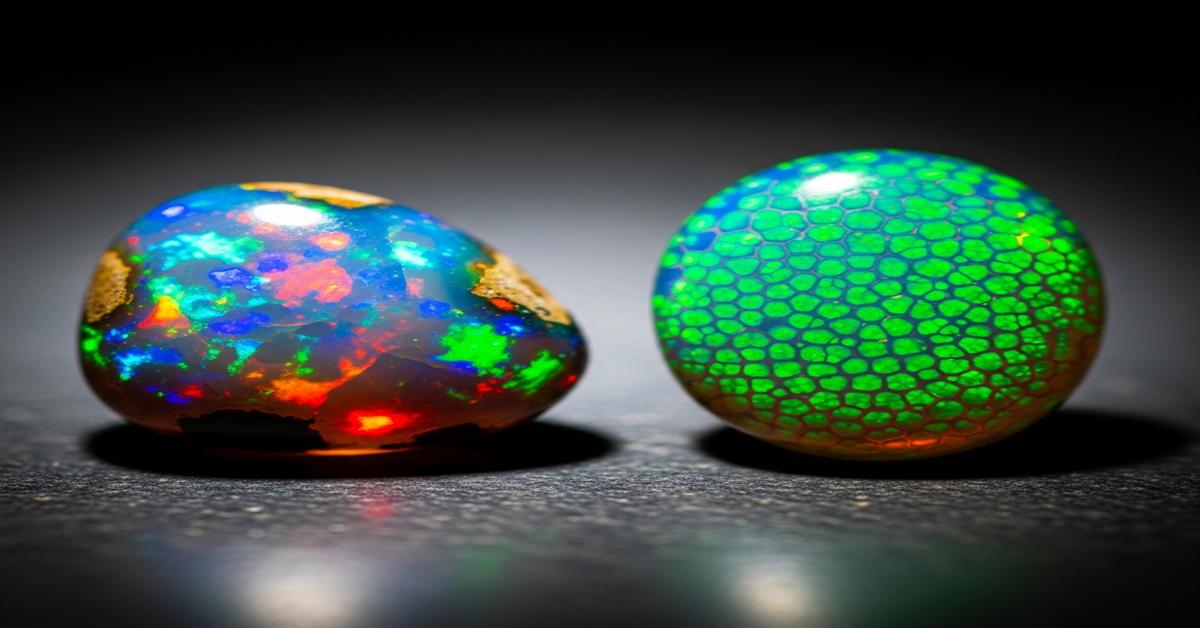
Opal’s magic lives in its “play-of-color” — those sudden spectral flashes that dance as you move the stone. Natural precious opal and Gilson synthetic opal both show this effect, but they do it in different ways. If you know what to look for, you can tell them apart without damaging the gem. This guide explains the physics behind the colors, the visual patterns that matter, and the simple tests gemologists use to separate natural opal from Gilson synthetic.
What creates play-of-color in opal
Play-of-color comes from diffraction. Opal is made of tiny, near-spherical silica particles packed in arrays. When the spheres are similar in size and arranged in a regular way, they act like a 3D diffraction grating. White light enters, and specific wavelengths are reflected back depending on sphere size, spacing, and viewing angle. That reflected wavelength is the color you see.
Two facts drive the differences you’ll see:
- Sphere size controls color. Smaller spheres return blue-green; larger ones return orange-red. If sizes vary, you get many colors in small patches.
- Order vs. disorder controls pattern. Perfect order gives regular, repeating color areas. Disorder breaks the pattern into irregular, patchy flashes.
Natural opal forms slowly in the ground. Its spheres usually vary in size and alignment from place to place. That disorder produces irregular, non-repeating flashes. Gilson synthetic is grown from uniform spheres arranged in a consistent lattice. The order makes color appear in repeating, geometric patches.
What makes Gilson synthetic opal different
Gilson opal is a true synthetic: it reproduces opal’s chemistry and sphere-based structure in a lab. The manufacturer creates almost identical silica spheres and lets them settle into ordered layers, then consolidates them. The result is a block with highly uniform domain sizes and a strong, regular lattice.
Why that matters:
- Uniformity. When sphere size is nearly the same throughout, large areas return the same colors at the same angles. Big swaths change color together as you tilt the stone.
- Columnar growth. Many Gilson pieces show a vertical, column-like internal structure from the way the spheres stacked during growth. That structure imprints a “lizard-skin” or “chicken-wire” pattern on the face and linear color bands on the side.
- Repeatability. Because the lattice is regular, the color pattern often repeats across the stone. Natural opal rarely repeats so cleanly.
Face-up clues: what the play-of-color actually looks like
View the cabochon face in neutral light first, then with a single small light (a phone LED works). Tilt slowly.
- Regular mosaic vs. chaotic patchwork. Gilson often shows a neat mosaic of polygonal cells — think honeycomb or lizard skin — with thin dark outlines between color cells. Natural opal’s cells are less uniform; patch edges are uneven, sizes vary, and the mosaic looks “messy” rather than tiled.
- Synchronized flashing. In Gilson, large zones flip color together with a small tilt. In natural opal, the flicker is more independent; one area will light while the next stays quiet, then they trade places.
- Color banding direction. Rotate the stone 90°. In Gilson, the broad flashes often “track” along consistent directions because the lattice domains are aligned. Natural opal tends to switch in less predictable ways.
- Cell size consistency. Gilson cells maintain a similar size across the face. Natural cell sizes wander — pinfire here, broadflash there — in a way that feels organic.
- Harlequin imitation. Gilson can mimic the rare “harlequin” pattern, but the tiles look too even and often too perfectly aligned. Natural harlequin tiles look more irregular in shape and spacing.
Why these work: Play-of-color is an angle-dependent reflection from crystal-like planes in the sphere lattice. A uniform, ordered lattice behaves like a well-made diffraction grating: neat, repeatable, and coherent over larger areas. Natural opal’s lattice is interrupted and mixed; color turns on and off in smaller, irregular domains.
Side-view and edge tests with a loupe
Turn the cabochon sideways. Use a 10× loupe. Look through the girdle or the back if it is polished.
- Columnar or stacked structure (Gilson). You may see fine vertical columns or stacked bands of color, like layers in a cake or straws bundled together. These are growth domains formed as the spheres settled layer by layer.
- Potch-color layering (natural). Natural opal often sits atop potch (common opal without play-of-color) and can show irregular, wavy boundaries between potch and color layers. The layers look organic, not mechanical.
- Repeating parallel lines (Gilson). Linear internal planes repeating at regular intervals along the side are a red flag for lab growth.
Why this works: Natural sedimentary processes produce uneven, wavy boundaries. Synthetic settling produces straighter, repeatable planes.
Microscope checks that settle the question
At 20–40× magnification, the diagnostics become clearer.
- Lizard-skin polygons (Gilson). Face-up, look for a network of small, polygonal color cells outlined by thin, darker boundaries. The polygons are often similar in size and repeat across the field.
- Randomized patch edges (natural). Boundaries are fuzzy, sizes vary, and the geometry lacks repetition. Inclusions such as tiny sand grains, iron oxides, or wispy potch are a natural giveaway.
- Void trains or straight seams (Gilson). You may see straight, fine seams or rows of tiny voids lining up with the columnar structure. Natural opal rarely shows such regularity.
- Crazing context (natural). If there are stress cracks (crazing), in natural opal they cross color domains irregularly and change width. Avoid using crazing alone as proof; some natural opals never craze, and some synthetics can develop surface cracks from wear.
Why this works: The ordered lattice in Gilson opal creates geometric domains. Natural opal’s growth interruptions and mixed sphere sizes blur that geometry.
Lighting and tilt: simple field tests
- Pinpoint light sweep. In a dark area, sweep a single LED across the face. In Gilson, large areas light up and extinguish together; in natural, you get a micro-strobe of tiny, independent flashes.
- White card test. Place the stone on a white card and tilt slowly under diffused light. The contrast makes geometric repetition easier to see in Gilson.
- Cross-tilt. Tilt north–south, then east–west. Gilson flashes will “follow” a directional logic due to aligned domains; natural opal will not.
These tests rely on the angle-dependent nature of diffraction. Uniform domains respond in sync; mixed domains respond independently.
Instrument data: helpful but not decisive
- Refractive index (RI). Both natural and Gilson opal read around 1.37 (spot RI). This doesn’t separate them.
- Specific gravity (SG). Natural opal roughly 1.98–2.25; Gilson often 1.90–2.10. Overlap is common. Porosity and water content blur the numbers.
- Fluorescence. Some Gilson opals show a moderate greenish fluorescence under SW UV; many naturals are inert to weak. But natural opal can fluoresce too. Use this only as supporting evidence.
- Spectrum. No consistent diagnostic absorption lines for either. Not useful.
Why instruments fall short: The chemistry and basic optics are the same. Structure and pattern, not bulk properties, are the reliable clues.
Don’t confuse with these lookalikes
- Doublets and triplets. These are assembled stones with a thin natural opal layer. Check the side: a sharp glue line between a dark backing and the opal cap (doublet) or between opal and a clear top (triplet) is obvious. They can show natural patterns but are not solid opal.
- Plastic “opal” simulants. Some plastics show glittery, flaky color rather than true diffraction. Under magnification, you see foil-like flecks and swirl marks. RI and SG are much lower than opal.
- Welo honeycomb (natural). Ethiopian (Welo) opal can show a honeycomb-like pattern naturally. The cells vary more in size and shape, boundaries look softer, and side views lack the straight, columnar repetition typical of Gilson.
A practical, step-by-step workflow
- 1. Start face-up, diffused light. Note the overall “feel” of the pattern. Is it tiled and even, or irregular and organic?
- 2. Do the tilt tests. Use a single LED. Watch if large areas flash in sync (Gilson tendency) or if flashes dance independently (natural tendency).
- 3. Check the edge at 10×. Look for columnar or stacked banding (Gilson) versus wavy, uneven potch-color layering (natural). Eliminate doublets/triplets by spotting glue lines.
- 4. Go to 20–40× if available. Seek lizard-skin polygons with repeating size (Gilson) versus irregular patches and natural inclusions (natural).
- 5. Use UV and SG only as backup. Treat fluorescence and heft as supporting clues, not proof.
- 6. Combine clues, don’t rely on one. Pattern regularity + synchronized flashing + columnar side-view is a strong Gilson signature.
Why disclosure and context matter
Gilson synthetic opal is durable, beautiful, and legitimate. It simply isn’t natural. Clear labeling protects buyers and the trade. If the price is far below market for the color and size, assume synthetic until proven otherwise. Provenance, vendor reputation, and a lab report remove doubt.
Quick reference: pattern cues you can trust
- Geometry: Repeating polygons with neat outlines favor Gilson. Irregular, non-repeating patches favor natural.
- Synchronization: Large areas flipping color together favors Gilson. Chaotic micro-flicker favors natural.
- Side view: Columnar/stacked internal lines favor Gilson. Wavy, uneven natural layering favors natural.
- Inclusions: Natural mineral specks and potch wisps favor natural. Clean interior with geometric order favors Gilson.
Bottom line: Both natural and Gilson opal owe their play-of-color to diffracting silica spheres. The difference is how neatly those spheres are arranged. Nature’s disorder writes irregular, lively patterns. Gilson’s order writes tidy mosaics that flash in sync. Train your eye on the pattern, verify with the side view, and use instruments as support, not a crutch. With practice, you can call it confidently from arm’s length — and be right when you put it under the microscope.

I am Satyam Pandey, a gemologist with a Diploma in Polished Diamond Grading from KGK Academy, Jaipur. I love writing about jewelry, gems, and diamonds, and I share simple, honest reviews and easy buying tips on JewellersReviews.com to help you choose pieces you’ll love with confidence.