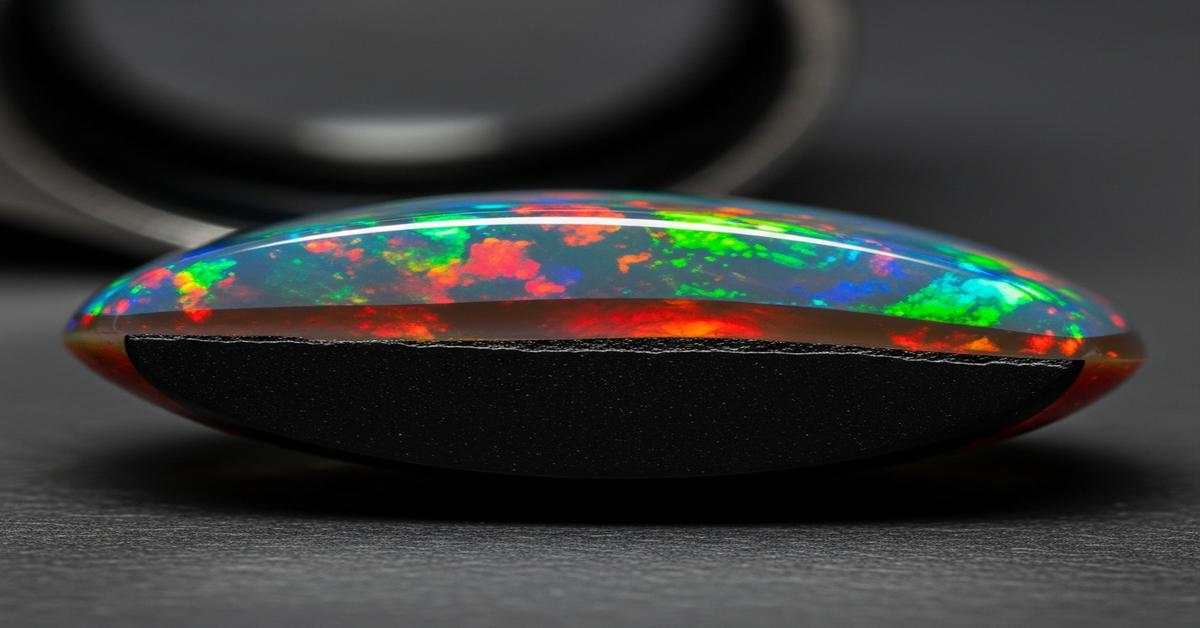
Opal’s color play is mesmerizing, so it’s no surprise that sellers try to stretch a small slice of opal into a bigger profit. One common trick is mounting a wafer-thin piece of precious opal onto a dark backing—or sandwiching it under a clear cap—then selling it as a “black opal.” If the backing is black plastic, you’re looking at a composite stone (a doublet or triplet), not a solid opal. That isn’t a problem by itself—assembled stones can be legitimate— but it becomes a scam when the seller hides the construction or prices it like a natural solid.
What “doublet” and “triplet” actually mean
A solid opal is a single piece of natural opal cut and polished. A doublet is a thin slice of natural precious opal glued to a backing. A triplet has three layers: a dark backing, a very thin opal layer, and a clear cap on top.
- Doublet backings can be natural materials (common opal “potch,” ironstone, basalt) or synthetic (plastic, resin, fiberboard). Black plastic is common because it’s cheap and evenly dark.
- Triplet caps are usually quartz, glass, or plastic. The clear cap protects a very thin opal slice and can act like a magnifying lens.
None of these are “fake opal.” The problem is misrepresentation: calling a doublet or triplet a “solid black opal,” or pricing it as one.
Why black plastic backings fool buyers
Opal looks darker—and more vivid—against a dark background. A black plastic backing creates the appearance of a high-value black opal from a tiny, low-cost shard. This is why doublets and triplets can look better than many solids at first glance. The backing doesn’t just intensify color; it also hides transparency and body tone that would normally signal a cheaper opal.
Triplets go further. The clear dome on top can magnify the color layer, making flashes look bigger and brighter. That’s intentional. It helps a paper-thin opal slice look rich while using very little natural material.
How to spot a composite opal in seconds (non-destructive checks)
You don’t need lab gear to catch most doublets and triplets. A few careful observations will do it.
- Edge view test: Tilt the stone and look at the rim under bright light. A solid opal shows one continuous material. A doublet shows a horizontal join line: colorful opal on top, dark backing below. A triplet shows two joins: clear cap on top, opal in the middle, dark backing below.
- Top surface clues: Many triplets have an unusually high, glassy dome. The surface may look too “glassy” compared to the silky luster of opal. If the dome creates a lens effect that slightly magnifies the pattern, suspect a cap.
- Back appearance: Solid opals typically have a natural-looking back with uneven color or matrix. Doublets and triplets often have a uniform, matte or glossy black back. If it looks like molded plastic—perfectly smooth, perfectly black—that’s a red flag.
- Color at the edge: In a solid opal, play-of-color often rolls over the edges. In a doublet or triplet, the color can stop abruptly at the join line because the opal layer is thin.
- Fog test (gentle): Breathe lightly on the surface. If there’s a cap, the condensation can highlight the boundary between layers as a faint circle near the edge. This is not foolproof, but it’s quick and safe.
- Weight feel: Triplets with glass or quartz caps can feel heavier than they look; those with plastic components can feel unexpectedly light. Extreme lightness or heaviness compared to size can signal a composite.
Stronger confirmation with a loupe
Use a 10x loupe if you have one. You’re looking for manufacturing signs.
- Glue line: A straight, clean line between layers is common in doublets and triplets. You may see a thin, dark adhesive layer or tiny trapped bubbles at the join.
- Cap material: Under magnification, a glass or quartz cap often shows a different surface texture and a clearer, colder “shine” than opal. Micro-scratches on plastic caps are also easier to see than on quartz.
- Thickness mismatch: The opal layer in a triplet can be paper-thin—sometimes a fraction of a millimeter. That wafer look is a giveaway when you view the edge.
Avoid destructive tests like hot needles or solvents. They can ruin a stone and create harmful fumes. Non-destructive observation is enough for most cases.
Value: what a composite opal should cost
Doublets and triplets are budget-friendly ways to wear real opal color, but they are worth a fraction of a comparable-looking solid. Why? The backing and cap do most of the visual heavy lifting, and the actual opal content is small. Also, adhesives and caps reduce long-term durability and repair options.
- Solids: Priced by carat. Fine black opals command high prices because the color is natural to the stone’s body and the piece is durable as one solid material.
- Doublets: Often priced per piece or at a steep discount relative to solids with similar face-up appeal. As a rough guide, many trade at a small fraction of the price of visually similar solids.
- Triplets: Usually the most affordable. Some are sold by piece rather than by carat, since most of the weight is cap and backing.
Be cautious with “per carat” pricing on composites. The carat weight includes non-opal materials, so the “price per carat” can be misleading.
Durability and care: composites need gentler treatment
A solid opal is a single material. A composite is a stack of different materials glued together. That difference matters in wear and maintenance.
- Water and chemicals: Prolonged soaking can creep into the glue line and cause cloudiness or delamination. Remove doublets/triplets before swimming, showering, or cleaning.
- Heat and sudden temperature change: Different layers expand at different rates. Rapid temperature swings can stress the joins. Keep away from hot car dashboards, steam, or jewelry torches.
- Cleaning: Use a soft damp cloth only. Avoid ultrasonic and steam cleaners; avoid strong detergents.
- Scratching: Plastic caps scratch easily. Glass caps resist better but can still abrade. Quartz caps are harder but can chip. Store the piece separately.
- Repairs and resizing: Heat from torch work can damage composites. If a ring needs resizing, tell your jeweler it’s a doublet or triplet so they can use low-heat methods.
Questions to ask before you buy
Clear, specific questions force honest disclosure. If a seller is vague, walk away.
- Is this a solid opal, doublet, or triplet? Don’t accept “natural opal” as an answer. Doublets and triplets contain natural opal but are not solids.
- What is the backing made of? Ask specifically about black plastic or resin vs. natural backing (potch, ironstone).
- If it’s a triplet, what is the cap material? Quartz, glass, or plastic?
- How thick is the opal layer? Thin layers are typical in triplets; you’re paying for appearance, not weight.
- How is it priced? Per carat or per piece? What is the return policy if an independent appraisal identifies a composite?
- Any treatments? Some opals are smoked, dyed, or resin-impregnated. These should be disclosed.
Listing red flags that often signal a composite
- “Black opal” at a suspiciously low price for its size and brightness.
- Uniform jet-black back with a perfectly smooth, molded look.
- High, glassy dome with a faint lens effect on the pattern.
- Vague descriptions like “natural opal” without stating solid/doublet/triplet.
- Weight emphasized over construction, especially “massive carat weight” for a low price.
If you already own one
If you discover your “black opal” is a doublet or triplet, you still have options.
- Keep and enjoy it for what it is. Many composites look fantastic if you treat them gently.
- Ask the seller for a remedy if it was sold as a solid or priced like one. Request a refund or partial credit.
- Get a written appraisal identifying the stone as a doublet or triplet; this supports returns and insurance.
- Service carefully. If it becomes cloudy or delaminates, a skilled cutter may be able to rebuild the piece, but costs can exceed the stone’s value.
Solid vs. composite: a quick side-by-side checklist
- Layers visible at edge? Yes = composite; No = likely solid.
- Back looks molded jet black? Likely doublet/triplet with plastic backing.
- High glassy dome with lens effect? Likely triplet (cap on top).
- Color wraps over the edge? More typical in solid; abrupt stop suggests thin opal layer.
- Sold per carat at a bargain price? Be cautious; composites shouldn’t be priced like fine solids.
Bottom line
If your opal’s back is black plastic, it’s a composite—at best a disclosed doublet or triplet, at worst a misrepresented “black opal.” The stone can still be pretty and wearable, but it shouldn’t carry the price or expectations of a solid opal. Learn the simple edge-view and surface clues above, ask direct questions, and you’ll avoid paying solid-opal prices for a clever stack of glue, cap, and a sliver of color.

I am Satyam Pandey, a gemologist with a Diploma in Polished Diamond Grading from KGK Academy, Jaipur. I love writing about jewelry, gems, and diamonds, and I share simple, honest reviews and easy buying tips on JewellersReviews.com to help you choose pieces you’ll love with confidence.