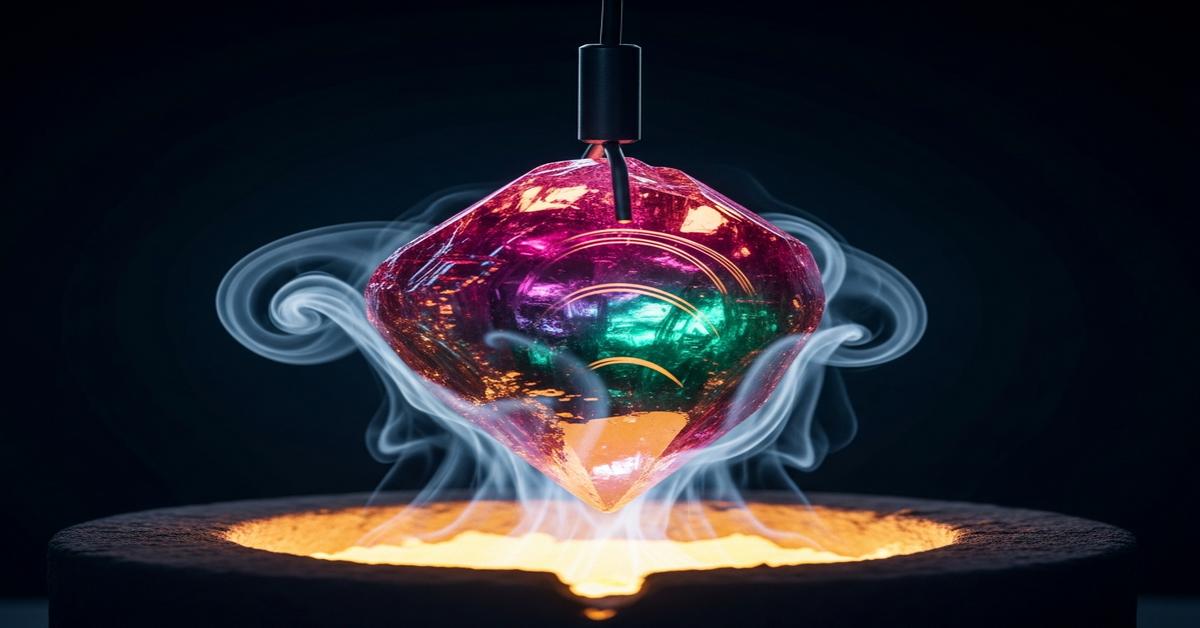
Alexandrite’s color-change is magic. Under daylight it looks green; under warm light it turns red. Natural stones do this because of chromium in chrysoberyl’s crystal lattice. Today, labs can reproduce that with high precision using the Czochralski, or “pulled,” growth method. If you know how the process works, you can recognize its fingerprints under the microscope. This guide explains how pulled alexandrite is made, and the specific microscopic signs that expose it.
What “pulled” growth really means
The Czochralski method is a melt-growth technique. Instead of dissolving the material in a flux or water solution, the entire charge is melted and a crystal is “pulled” out of the liquid.
- The charge: High-purity alumina (Al₂O₃) and beryllia (BeO) are mixed with a tiny amount of chromium oxide (Cr₂O₃). Chromium is what gives alexandrite its color-change. A trace of vanadium may be added to fine-tune hue and saturation.
- The crucible: The mix is melted in an iridium crucible. Iridium survives the extreme temperatures chrysoberyl needs (about 1870 °C). The melt composition and oxygen level are tightly controlled; both change how much chromium the crystal accepts and how bright the color-change will be.
- Seeding: A small piece of chrysoberyl called the seed is dipped into the melt. The seed is oriented to favor a stable growth direction. Orientation matters; it affects pleochroism and the cutting options later.
- Pulling and rotation: The seed is withdrawn slowly (often 1–5 mm/hour) while rotating a few tens to a few hundreds of rpm. Pulling defines the thermal gradient. Rotation evens out temperature and chemistry at the growth front. The crystal lengthens into a carrot-shaped “boule.”
- Cooling and annealing: The boule is detached and cooled carefully. Quick cooling builds stress; controlled cool-down (and sometimes annealing) reduces the risk of cracks but doesn’t erase all internal strain.
Every one of those steps leaves structure in the crystal. Rotation imprints curved growth patterns. Dissolved gases can become trapped as bubbles. The crucible can shed tiny metallic particles. Thermal gradients lock in strain. Those are the clues a gemologist looks for.
Why labs use Czochralski for alexandrite
Alexandrite is orthorhombic chrysoberyl doped mainly with chromium. The color-change depends on the exact chromium concentration, how chromium substitutes into the lattice, and how iron or vanadium interfere with its light absorption. Melt growth gives the operator precise control over these variables.
- Consistent chemistry: The melt is uniform. That produces even color and repeatable change from green to red. Natural crystals are patchy because the earth’s chemistry fluctuates during growth.
- Size and clarity: Pulling can produce clean, large boules with few cracks. That’s hard to find in nature, where twinning, zoning, and included minerals are common.
- Orientation on demand: Because the seed orientation is chosen, cutters can plan for maximum color-change and brightness. Nature doesn’t plan for you.
The same advantages create diagnostic differences. Uniform chemistry means smoother zoning. Controlled growth means certain man-made patterns repeat predictably. Those contrasts are what you see under magnification.
Microscopic fingerprints of pulled alexandrite
Several features, seen together, strongly indicate Czochralski-grown alexandrite. Each has a physical reason rooted in the process.
- Curved growth striae (pulling lines): Fine, slightly wavy or curved lines sweep across the stone, often in arcs or shallow S-shaped bands. They are best seen with fiber-optic or oblique lighting. They form because the crystal rotates as it grows. Small fluctuations in chromium uptake show up as color intensity variations along the growth front, which is curved relative to the seed and crucible. Nature’s growth planes in chrysoberyl are geometric and straight; curved, rhythmic striae are a synthetic melt-growth hallmark.
- Swirl zoning: Instead of straight sector boundaries, you may see gentle “swirls” or sweeping chevrons that look stirred. That pattern reflects convection currents in the melt coupled with rotation. In naturals, zoning is typically angular and follows crystal forms; it does not look stirred.
- Gas bubbles: Isolated, perfectly round bubbles, sometimes in short strings, occur along striae. Some are slightly elongated in the pulling direction. They result from gases (often dissolved oxygen or volatile impurities) coming out of solution at the growth front. Natural alexandrite very rarely traps perfect spheres; it more often shows negative crystals, liquid films, or multiphase inclusions with angular outlines.
- Metallic particles from the crucible: Minute, highly reflective, opaque dark platelets or specks can occur, occasionally in thin layers. They’re from iridium crucible wear. Under reflected light they flash bright; in transmitted light they appear black with sharp edges. Natural stones do not contain iridium debris.
- Low-density “clean” interiors plus localized strain: Pulled alexandrite often looks extraordinarily clean—until you cross-polarize. Under crossed polars, you’ll see bright, patchy interference colors, undulating bands, and a “mosaic” extinction that changes as you tilt the stone. Rapid growth and steep thermal gradients generate dislocations and internal stress. Natural chrysoberyl has strain too, but it more often shows clearly defined polysynthetic twin lamellae and parting planes that read as straight, repetitive lines rather than diffuse mosaic patterns.
- Seed interface or core: Some stones show a subtle boundary between the initial seed region and later growth, visible as a slight color or inclusion change across a curved line. That’s the “start” of the boule preserved in the cut stone.
- Uniform color-change with limited pleochroic patchiness: Because chemistry is controlled, the change from green to red is smooth across the stone. Natural crystals often show sectors that change color differently or zones with differing saturation. While this is not diagnostic by itself, it supports other evidence.
How to see the clues in practice
Method matters. Many of these features hide unless you set up the observation correctly.
- Magnification: Use 10x–40x. Higher power helps resolve very fine striae and tiny metallic platelets.
- Lighting: Curved striae and bubbles show under fiber-optic light swept across the surface at a shallow angle. Darkfield helps isolate bubbles as bright points against a dark background.
- Immersion: Put the stone in a matching liquid (like di-iodomethane substitutes) to reduce surface reflections. Zoning and striae “pop” in immersion.
- Crossed polars: Rotate the stone between crossed polarizing filters. Note patchy, irregular strain rather than straight, repeating lamellae. Tilt the stone to see the strain fringes move.
- Spectroscope: Expect strong chromium lines in the red (the “R-lines” around 680 nm) and absorption in the yellow-green. This confirms chromium but does not separate natural from synthetic. Very strong, crisp lines with intense red fluorescence may hint at low iron typical of synthetics.
- UV response: Many pulled alexandrites show moderate to strong red fluorescence in long-wave UV if iron is low. Some natural stones are weak to inert due to higher iron. Treat this as supportive, not decisive.
Pulled vs. flux-grown vs. natural: the quick contrasts
- Pulled (Czochralski): Curved growth striae; round or slightly elongated gas bubbles; occasional iridium specks; clean interiors with mosaic strain. Zoning appears in wide sweeps or arcs.
- Flux-grown: Wispy, “fingerprint-like” flux veils and negative crystals; residue-filled cavities; frequent metallic platinum platelets from the flux crucible; angular growth features rather than smoothly curved striae. Interiors may look “feathery” rather than clean.
- Natural: Mineral inclusions (mica-like platelets, spinel, rutile needles), liquid films, multiphase inclusions, healed feathers; polysynthetic twinning and parting on straight planes; angular color zoning tied to crystal forms; no curved striae; bubbles are uncommon and rarely perfect spheres.
No single clue is enough. The pattern of evidence is what matters.
Common pitfalls and how to avoid them
- Confusing polishing marks with striae: Polishing lines sit on the surface and follow lap direction. Rotate the stone and change lighting; true striae stay put inside the gem and curve smoothly.
- Reading heat-induced strain as synthetic: Natural stones can show stress after cutting or heating. Look for the type of strain. Synthetic mosaic strain lacks the straight, evenly spaced twin lamellae that chrysoberyl often displays.
- Assuming fluorescence proves synthetic: It does not. Use it only alongside inclusion and growth evidence.
- Overreliance on “cleanliness”: Some naturals are very clean, and some synthetics include flux-like veils if misidentified growth methods are in play. Always search deliberately for curved striae and bubbles in strings.
Why these features exist: the physics in brief
- Curved striae: Rotation and small temperature oscillations change how much chromium enters the lattice at the growth interface, drawing compositional contours that are curved relative to the pulling axis.
- Bubbles: Melt contains dissolved gases. As the crystal solidifies, solubility drops and microscopic bubbles nucleate. Smooth, spherical shapes reflect surface tension in a fluid pocket, something rarely preserved in nature’s high-pressure growth environment.
- Metallic particles: Mechanical or chemical erosion at the crucible wall sheds iridium into the melt. Some particles get trapped at the freezing front and end up as bright platelets.
- Strain fields: Fast growth and steep thermal gradients build dislocations. These distort the crystal’s optical path, giving the patchy interference colors seen between crossed polars.
Putting it together: a simple workflow
- Start with immersion and fiber-optic light. Scan for curved striae and strings of round bubbles.
- Switch to darkfield. Confirm perfectly spherical or slightly elongated bubbles and look for bright metallic specks.
- Use crossed polars. Note mosaic strain rather than straight twin lamellae.
- Check overall zoning. Is it smooth and sweeping, not angular? That supports a pulled origin.
- Record spectroscope and UV reactions as supporting data, not primary evidence.
Bottom line
Pulled (Czochralski) alexandrite is engineered for beauty and consistency. The same controls that create its even color-change also stamp it with telltale microstructures: curved growth striae, spherical bubbles, occasional iridium platelets, and a clean interior crossed by patchy strain. See those together, and you are almost certainly looking at a synthetic grown from a melt. Know the “why” behind each clue, and your microscope becomes a lie detector.

I am Satyam Pandey, a gemologist with a Diploma in Polished Diamond Grading from KGK Academy, Jaipur. I love writing about jewelry, gems, and diamonds, and I share simple, honest reviews and easy buying tips on JewellersReviews.com to help you choose pieces you’ll love with confidence.