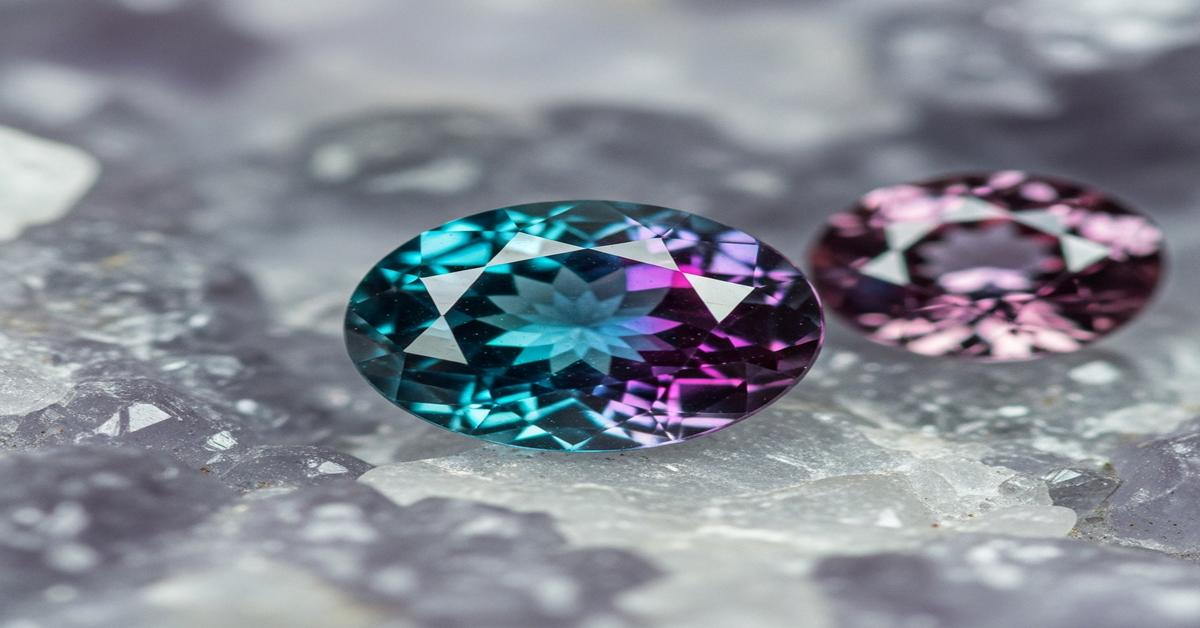
Natural alexandrite is one of the rarest gemstones on earth. Fine stones can sell for $10,000–$30,000 per carat, and exceptional pieces go far higher. So when someone pays $500 for a “1-carat alexandrite” with a bold green-to-red color change, there’s only one likely reason: it isn’t natural. It’s either lab-grown alexandrite or a different gem sold as alexandrite. Here’s how to tell the difference, why the price gap is so wide, and what to do next.
Why natural alexandrite is stunningly expensive
Alexandrite is the color-change variety of chrysoberyl colored by chromium. It shifts from green in daylight to red in warm indoor light. That shift requires a narrow mix of chemistry and geology. Those conditions are incredibly rare and don’t occur often enough to meet demand.
- Geology is the bottleneck. You need beryllium-rich rocks, chromium to color it, low iron (so the color-change isn’t muddy), and the right pressure and temperature to grow gem-quality crystals. Those things rarely line up.
- Most naturals are small, included, and muted. Clean stones over 1 carat with a strong green-to-red change are scarce. Over 2 carats is rarer still. Over 5 carats with fine color is museum-level. Scarcity drives price.
- There’s no common treatment that cheaply upgrades it. Unlike sapphire or ruby, you can’t simply heat or fill most alexandrite and fix its color. What nature gave is what you have.
That is why a natural, well-cut 1-carat alexandrite with a strong change routinely commands five figures per carat. The supply is limited; the demand isn’t.
So why is yours $500?
Because price follows supply. Two scenarios explain a low price:
- It’s lab-grown alexandrite. Flux or hydrothermal methods can create alexandrite with dramatic color change and good clarity in months, not millions of years. Cost is much lower, and supply is scalable.
- It isn’t alexandrite at all. Many “alexandrite” listings are color-change sapphire, spinel, glass, or synthetics labeled as “alexandrite.” Sellers sometimes say “simulated” in fine print or rely on vague phrases like “created,” “lab,” or “Alex-type.”
There are rarer exceptions: a small, heavily included natural with weak color change might sell under $1,000. But a clean, bright, strongly changing 1–2 carat for $500? Not natural.
Quick checks you can do at home
These clues don’t prove origin, but they help you spot the obvious.
- Price-to-size mismatch. Natural stones over 1 carat with clean clarity and strong color change will not be a few hundred dollars. If the price looks like a bargain, it’s almost certainly lab-grown or a simulant.
- Lighting test done right. View the gem:
- In daylight (near a window at midday).
- Under warm incandescent or halogen light (2700–3000K). Not cool LED.
A natural often shows bluish-green to green in daylight and red to purplish-red in warm light. Many naturals have some gray or brown masking; a perfect emerald-green to raspberry-red flip is more common in lab stones.
- Clarity and cut “too perfect.” Naturals often show small inclusions and compromise cuts that preserve weight. Lab stones are often eye-clean, symmetrically cut, and very bright.
- Size reality check. Natural, fine 2–3 carat alexandrite is very rare and very costly. A 3-carat “natural alexandrite” under $2,000 is a red flag.
- Labeling language. Words like “created,” “lab,” “synthetic,” “simulated,” “nano,” “Chatham,” “Tairus,” or “Czochralski/flux-grown” indicate non-natural origin. “Genuine” sometimes only means “real gemstone,” not natural.
- Look with a 10x loupe. Eye some telltale textures:
- Flux-grown synthetics often show wispy “flux veils,” snow-like clouds, or reflective metallic platelets (from platinum or other crucible metals).
- Natural stones commonly show fine parallel growth lines, twinning planes, angular zoning, healed fingerprints, and natural crystals trapped inside. None of these alone prove origin, but metallic platelets are strong evidence of flux growth.
What the pros check to settle it
A gemologist or lab can answer the question definitively. Here’s how and why their tests work.
- Microscopy is the fastest, most reliable method. Growth features and inclusions are “fingerprints” of formation.
- Flux-grown synthetic alexandrite: wispy flux veils, droplets, granular “breadcrumb” textures, and flat, reflective platelets are classic.
- Natural alexandrite: angular growth zoning, polysynthetic twinning, healed fissures, and natural mineral inclusions (e.g., tiny crystals) are common.
- Refractive index (RI) and birefringence confirm species. Alexandrite (chrysoberyl) is typically RI 1.741–1.760 with birefringence 0.008–0.010. This separates it from glass and many simulants, though not natural vs synthetic.
- Specific gravity (SG) around 3.73 supports chrysoberyl ID. Again, it’s good for spotting impostors, not origin.
- Spectroscope shows chromium absorption lines typical of alexandrite. Both natural and synthetic can show them, but spectra confirm you’re not dealing with a non-Cr simulant.
- UV fluorescence can help: many Cr-bearing alexandrites show weak red fluorescence. Some synthetics fluoresce more strongly. It’s supportive, not decisive.
- Advanced chemistry (LA-ICP-MS, EDXRF) can detect trace elements or platinum residues from flux growth. Labs use this when microscopy is ambiguous.
- Formal reports from major labs state natural vs synthetic, identify color-change strength, and sometimes origin. This is the gold standard for higher-value stones.
Natural vs lab-grown vs simulant: clean definitions
- Natural alexandrite: mined chrysoberyl with chromium, formed in the earth. Rarer, pricier, often included, with variable color change.
- Lab-grown (synthetic) alexandrite: chrysoberyl with the same chemistry and structure as natural, grown by flux or hydrothermal methods. Often cleaner, larger, and with strong, “ideal” color change. Much cheaper.
- Simulants: different materials that only mimic the look.
- Color-change sapphire or spinel: can shift blue/purple but have different RI/SG and growth patterns.
- Glass, YAG, or other synthetics: often show bubbles, low hardness, and incorrect RI.
- “Lab alexandrite” mislabels: some sellers call color-change corundum “alexandrite.” It isn’t.
Color change: what “strong” really looks like
Color-change quality has tiers. A gem might go from green to reddish, but the purity of both hues and the percentage of change matter.
- Daylight hue: The most prized naturals are pure green to bluish-green. Yellowish or gray-green lowers value.
- Incandescent hue: The best shift to red or purplish-red, not brownish or muddy.
- Extent of change: Strong change (often described as 80–100%) is scarce in naturals, especially in sizes above 1 carat. Very dramatic flips are common in lab-grown stones.
This is why your $500 stone may look spectacular: lab growth can target chromium levels that deliver that theatrical flip. Nature rarely does—at least not cheaply.
Real-world price ranges to sanity-check a listing
Prices vary by hue, change, clarity, cut, and size, but these are reasonable ballparks for 1-carat stones:
- Natural alexandrite, fine: $10,000–$30,000+/ct. Exceptional Russian/Brazilian can exceed this.
- Natural alexandrite, commercial (noticeable but not perfect change, some inclusions): $3,000–$10,000/ct.
- Lab-grown alexandrite: typically $50–$500/ct depending on size and make.
- Simulants (color-change sapphire/spinel/glass): usually under $100–$300/ct.
If a stone is 2–3 carats with a vivid change and is priced like lab-grown, it probably is lab-grown.
How sellers should disclose—and where it goes wrong
- Correct disclosure: “Natural alexandrite,” “Synthetic alexandrite,” or “Color-change sapphire” are clear terms.
- Common red flags: “Genuine alexandrite” (but it’s synthetic), “Created alexandrite,” “Simulated alexandrite,” or burying “lab” in the fine print. Some listings show a lab report for a different stone or only say “chrysoberyl” without the natural/synthetic line.
Always read the full description and ask for a lab report if the price is high. A real report should explicitly say “Natural chrysoberyl var. alexandrite” and note color-change observations.
What to do if you suspect it’s lab-grown
- Check the return window and contact the seller in writing. Be direct and factual.
- Get an independent lab report. A basic identification and origin report is typically a modest fee compared to the value difference. The report will say natural or synthetic and whether it’s even alexandrite.
- Compare the report to the listing. If it contradicts, request a refund based on misrepresentation.
- If you keep it, price it correctly. Lab-grown alexandrite is beautiful and durable. Just don’t insure or resell it as natural.
A practical buying checklist
- Demand clear labeling: natural vs synthetic vs simulant.
- Use the lighting test: daylight vs warm incandescent, not cool LED only.
- Sanity-check price vs size: a clean, strong-change 1 ct natural isn’t hundreds of dollars.
- Ask for a lab report on anything over about $2,000—or any “bargain.”
- Loupe the inclusions: metallic platelets or wispy flux veils suggest synthetic; bubbles suggest glass.
- Verify basics: RI around 1.74–1.76 and SG ~3.73 confirm chrysoberyl rather than a lookalike.
- Expect natural imperfections: some inclusions, imperfect symmetry, and nuanced color are normal in naturals.
The bottom line: if you paid $500 for a crisp, clean, 1–2 carat stone with a vivid green-to-red flip, you almost certainly bought a lab-grown alexandrite or a simulant. That doesn’t make it worthless—it just means it isn’t the geological miracle that commands $15,000 per carat. Know the signs, test when in doubt, and match price to reality.

I am Satyam Pandey, a gemologist with a Diploma in Polished Diamond Grading from KGK Academy, Jaipur. I love writing about jewelry, gems, and diamonds, and I share simple, honest reviews and easy buying tips on JewellersReviews.com to help you choose pieces you’ll love with confidence.