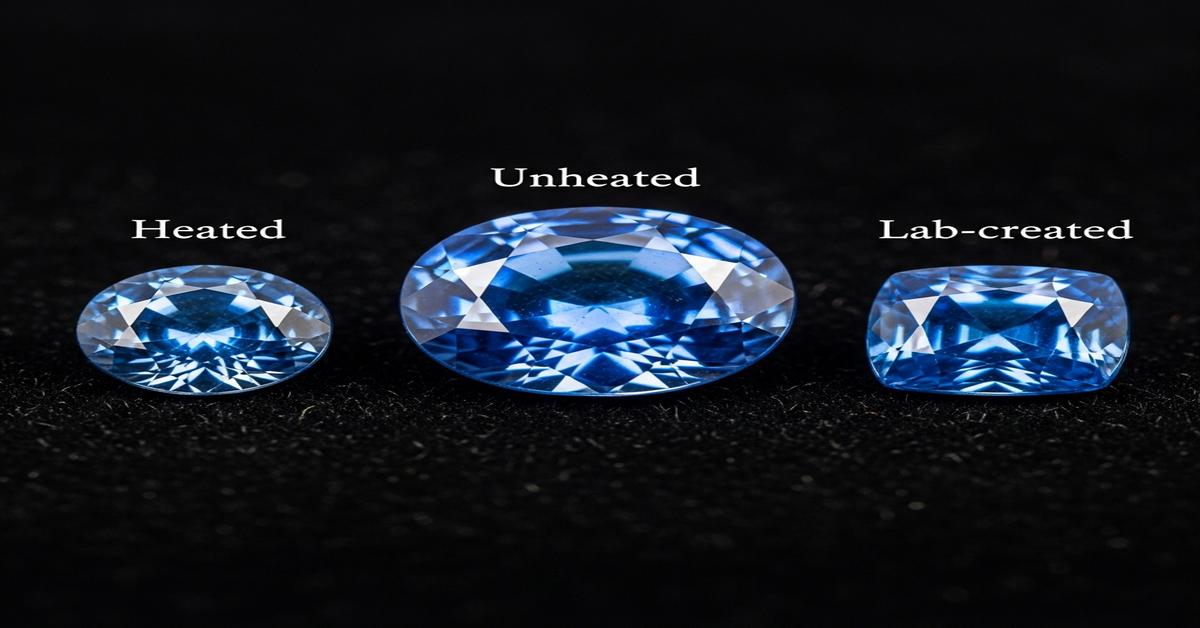
Shopping for a sapphire can feel like learning a new language. Sellers throw around terms like “heated,” “unheated,” and “lab” as if everyone knows what they mean. The differences matter because they change price, rarity, and long-term value. Here’s a clear, practical guide to help you buy with confidence—and why an unheated natural sapphire can be worth 10x to 100x more than other options when quality and size match.
What “heated,” “unheated,” and “lab” really mean
Natural sapphire means the stone formed in the earth. It may be treated or untreated.
- Heated sapphire (natural): A natural sapphire that has been heated in a furnace—usually 1600–1800°C—to improve color and clarity. This is the most common treatment in the market. It is stable and permanent.
- Unheated sapphire (natural): A natural sapphire with no evidence of heating. The color and clarity are “as found” in nature. These are rare, especially in fine color and larger sizes.
- Lab-grown sapphire: Synthetic corundum grown by humans (e.g., Verneuil, flux, or Czochralski methods). Chemically and physically the same as sapphire, but not mined. It is abundant and inexpensive.
These terms are not about durability. All three are corundum (Mohs 9). They are about rarity, origin, and demand—three things that set price.
How heat changes a sapphire—and why it matters
Most natural sapphires come out of the ground with a mix of strengths and flaws. Color may be slightly gray or greenish. Microscopic rutile “silk” can cloud the stone. Heating fixes both by shifting trace elements and dissolving silk. You get bluer blues, peachier padparadscha, and cleaner-looking stones.
Because heat creates the look many buyers like, supply becomes much larger. When supply rises, price falls—even when the stone looks beautiful. That’s the key: heat reduces rarity, not beauty.
There are different levels of treatment:
- Conventional heat: High-temperature heating with no foreign additives. Accepted by most of the trade.
- Flux-assisted healing: Heat with chemicals that help heal fractures. Less accepted. Can leave residues in fissures.
- Beryllium diffusion: Foreign atoms diffuse into the crystal to change color (often orange/yellow/orange-pink). This is not the same as conventional heat and is a much bigger disclosure issue.
- Lead-glass filling (mostly rubies, sometimes sapphire): Glass fills fractures. Very low value and fragile. Avoid for fine jewelry.
Reputable sellers should state the treatment clearly. Good labs can separate unheated from heated by studying inclusions and chemical signatures. That proof is part of what you pay for in unheated stones.
Value: why unheated can be 100x more valuable
Price is driven by rarity and demand. Unheated fine sapphires are rare because nature rarely gets color and clarity perfect without human help. Collectors and high-end buyers pay premiums for that rarity and for the “purity” story. Meanwhile, lab sapphires are abundant, and heated sapphires are far more available than unheated equivalents.
Here are realistic mid-2020s retail ranges to show the gap (actual price depends on color, clarity, cut, carat, and origin):
- Lab-grown blue sapphire (2–3 ct, fine color): about $100–$300 per carat.
- Heated natural blue sapphire (2–3 ct, fine color): about $1,500–$5,000 per carat.
- Unheated natural blue sapphire (2–3 ct, fine to extra-fine): about $8,000–$30,000 per carat. Exceptional stones and elite origins can go higher.
- Top-tier unheated (Kashmir, Burma, or best Sri Lanka, 3–5 ct, exceptional): $40,000–$150,000+ per carat is possible.
Do the math. A 3 ct lab sapphire at $200/ct is $600. A comparable-looking 3 ct heated at $3,000/ct is $9,000. A comparable 3 ct unheated at $15,000/ct is $45,000. That’s 75x the lab stone, and 5x the heated stone. In elite cases, unheated can exceed lab by more than 100x. The premium exists because the stone is genuinely rarer, independently proven, and in demand by collectors.
Importantly, this isn’t just about blue. The same logic applies to padparadscha, vivid pink, and royal violet-blue. Unheated, fine, and larger equals scarce—and scarcity drives price.
Spotting the differences in the real world
You can’t reliably tell heat or lab origin by eye alone. Use process and paperwork:
- Ask for a lab report from a respected lab. Look for treatment comments like “No Indications of Heating” or “Heated.” For high-value stones, origin (e.g., Kashmir, Burma, Sri Lanka, Madagascar) adds price power.
- Read the wording carefully. “No indications of heating” means unheated. “Heated” means conventional heating. “Evidence of diffusion” or “surface-reaching residues” lowers value. “Created” or “synthetic” means lab-grown.
- Check for consistent identity: The carat weight, measurements, and proportions on the report must match the stone.
- Use magnification if available. Natural inclusions (needles, crystals, zoning) look different from the curved growth lines or gas bubbles seen in some lab sapphires. But trust a lab over your loupe.
How reports and origin affect price
Unheated status from a top lab adds confidence and marketability. For expensive stones, buyers also value origin calls because certain localities are famous for color and texture (e.g., velvety “cornflower” from Kashmir, royal blue from Burma). The stricter the lab, the stronger the premium. This is because collectors want stones that can be resold or insured easily, and top lab paperwork reduces doubt.
When each choice makes sense
- Lab-grown: Best for tight budgets, bold designs, or large looks without stress. Chemically identical and very durable. Expect little resale value.
- Heated natural: Ideal balance of beauty and price. Excellent for engagement rings and daily wear. High selection and good value per carat.
- Unheated natural: Best for collectors, milestone pieces, or buyers seeking long-term value. Choose when color is top-tier and you have proper lab documentation.
Example: If you want a 2 ct royal blue engagement ring under $10,000, heated is the sweet spot. If you want a treasure-grade 3 ct with investment-level rarity, budget for unheated and a top lab report. If you want a 6 ct statement ring for $1,500, lab-grown is the honest way to get the look.
Beware of misleading treatments
- “Enhanced” is vague. Ask “Heated? Diffused? Glass-filled?” Vagueness is a red flag.
- Beryllium diffusion: Not standard heat. It changes composition and color. It should be disclosed explicitly. Price should reflect it.
- Lead-glass-filled corundum: Avoid for rings. It can etch in household cleaners and fracture under heat from a jeweler’s torch.
What to ask your seller
- Is the sapphire natural, lab-grown, or simulant? Put it in writing.
- Has it been heated? If yes, conventional heat or diffusion/glass-filled?
- Do you have a lab report? Which lab? What does it say about treatment and origin?
- What is the return period and is it contingent on independent verification?
- If recutting is needed to improve brilliance, how will weight loss affect value and report?
- Can you provide high-resolution photos and microscope videos of inclusions?
- Has the stone been clarity enhanced or fracture filled?
- What is your policy if a new report disagrees with the current one?
- Is the price based on comparable recent sales? Which?
- Will you insure shipping both ways for lab submissions?
Color first, then everything else
Color drives sapphire value more than any other factor. Buyers pay for hue (pure blue or balanced padparadscha), saturation (rich but not inky), and tone (not too dark, not too light). Heat often pushes color into the “ideal” zone, which is why heated stones can look superb. But when an unheated sapphire naturally sits in that sweet spot, it’s scarce—and that’s the core reason for the price jump.
Cut, clarity, and carat still count
Even among unheated stones, poor cut or overly dark tone holds value back. Look for lively sparkle and even color. Eye-clean clarity is usually enough; sapphires forgive minute inclusions if color is great. Carat weight multiplies price nonlinearly—especially for unheated stones above 2–3 ct, where rarity spikes.
Care, setting, and insurance
- Cleaning: Warm soapy water and a soft brush. Ultrasonic is usually fine for heated and unheated stones that are fracture-free. Avoid for glass-filled material.
- Repairs: Tell your jeweler the treatment. Avoid open flame near glass-filled stones; they can be damaged.
- Setting choice: Protective settings for larger stones (bezels or sturdy prongs). Sapphires are hard but can chip on corners.
- Insurance: List treatment and lab report number on the policy. It affects replacement cost.
Quick decision guide
- Under $2,000 and want big look: Choose lab-grown. You’ll get size, color, and low stress.
- $3,000–$12,000, daily-wear engagement ring: Choose heated natural. You’ll get excellent color and durable beauty.
- $20,000+ and want rarity or future liquidity: Hunt for unheated with a top lab report. Focus on color first, then origin.
Bottom line
Heated sapphires offer beauty and value. Unheated sapphires offer rarity and status—when color and size are strong, they can sell for 10x to 100x more than lab-grown and several times more than heated. Lab-grown gives you the look for less. Decide what matters most—budget, beauty, or rarity—and buy with clear disclosure and a solid lab report. That’s how you get the sapphire you want, and the value you’re paying for.

I am Satyam Pandey, a gemologist with a Diploma in Polished Diamond Grading from KGK Academy, Jaipur. I love writing about jewelry, gems, and diamonds, and I share simple, honest reviews and easy buying tips on JewellersReviews.com to help you choose pieces you’ll love with confidence.