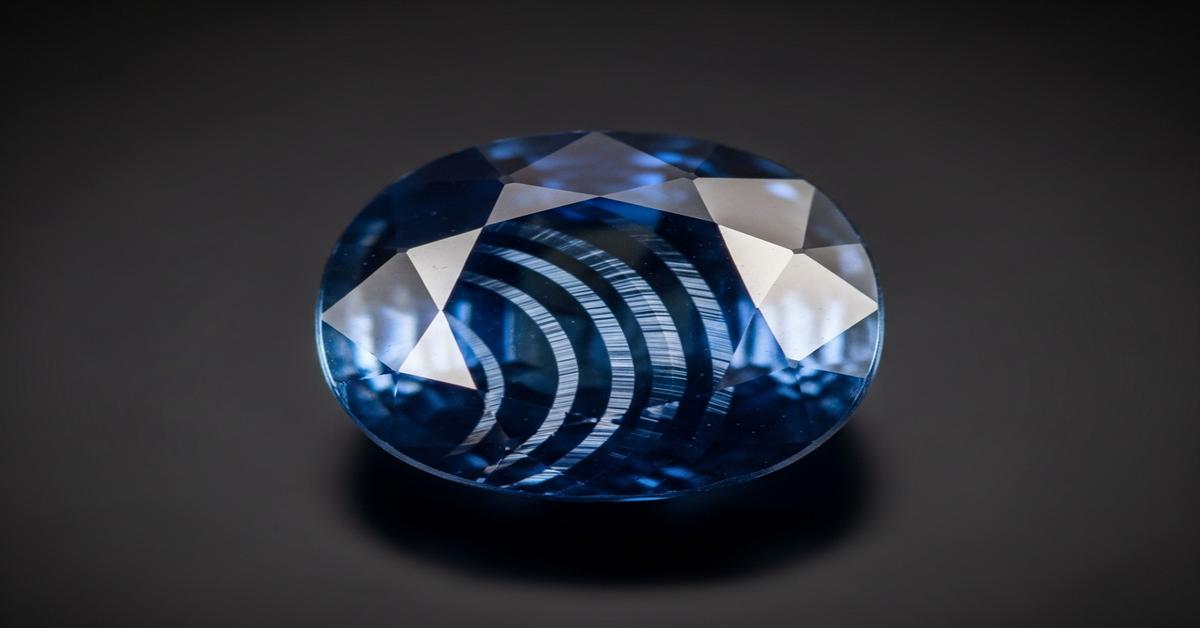
Sapphires are among the most faked gems in jewelry. The most common impostor is a lab-grown sapphire made by the flame fusion (Verneuil) method. It is real corundum chemically, but not natural. The single most reliable visual clue is curved striae—fine, sweeping internal growth lines that arc like ripples. When you know how to look, curved striae give away a flame fusion sapphire in seconds. Many jewelers miss them because they are subtle, easy to hide under facet reflections, and not always obvious under basic shop lighting.
What “curved striae” are and why they matter
Curved striae are internal growth lines that appear as faint, evenly spaced, curved bands or arcs inside the stone. Think of them as ghost-like lines that bow across the gem. They form during rapid, directional growth when molten material cools in a flame.
Why this matters:
- Natural sapphire shows straight or angular zoning, reflecting its hexagonal crystal structure. Lines usually meet at angles or run straight. Arcs that sweep smoothly are not natural growth forms in sapphire.
- Curved = flame fusion. If you clearly see curved striae or curved color banding inside sapphire, you are dealing with a Verneuil flame fusion synthetic. Period.
- Absence of curved striae does not prove natural. Other lab methods (hydrothermal, flux) may not create curves. They can look very natural and require lab testing.
How flame fusion sapphires grow (and why curves appear)
In the Verneuil process, fine alumina powder melts in an oxyhydrogen flame and drips onto a seed, forming a boule. The bead of molten material oscillates slightly while the boule grows quickly from top to bottom. The growth front is gently curved, and each layer freezes that curvature into the crystal as faint bands. Those bands become the curved striae you see later under magnification.
Natural sapphires, in contrast, grow slowly in the earth from hot fluids or melts. Their internal zoning follows the crystal’s hexagonal symmetry. That’s why natural growth lines look straight, angular, or hexagonally stepped—never uniformly curved over large areas.
Spotting curved striae at home: a simple workflow
You don’t need a lab to find curved striae, just good habits and a little patience.
- Get a clean stone. Wash gently with soapy water and a soft brush. Residue masks internal features.
- Use a 10× loupe and a small bright light. A flashlight or fiber-optic penlight works. Avoid harsh overhead light.
- View through the crown. Look down through the table, then tilt the stone 5–15 degrees. Curved striae often show as faint, parallel arcs.
- Try darkfield or side lighting. Place the stone on a dark surface and shine light across from the side. The arcs can “pop” into view.
- Use immersion. Place the gem in a clear glass of water with a drop of dish soap (to reduce surface reflections). Water reduces glare and makes internal patterns easier to see.
- Differentiate from polishing lines. Polishing marks sit on the surface and move with the facet reflection. Striae are inside the stone; they stay put as you rock the gem and shift focus.
- Follow the arcs. In many fakes, you’ll see curved bands running across multiple facets. Natural zoning will break into straight or angular segments.
What curved striae look like vs. natural growth lines
- Curved striae (synthetic): Evenly spaced, smooth arcs; sometimes accompanied by curved color banding. The arcs can appear like a stack of gentle waves inside the gem.
- Natural zoning: Straight or hexagonal bands that meet at angles; sometimes patchy or stepped. Color zoning in natural stones often follows crystal faces and looks geometric, not sweeping.
- Quick test: If the bands make a consistent bow shape across the interior, suspect flame fusion. If they intersect at angles or form hexagonal outlines, think natural.
Other clues that support the diagnosis
Curved striae are the headline, but you can stack clues.
- Gas bubbles: Tiny round or slightly elongated bubbles may align along curved bands in flame fusion stones. Natural corundum rarely shows spherical bubbles.
- Rutile silk (natural): Fine rutile needles can form a soft haze and intersect at 60/120-degree angles. Heat treatment in natural stones can dissolve silk, but remnants often remain as “snow” or needles. Flame fusion stones lack natural silk; if asterism (a star) is present in synthetics, it’s often from added rutile, not natural silk patterns.
- Fingerprints/Healing fissures (natural): Wispy, fingerprint-like inclusions with tiny angular cavities signal natural growth and healing. They don’t occur in flame fusion stones.
- Color distribution: Flame fusion blues can be very uniform or show curved blue bands. Natural blues often show uneven, angular zoning and windowing.
Important: Some tests do not separate natural from lab sapphire because the chemistry and optics are the same:
- Refractive index: ~1.762–1.770 in both.
- Birefringence: ~0.008–0.010 in both.
- Specific gravity: ~3.99–4.05 in both.
- Pleochroism: Visible in both; not diagnostic.
When curved striae are hard to see
Even trained jewelers get fooled when:
- The stone is dark or small. Dense color makes internal features hard to read. Try immersion and stronger light.
- Striae are masked by facet reflections. Rock the stone slowly; change angles and lighting. They can hide under glare.
- The cut is shallow or the table is abraded. Scratches and pits on the surface distract. Clean first and refocus into the interior.
- Curves are faint. Some flame fusion boules show weaker striae. Look for curved color bands instead of only line texture.
- The gem is not flame fusion. Hydrothermal or flux-grown synthetics may show straight zoning, “nail-head” spicules, or flux inclusions. No curves doesn’t equal natural; it means you need advanced testing.
Tools and tests jewelers use—and their limits
- Loupe (10×) and microscope (20–60×): Best for curved striae, bubbles, silk, and fingerprints. Most conclusive for flame fusion ID.
- Immersion cell: Water, glycerin, or refractive liquids reveal zoning and internal structure. Helps separate curved vs. straight bands.
- Polariscope and dichroscope: Confirm optic character and pleochroism but won’t separate natural from synthetic corundum.
- UV fluorescence: Can vary. Blue sapphires may be weak to inert. Not a reliable natural vs. synthetic separator, except in specific varieties.
- Spectroscope: Shows Fe/Ti features but overlaps across natural and synthetic.
- Advanced lab analysis (Raman, FTIR, trace-element analysis): Needed to separate natural from non–flame-fusion lab stones or to detect diffusion treatments.
Bottom line: For flame fusion, curved striae under the microscope can be enough. For anything else, a lab report is prudent.
Why even jewelers get fooled
- Assuming age equals natural: Flame fusion sapphires have been made since the early 1900s. Many “heirloom” rings hold synthetics in antique mountings.
- Relying on color and brilliance: Flame fusion stones are clean and bright; that’s the point. Eye appeal is not proof of origin.
- Busy shop lighting: Overhead LEDs wash out fine internal features. Without immersion or darkfield, curves can vanish.
- Partial testing: Measuring RI or SG confirms “corundum,” not “natural.” Without magnification, mistakes happen.
Buying tips and questions to ask
- Ask for origin disclosure: “Is it natural or lab-grown?” Sellers should tell you and put it in writing.
- Request a lab report for higher-value stones: For blues above modest budgets, an independent gem lab report protects you, especially if no curved striae are visible but doubt remains.
- Ask about treatments: Heat treatment is common in natural sapphire; diffusion treatments can alter color. Get disclosures.
- Inspect under magnification: If the seller won’t allow a loupe or microscope view, be cautious.
- Check return policy: If a later lab test says “synthetic,” you need recourse.
Quick myths to ignore
- “It’s set in gold, so it must be natural.” High-end settings often hold synthetics, especially in vintage pieces.
- “It’s very clean—must be natural.” Flame fusion sapphires are often cleaner than natural stones.
- “The RI matches sapphire, so it’s natural.” Synthetic and natural corundum share the same RI and SG.
- “No curved lines, so it’s natural.” Some lab sapphires are not flame fusion and won’t show curves. Absence is not proof.
Examples that teach your eye
- Classic blue flame fusion: Under 10×, you see gentle, parallel arcs running across the table and into the pavilion. A few round bubbles sit along the bands. Verdict: synthetic (flame fusion).
- Natural Ceylon-type blue: Uneven, angular color patches and faint, straight zoning. Maybe a few fine rutile needles crossing at angles. No smooth arcs. Verdict: likely natural; lab confirmation if high value.
- Synthetic star sapphire (“Linde” style): Sharp, perfectly centered six-ray star; under magnification, curved bands and occasional bubbles. Verdict: synthetic (flame fusion with rutile).
A practical checklist you can use
- Clean the stone; dry it well.
- Use a 10× loupe and side lighting.
- Look through the table and along the pavilion mains.
- Rock the stone; watch for internal, curving bands that stay in place.
- Confirm they are internal (not surface polish lines) by shifting focus.
- Check for bubbles, curved color banding, and absence of natural silk or fingerprints.
- If curves are clear: synthetic (flame fusion). If not clear: do not assume natural; consider lab testing.
Bottom line
Curved striae are the telltale sign of a flame fusion sapphire. They are subtle but decisive once you know how to look. Natural sapphires show straight or angular internal zoning; they do not display smooth, sweeping arcs. Many jewelers rely on general appearance or basic instruments and miss this point—especially in older mountings or bright showroom lighting. Use a loupe, control your light, and be patient. If you see curved striae, you have a lab-grown flame fusion sapphire. If you don’t, and the stone is valuable, let a trusted gem lab make the final call.

I am Satyam Pandey, a gemologist with a Diploma in Polished Diamond Grading from KGK Academy, Jaipur. I love writing about jewelry, gems, and diamonds, and I share simple, honest reviews and easy buying tips on JewellersReviews.com to help you choose pieces you’ll love with confidence.