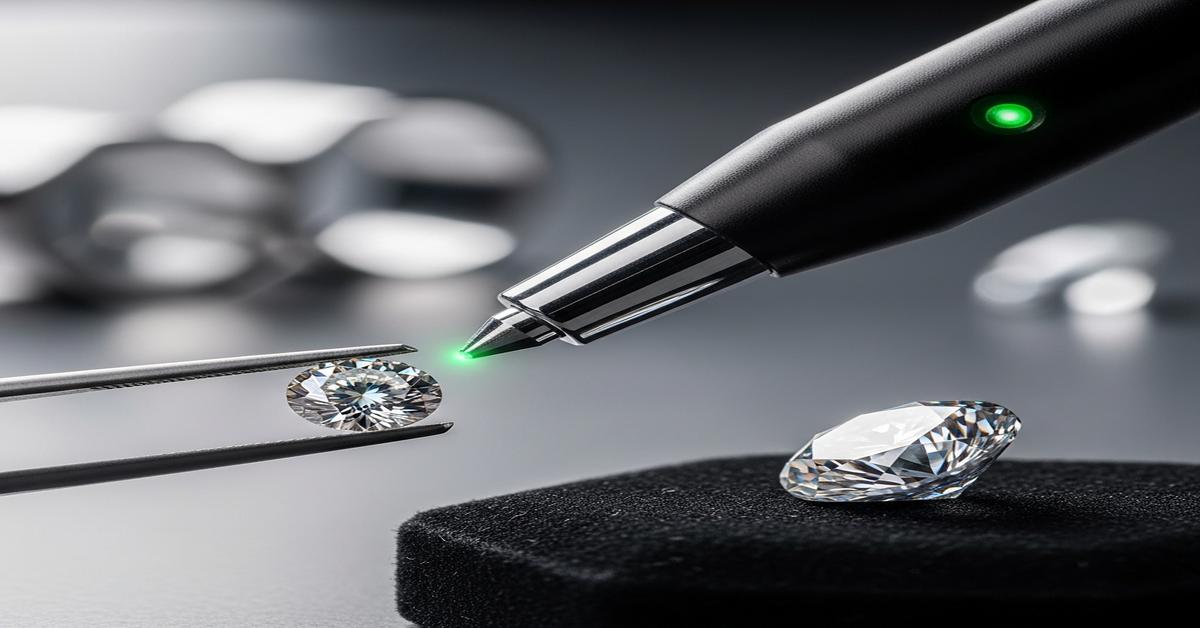
Diamond tester pens are everywhere now. Most of them claim to tell you whether a stone is a diamond with a quick beep. Here’s the catch: those pens usually measure only heat flow. Moissanite conducts heat almost as well as diamond, so it often triggers the “diamond” beep. That’s why your pen “lies.” If you want an answer you can trust in seconds, there’s only one reliable pocket test: use a dual-conductivity probe that checks both thermal and electrical conductivity.
Why your diamond tester pen calls moissanite a diamond
Most “diamond testers” are thermal conductivity meters. They push a warmed tip against the stone and monitor how fast heat moves away. Diamond is an extreme heat conductor, far above glass and cubic zirconia (CZ). Moissanite, however, is also an excellent heat conductor because it’s silicon carbide. On a thermal-only pen, both diamond and moissanite look “very high.” That’s why moissanite often rings as diamond.
Why it happens: The pen makes a simple comparison: heat leaves the probe fast (diamond) or slow (simulant). It doesn’t know why the heat leaves fast. Moissanite sends heat away quickly, so the pen assumes “diamond.” It’s not failing; it’s measuring the wrong property to separate those two materials.
The only instant way: test thermal and electrical conductivity together
A combined diamond–moissanite tester adds an electrical check to the thermal measurement. This is what gives you a fast, trustworthy yes/no.
- Diamond: an electrical insulator. It won’t pass a tiny current under the probe (with one important exception noted below).
- Moissanite: a semiconductor. It conducts electricity. The instrument detects this and flags “moissanite.”
Bottom line: Thermal-only pens confuse moissanite for diamond. Dual-conductivity testers do not, because moissanite’s electrical behavior is different from diamond’s.
How to use a dual-conductivity tester correctly
Operator error is the second biggest reason for “lying” pens. A 30-second setup prevents most false readings.
- Clean the stone. Oils, lotion, or water film can slow or alter the signals. Wipe with alcohol or a clean dry cloth.
- Let it reach room temperature. Very cold or hot stones skew thermal readings.
- Avoid metal contact. Metal prongs can wick heat and carry current. Hold the ring by the shank. If your tester has a metal alert, keep it quiet. Approach facets, not prongs or the girdle edge touching metal.
- Stabilize your hand. Use a steady, light touch. Press straight down on a flat facet. Don’t slide.
- Test more than one spot. Touch at least three facets—table, crown, and pavilion (if loose). Consistency matters.
- Watch both indicators. The thermal scale signals “diamond-like” heat flow; the electrical circuit then checks conductivity. The combined result is your answer.
- Mind the stone size. Very tiny stones may be harder to read. Use the fine tip, highest sensitivity, and repeat across several stones in a cluster.
- Keep batteries fresh. Low power causes erratic results. Replace or recharge when indicators suggest.
Interpreting results:
- High thermal + no electrical conductivity = diamond (natural or lab-grown), with rare exceptions.
- High thermal + electrical conductivity = moissanite.
- Low thermal + no electrical conductivity = typical simulant (CZ, glass, YAG, spinel).
Fast visual cross-checks (useful, not foolproof)
In good light and with a 10× loupe, you can add quick visual tells. They are not “instant” without practice, and they have caveats.
- Birefringence (facet doubling): Moissanite is doubly refractive. Look through the crown at the far side of the stone and examine facet edges. In moissanite, you often see doubled facet junctions, especially when viewing off-center. Diamond is singly refractive, so edges stay crisp and single. Limitations: The effect is orientation dependent and can be subtle in small stones or well-oriented cuts.
- Fire and sparkle: Moissanite has higher dispersion than diamond, so colored flashes can look more “rainbow-y.” Limitations: Lighting can exaggerate or hide this, and some diamonds are very fiery.
- Inclusions and growth: Moissanite often shows fine, parallel needles or “hazy” zones; diamonds show crystals, feathers, or clouds. Limitations: Clean stones without inclusions won’t help here.
Use these as supporting clues, never as the only test.
Important edge cases and pitfalls
- Type IIb diamonds (electrically conductive): A tiny subset of diamonds (typically natural fancy blue or certain HPHT-grown stones) conduct electricity. A dual tester may flag “moissanite” because it detects conductivity. The tell: the stone still shows diamond-like thermal response, and other checks (Raman spectroscopy or a pro’s verification) confirm diamond. These are rare and usually noted by color or documentation.
- Mounted stones: Metal prongs and settings can steal heat and carry current. Keep the probe off metal, and test multiple facets. If readings are inconsistent, test the stone loose.
- Coatings and contamination: Surface films, diamond-like coatings, or dirt can delay heat flow. Clean before testing.
- Tiny melee stones: Stones under ~2 mm can defeat cheap pens. Use a fine-tip, high-quality tester or rely on a pro method for bulk sorting.
- Battery sag and ambient temperature: Pens misread when cold or low on power. Warm the device, replace batteries, and retest.
Why lab instruments aren’t “instant” for most people
Professional gem labs use instruments that don’t rely on heat/electric tricks:
- Raman spectroscopy: Diamond shows a strong line around 1332 cm⁻¹. This is definitive, but the equipment is expensive and not pocket-sized.
- Infrared spectroscopy (FTIR): Distinguishes diamond types and treatments. Again, lab gear.
- Advanced optics (microscopes, polariscope): Conclusive in expert hands, not instant for a casual buyer.
These methods are the gold standard, but not practical when you need an answer at a countertop or in a private sale. That’s why the dual-conductivity pen is the only instant consumer method that works reliably.
What to look for in a reliable tester
- Dual mode: Clearly labeled diamond/moissanite differentiation using both thermal and electrical checks.
- Metal contact alert: Audible or visual warning if you touch prongs.
- Fine probe tip: To reach small facets and avoid the girdle.
- Adjustable sensitivity and quick calibration: Stable readings across temperatures and sizes.
- Solid build and known brand: Cheap clones drift and give inconsistent results.
- Clear indications: Separate lights or tones for diamond, moissanite, and simulants.
Tip: Practice on known stones (a CZ, a moissanite, and a tested diamond). You’ll learn the response pattern in minutes.
A 60-second workflow to know what you’re holding
- Clean the stone and let it sit for a minute at room temperature.
- Power on your dual tester; confirm battery level and calibration.
- Hold the ring by the shank; avoid touching the stone or prongs.
- Touch the probe straight down on the table facet. Watch both indicators.
- Repeat on two additional facets away from metal.
- Read the combined result:
- Diamond-like thermal + no electrical conductivity → Diamond.
- Diamond-like thermal + electrical conductivity → Moissanite.
- Low thermal → Other simulant.
- If you see “diamond” on thermal but “moissanite” on electrical and the stone is vivid blue or documented as Type IIb, consider the conductive-diamond exception and verify professionally.
Common questions, clear answers
- Will lab-grown diamonds pass? Yes. Lab-grown diamonds are diamond. They show diamond-like thermal response and, unless they are Type IIb (some HPHT-grown stones), they will be electrically insulating.
- Can moissanite scratch glass? Yes. So can many hard materials. Scratch tests don’t identify diamond and can damage the stone or finish.
- Does the “fog test” work? Not reliably. Surface cleanliness and room humidity change results. Don’t use it to separate diamond from moissanite.
- Why do some pens give different answers on the same stone? Metal contact, dirt, unstable battery, temperature differences, or pressing on a tiny facet can all cause swings. Control these variables and test multiple points.
- Is there a visual sign I can trust without tools? Not 100%. Birefringence in moissanite is great when obvious, but it’s not guaranteed to show. Use the dual tester for a definitive, instant result.
The takeaway: Thermal-only diamond pens are not designed to outsmart moissanite, and that’s why they “lie.” If you need an instant, pocketable truth test, use a dual-conductivity diamond–moissanite tester and follow proper technique. Everything else—loupe clues, fogging, sparkle—can help, but only as backup. For absolute certainty beyond edge cases like Type IIb diamonds, laboratory identification is the final word, but you won’t need it for everyday checks when your tester measures both heat and electricity.

I am Satyam Pandey, a gemologist with a Diploma in Polished Diamond Grading from KGK Academy, Jaipur. I love writing about jewelry, gems, and diamonds, and I share simple, honest reviews and easy buying tips on JewellersReviews.com to help you choose pieces you’ll love with confidence.